
Mostly discreet, the deer becomes the noisiest and most boisterous inhabitant of the forests in September. Its roar then resounds at nightfall or dawn, sometimes during the day, making the few humans who wander nearby shudder. There is something deeply mysterious, almost supernatural, in this hoarse and intense cry, which, like thunder in the heart of darkness, seems to emerge from the very bowels of the earth. With a little imagination, one could quite easily believe it came from a parallel dimension, from an unknown and unexplored country… in short, from the Other World dear to Celtic mythology. That being said, it is not surprising that this « king of the forests » has been considered, from Antiquity to the present day, as a symbol of passage between life and death, and more generally between reality and the unreal. We then speak of a « psychopomp » animal, that is to say, one that allows the transfer between worlds, the journey of souls from Earth to the Beyond. It is precisely this aspect of the deer that we will try to clarify, through wanderings that will take us from Celtic Ireland and lead us to Hogwarts.
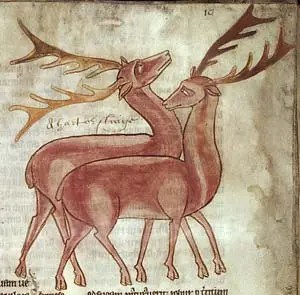
The Pursuit of a Stag to the Otherworld: A Classic Motif.
We must first address an extremely common narrative pattern, in which a character sets out in pursuit of a stag that, more or less subtly, leads him astray until he reaches another world. Very often, this encounter takes place during a hunt, during which the hero becomes separated from his companions without realizing it. This motif is observed repeatedly in Celtic mythology, both Irish and Welsh.
Regarding the first, we can consider the story of Oisin, son of the famous Finn. He is hunting with his father, chasing stags, when, in the middle of the forest, he spots a young woman of supernatural beauty, riding a dazzling white horse. The lady in question turns out to come from a distant kingdom called the « Land of Youth » and, in love with Oisin, she invites him to join her there. After an emotional farewell to his people, our hero sets off with the beautiful stranger on his steed. However, during their travels, several clues are scattered throughout the manuscript to indicate to the reader a gradual passage towards the sidh, that is to say towards the land of the Tuatha-de-Danann, who are the Celtic gods. For example, they see « a young girl at the top of a wave on a brown steed, holding a golden apple in her right hand. » However, the apple is a marker of paradise, of which one will be convinced by thinking of the Garden of Eden or King Arthur’s final resting place, the Isle of Avallon. But above all, and this is precisely the detail that interests us, they see a « hornless doe leaping nimbly while a white dog barks behind her. »[i] Thus, the animal symbolically leads Oisin to the Otherworld, twice: first by leading him to Niamh, then by accompanying him to the « Land of Youth. » After a few years, however, Oisin begins to miss the landscapes of Ireland, and he decides to leave despite his wife’s warnings. Upon returning to his homeland, he recognizes nothing. Three hundred years have in fact passed, and when he realizes it, the unfortunate mortal falls from his horse, dead.
In Welsh mythology, too, it is the hunt for a deer that leads Pwyll, lord of the kingdom of Dyfell, to come into contact with the Otherworld. While wandering through the woods, he hears dogs that don’t belong to him barking nearby. Approaching, he discovers a deer in a clearing, which a mysterious pack of white animals with red ears is attacking. Pwyll scares them off and sets his own hounds on the prey, until he sees a rider coming towards him. This rider is a man named Arawn who, as the color of his dogs suggests, comes from the Otherworld. He accuses Pwyll of not respecting the rules of the hunt by stealing the deer he was chasing. Therefore, to atone for this affront, he offers him a pact: the two will have to trade places for a year. In addition, Pwyll will have to face a certain Havgan, Arawn’s enemy. In this myth, from the first branch of the Mabinogion, Pwyll is led to the Other World by the pursuit of a deer, which leads him to meet a supernatural being who opens the door for him[ii].
This encounter with a marvelous knight through a deer hunt is found in the Lai de Tyolet, an anonymous poem from the Middle Ages that fits into the framework of Arthurian legends[iii]. It depicts a young man living with his widowed mother in the forest, and to whom a fairy gave at birth the ability to attract animals by whistling. But one day, he sees a deer that does not approach and which he therefore decides to follow. This one leads him to a second deer, then crosses a river. Tyolet then loses interest and kills the newcomer. However, when he raises his head, he realizes with amazement that the first deer has transformed into a knight, who is watching him from the other side of the river. Having never seen such an individual, he asks him a multitude of questions, until his interlocutor orders him to return home to don his father’s armor. Afterward, Tyolet goes to Arthur’s court where he experiences new adventures, culminating in his marriage to a mysterious princess. Thus, it is once again the trail of the deer that leads our hero to the supernatural, in this case to a shapeshifting knight, the incarnation of the Otherworld and magic.
The Christian imagination is not lacking in this regard, and even offers us a quite unique psychopomp figure: that of the crucified deer, an allegory of Christ and the divine light illuminating man. This enigmatic creature is found as much in the Legendary Lives of Saints Hubert and Eustace as in a tale about a Scottish king named David. The first, Hubert, was a lord so passionate about hunting that he forgot his moral obligations. His sin is such that he even goes so far as to practice his favorite activity on Good Friday (that is, on the date commemorating the death of Jesus). It is precisely on this day that he encounters a deer that immediately strikes him as extraordinary: it is completely white and bears a glittering cross between its antlers. Hubert begins by tracking the animal, but is abruptly interrupted when a voice rises from nowhere and addresses him in these terms: « How long will you pursue beasts in the forests? How long will this vain passion make you forget the salvation of your soul? » The lord ends up prostrating himself and following the advice given to him, converting and dedicating his life to the Church[iv]. The motif is more or less the same in the story of Saint Eustace. As a Roman general, he was chasing a herd of deer when he noticed that one of them was clearly more beautiful and larger than the others. He decided to chase it until it caught up with him and saw a crucifix between its antlers. The animal then spoke to Eustace and claimed to have come to save him, leading him to the one God[v]. Finally, as for David, the Scottish king, he was already a Christian in 1128 when he crossed paths with the Christ-like deer. It attacked him and forced him to defend himself by grabbing its antlers. It was only then that he saw the cross, which would later inspire him to found Halyrood Abbey (whose etymology comes from « holy cross » in Scots)[vi].
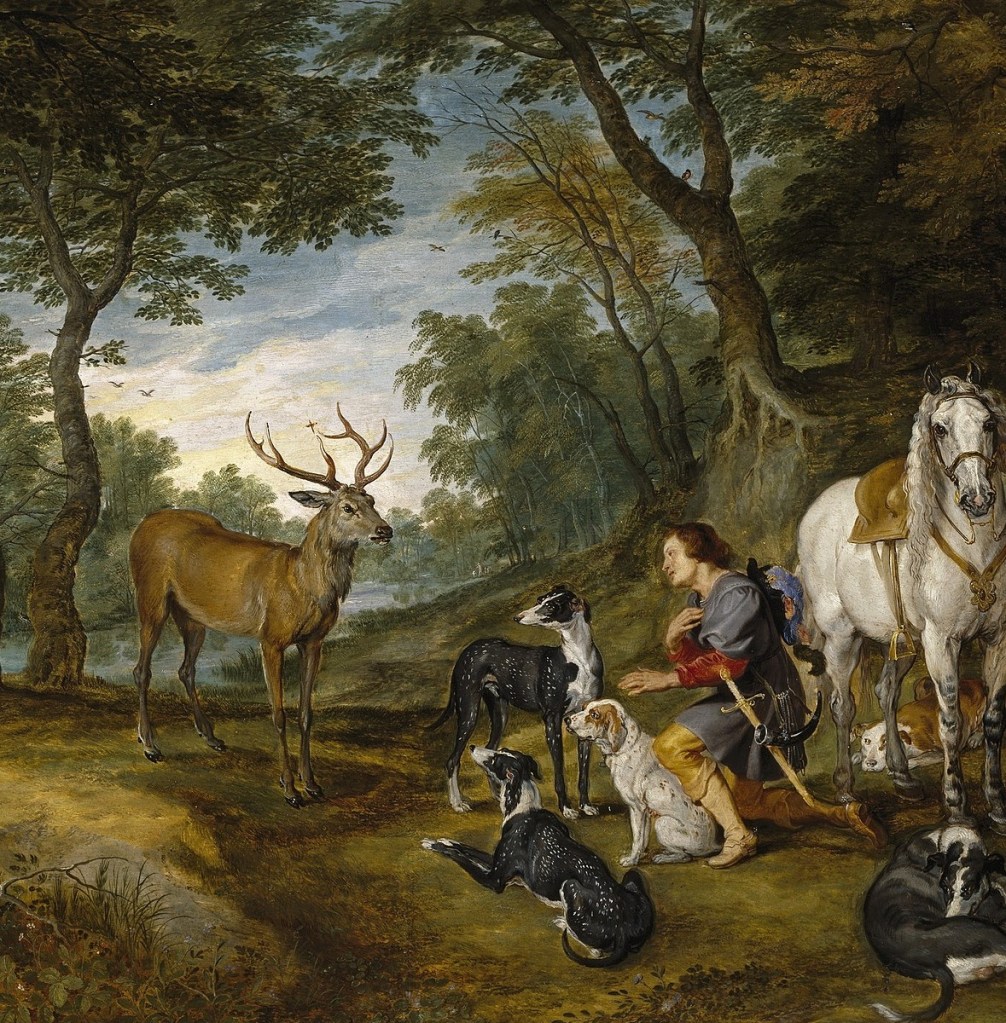
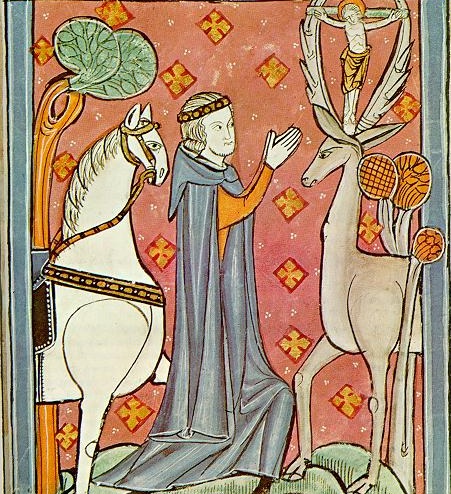
In the three cases we have just discussed, the deer therefore leads the characters to the beyond, the immaterial spheres of existence, in this case by leading them to God. It encourages them to abandon human futilities to join something greater and more spiritual, an « other world » in short. The Christian allegory represented by the deer owes nothing to chance. Let us recall that this animal has the particularity of losing its antlers every year… but also of seeing them grow back. In this respect, it is the image of the cycle of death and resurrection, which of course brings us back to Jesus. Thus, the deer, like Hermes in Greek mythology, is the messenger and ferryman between the world of the living and that of the dead; between material reality and the mystical dimension.
The legendary figure of the white stag.
We have observed that, in most of the episodes narrated above, psychopomp stags are distinguished more or less subtly from their fellow creatures by physical or behavioral characteristics: they can be larger, more agile, more beautiful, faster, transform into knights, or even carry a dazzling crucifix between their antlers. But the most widespread and reliable criterion that allows us to suspect a world-crossing stag is its color. In many cases, in fact, the creature in question is white, either entirely or partially. In Celtic mythology, this singularity is specific to all animals from the Otherworld, and it is sometimes accompanied by red portions, such as the eyes or ears (remember, for example, the dogs of Arawn). The Middle Ages, however, continued this tradition by focusing more on the deer than on other mammals.
Thus, we find the mention of a white stag in the Lancelot-Grail, this cycle of novels related to the Knights of the Round Table and the quest for the legendary chalice. However, this mysterious creature once again merges with the figure of Christ, intimately linked to the Grail since it is believed to be the container used during the Last Supper. It is first Lancelot, the knight-sinner, who sees the animal. He wears a gold chain around his neck and is surrounded by six lions, « who guarded him as preciously as a mother her child. » Guinevere’s lover encounters the same procession a little later, this time in the company of the magician Mordred, and both try to follow him before being interrupted by two knights who throw them to the ground. It is finally Galahad, the knight with the pure heart, escorted by Perceval and Bohort, who manages to accompany him to a hermitage where an old man is saying mass. Then a phenomenon occurs which proves beyond doubt the supernatural character of the white stag, and its connection with the Other World: « The Stag indeed seemed to them to become a man and, on the altar, he took his place in a magnificent seat. » The four wild beasts then transform into four winged creatures representing the evangelists – the human, the lion, the ox and the eagle – and leave carrying the seated individual. It is finally a voice from the beyond which reveals the true nature of the said individual: « It is thus, » she says, « that the Son of God descended into the Virgin Mary, without her losing her virginity. »[vii] The white stag is therefore Christ. The animal symbolically leads to God, as much for Hubert, Eustace and King David as for Galahad and his companions.

However, this strange mammal is not always surrounded by biblical sanctity. In the Lay of Graelent, for example, a medieval text written by Marie de France, the white doe does not lead the knight to God, but to a beautiful naked woman bathing in a fountain with two maids. Graelent, having just rejected the queen’s advances, becomes passionately infatuated with her, stealing the clothes she had hung on a tree. A rape scene ensues, leading incomprehensibly to a consensual love affair. But we learn a little later that the lady is not entirely human, since she offers to appear to Graelent wherever and whenever he wishes. In reality, she is more like a fairy, which the pursuit of the white stag could easily have led us to believe. She ends up taking Graelent to the Otherworld, from where he will never return.[viii]
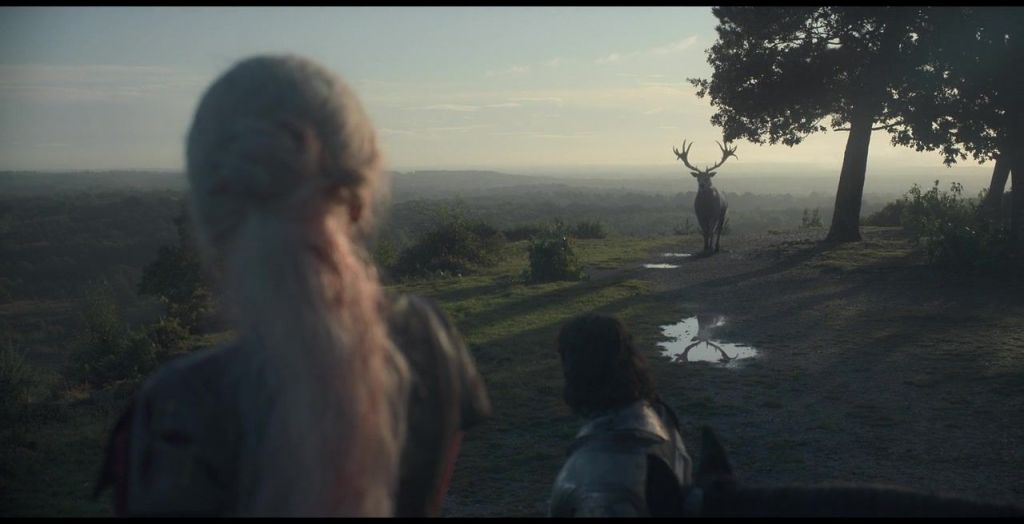
It is interesting to note that the figure of the white stag crosses the centuries, and is found in contemporary works that are familiar to us. Often, it appears to the protagonists in the context of a hunt, which underlines the persistence of the same motif from Celtic Antiquity to the present day. However, those who are lucky enough to cross its path are not necessarily inveterate hunters, but rather singular, gentle beings, whose temperament contrasts precisely with the noise and fury of the hunt. For example, in House of the Dragon, which is a series focusing on the reign of the Targaryens more than 150 years before the birth of the famous Daenerys of Games of Thrones, there is talk of a hunting party organized by King Viserys[ix]. However, this is linked to the rumor that a white stag is found in the surrounding forests. It is then considered that the mammal could be used to decide between the heirs who are fighting over the future throne, namely Rhanyra and her half-brother Aegon. However, when the former finally meets the mythical animal, she simply refuses to harm it. They observe each other for a long time, and this interaction alone convinces her that she is indeed the rightful heir. Here, the stag thus plays its role as « king of the forest »; it chooses the future monarch. However, it also takes on an obvious supernatural character, which the stag’s staging emphasizes in various ways. The young girl is in fact isolated with Sir Criston at the moment of the meeting, while a large crowd is participating in the hunt. Moreover, the scene is calm and silent, and thus contrasts with those that precede and follow, where the din of dogs, shouts and horns resounds from all sides. Finally, it takes place in an open area, with a bright setting, which is distinguished from the dark forest where the men are riding [x].
The motif of the white stag hunt is also found in The Chronicles of Narnia, but this time the animal plays the opposite role from the one we usually know it for. While the creature usually escorts humans to the wonderful world, here it is the one who leads the children out of the parallel kingdom and back to their rooms. At the end of the first volume, in fact, when Peter, Susan, Edmund and Lucy have become kings and queens of Narnia, they learn of rumors about a white stag wandering the forests of the country; a white stag capable of fulfilling the wishes of whoever can catch it. They go hunting and eventually spot its trail. But the white stag does not let itself be captured so easily and leads them deep into the thick undergrowth… until they reach a street lamp. There, they regain the memories of their previous lives and find themselves, unwittingly, in the wardrobe that had once led them to Narnia. [xi] From then on, the stag once again plays the role of ferryman between worlds… but in an unusual way, as it dispels magic to escort the children back into modern society.
In the video game The Elder Scrolls V: Skyrim, a quest also involves hunting a white stag in order to communicate with a spectral and supernatural creature named Hircine. This creature cursed a certain Sinding, causing him to become an uncontrollable werewolf who tore a little girl to pieces and was imprisoned. The origin of this spell is the theft of a ring, which the player must return to Hircine to free Sinding. However, there is only one way to contact him: to do so, one must find and kill the mythical white stag. Thus, the deer is once again an intermediary between worlds, a bridge between reality and the spectral dimension inhabited by Hircine; which, incidentally, appears in the form of a ghostly stag. [xii]
Let us note, in conclusion, that the white stag is, in fiction, a fantastical, fairy-like animal, like the unicorn, to which it is symbolically very close. However, unlike the latter, it has a real existence attested by science. Indeed, our forests are indeed populated by white stags, which are in fact affected by leucism; this pathology causes paleness in various parts of the body, including the skin and hair. It goes without saying that these individuals are exceptional, and they often become famous in the region where they live. The Isle of Arran in Scotland, for example, was said to have been home to a white deer in the 1960s, and legend has it that others have been spotted since. In any case, the animal is now the mascot of the island and the brand of whisky produced there.
The deer between life and death.
In the Camonica Valley, in Lombardy, lies one of the largest collections of petroglyphs in the world. However, a study of the discovered figures shows that the deer already occupied a privileged place in the human imagination in prehistoric times. The animal is depicted being hunted, certainly, but also in the form of anthropomorphic creatures with antlers, which could correspond to deities. [xiii] This strong representation of the deer in rock art is common to most of the major known sites, and one can therefore wonder about the symbolic role played by this animal. It is not impossible that it already occupied a psychopomp function, allowing the passage of deceased souls to the divine spheres.
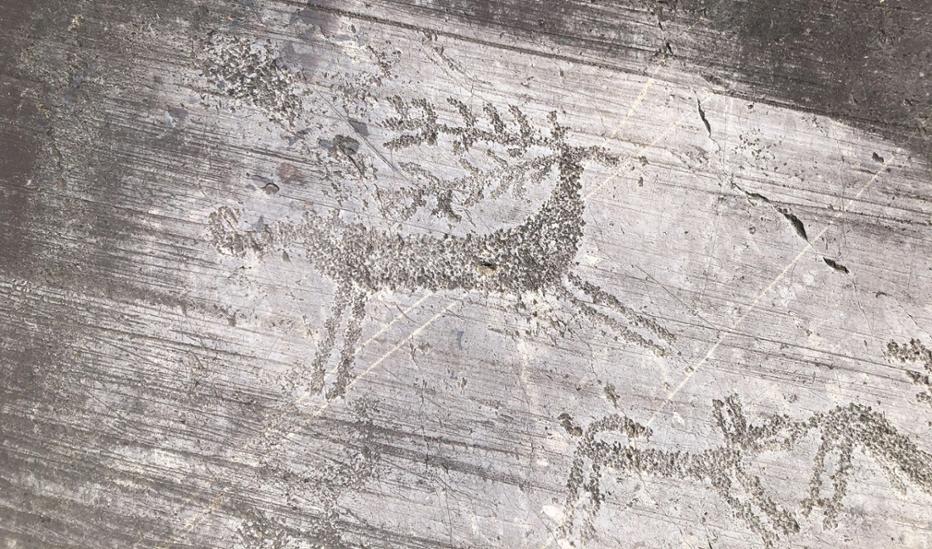
While penetrating the minds of such remote times, and in possession of such limited sources, is utopian, it can be affirmed that the deer of the Celtic era forged a unique relationship with the world of the dead. Moreover, the deer that became our « king of the forests » was associated with the concept of eternity, as if the notions of life and death did not interfere with the existence of this pure and enchanted being, who straddled the border connecting the two states. In this regard, it is worthwhile to examine a particular deer from the Irish tale of Culhwch and Olwen.
This story features a young man named Culhwch who, due to a curse from his stepmother, falls in love with a certain Olwen, the only woman he can marry, but who, to his great misfortune, is the daughter of the terrible giant Yspaddaden. The monstrous stepfather in fact conditions his protégé’s hand in a series of seemingly impossible tests, some of which can only be achieved with the support of a supernatural being named Mabon, « divine son. » But it turns out that Mabon was abducted at the age of three by his mother and that no one knows where he is. Culhwch then gets help from a certain Gwrhyr, who has the particularity of being able to speak to animals and who begins to investigate among the inhabitants of the forest. Now, one of them is the Redynvre stag, who explains to Gwrhyr that when he arrived at this place, there were no trees except for a young oak, which has since grown to become an « oak with a hundred branches, » then perished, becoming nothing more than a dried-up stump[xiv]… It goes without saying that the cervid’s mention of the tree is intended to emphasize the immense span of time that has passed, especially since it refers to the life cycle of an oak tree, renowned for its longevity. Thus, the stag symbolizes supernatural old age, eternity beyond death… It does not pass away and straddles the boundary that separates the world of the living from the world of wonder.
This immortal quality, of course, testifies to a magical essence. Indeed, it is found in the most famous magician of the Middle Ages, and perhaps even of all time: Merlin. Indeed, despite the fact that there is a « Merlin’s tomb » in the forest of Brocéliande, the wise protector of the Round Table generally does not die in the stories we know about him. Better still, his extraordinary old age and fantastic longevity are frequently emphasized in the manuscripts. Born of magic, he is a supernatural being and therefore presumed to be imperishable. Furthermore, the magician’s favorite tree, the one under which he divulges his prophecies, is the apple tree, the tree of the Otherworld, but also of the eternity that results from it. In the most widespread version, that of the Lancelot-Grail, Merlin ends up being imprisoned by the fairy Viviane, in an enigmatic place where he will have to survive until the end of time. On the other hand, there is never any question of death in the sense that we understand it. But what does the deer have to do with it? Well, Merlin shows a particular relationship with the animal that interests us. Not only is he able to communicate with it (as with the other animals of the forest), but he also happens to transform into a deer on occasion. For example, in the Lancelot-Grail, a series of anonymous works dating from the 13th century that is also called the « Vulgate Cycle », the sorcerer finds himself in the form of a deer in the forests of Rome, then in the palace of Julius Caesar, whom he helps in the interpretation of his dreams[xv]. Thus, through Merlin, the deer once again shows a strange relationship with the river of death, which he crosses without even getting wet. He crosses the ages above mortal souls, like a symbol of eternity that no one can reach.
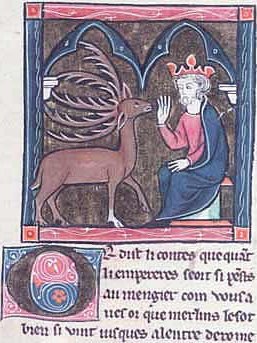
However, if the marvelous stag symbolizes immortality, it nonetheless always plays its role as a ferryman of souls to the afterlife. Thus, if it does indeed cross this famous river between life and death, it often does so with someone on its back. In fact, stags are frequently mentioned in places that constitute an interface, or an airlock to the Otherworld. In Germano-Scandinavian mythology, for example, there is a stag named Eikthyrnir, who according to Storri Sturluson’s Prose Edda « stands near the father’s hall and bites the branches of Læradr »[xvi]. Now, this famous « father’s hall » is none other than Valhalla, that is to say the palace where Odin welcomes the warriors fallen in battle, who are invited to feast and train there while waiting for Ragnarök. Eikthyrnir thus perfectly embodies the psychopomp dimension of the stag, which here welcomes humans into the world of the gods after their passing.
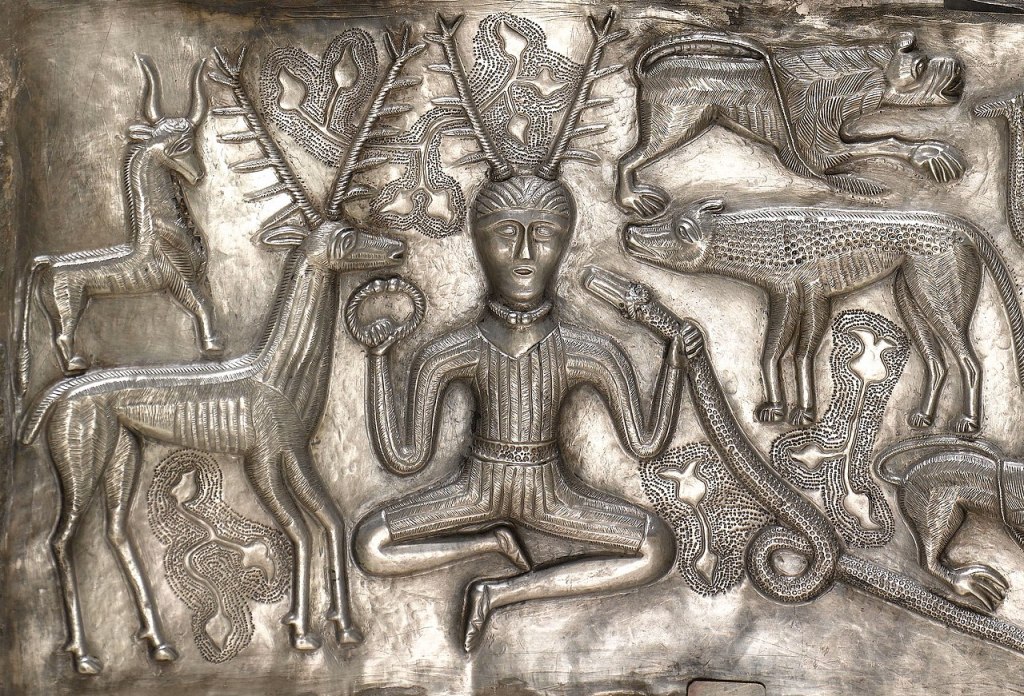
In many cases, there is also talk of a psychopomp deer god, working to ensure the smooth passage of souls to the realm of the dead. When we think of such an entity, the image of Cernunnos naturally comes to mind. This Gallic deity adorned with horns on his head is indeed linked to the idea of a cycle, and therefore of a journey between life and death; something that the loss and regrowth of antlers may suggest. Nevertheless, the paucity of sources available on this figure forces us to remain at the stage of conjecture. However, the iconography offers us some very interesting clues that point in this direction, such as the fact that the god is sometimes depicted as young and beardless, and sometimes as a bearded old man, as if his existence were an eternal renewal. In any case, contemporary fiction has not hesitated to make Cernunnos a psychopomp being, favoring the passage of the living towards the post-mortem spheres. For example, in the series Zone Blanche, he is responsible for several murders aimed at preserving the forest in which he resides, but he is also the guardian of the border leading to the afterlife, choosing those who should or should not cross it. The beginning of season 2 thus sees him take care of the main character of Laurène Weiss, and even resurrect her by burying her underground after she was shot dead[xvii]. From then on, Cernunnos occupies the interface between the two states, and plays with them by passing souls from one side or the other as he sees fit.
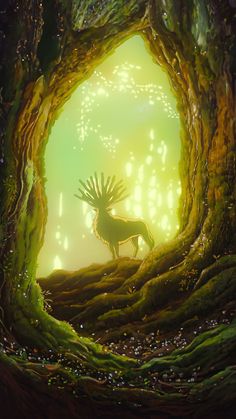
The scene of the antlered god caring for the hero in a sanctuary in the heart of nature is reminiscent of another well-known contemporary work: Hayao Miyazaki’s animated film Princess Mononoke[xviii]. Indeed, in this film, it is about a forest threatened by the human economy, generating a conflict in which the action of the main characters Ashitaka and San (the « Princess Mononoke ») takes place. The forest is embodied in a « Spirit », a mysterious entity surrounded by a mythical and divine character, which takes the form of a large peaceful deer with an anthropomorphic face. However, the film includes a scene during which Ashitika is on the verge of death following a gunshot wound sustained in a fight in the forge village. He is then led into the forest sanctuary by San, then placed in the grass where he receives a visit from the Spirit, who escorts him back to the world of the living. Everything is staged to demonstrate the deer’s power to grant life… or, on the contrary, to take it away. Thus, when it approaches, each of its steps makes the vegetation bloom in the place it has trodden. Conversely, just before healing Ashitika, the Spirit causes a plant to wither with its mere gaze. From then on, this enigmatic being perfectly represents the psychopomp dimension of the deer, capable of dispensing both life and death; fertile abundance and arid decrepitude. It embodies the cosmic force par excellence, deciding the subsistence or, on the contrary, the decline of each of us. The Spirit accompanies souls in this troubled zone that separates presence and absence, life and death; it serves as their guide. If it allows Ashitika to return to the shore of existence, it conversely shortens the suffering of a cursed boar by leading it to death. Finally, let us note an interesting detail: the Spirit of the forest is capable of walking on water… as Jesus did[xix], who can manifest himself precisely through the figure of the deer, as we have shown.
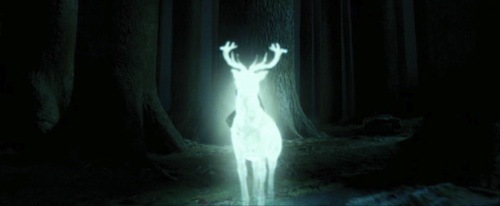
Let’s conclude this brief overview of psychopomp deer by discussing a very famous work: the Harry Potter saga. Indeed, it is marked by two major encounters with the deer, each of which is consistent with the idea of a pivotal animal, connecting the real and the supernatural, guarding the border between life and death. First, Harry and his friends see a large white deer in the third book, devoted to « The Prisoner of Azkaban »[xx]. It miraculously appears in the Forbidden Forest and thus allows them to put to flight the dementors who were sucking out their souls. From then on, the deer manifests itself as a protector of life. But better still, Harry initially imagines that the animal comes directly from the world of the dead. Indeed, he suggests to his friends that the deer could be his father, James Potter, who as an Animagus was capable of metamorphosis. It turns out that the apparition was actually Harry’s own Patronus, duplicated through time travel. However, the stag in question in no way betrays the symbolism associated with it; it effectively connects worlds, enabling the junction between two divergent time dimensions.
Without revisiting the various Patronuses produced by Harry in the intervening volumes, let’s now turn to the final book, in which the second crucial encounter with a mysterious white stag takes place. Harry, accompanied by Ron and Hermione, is then searching for Horcruxes, that is, objects containing a fragment of Voldemort’s soul. Standing guard in front of the tent in the middle of a winter evening, he encounters a phenomenon that is, to say the least, disturbing: he first distinguishes a light between the trees, before realizing that it is in fact « a silvery white doe, bright as the moon and dazzling »[xxi]. Everything then seems to indicate a ghostly apparition, from the time of its occurrence to the description of the animal, supernaturally pale and leaving no trace on the snow. The doe finally leads him to a pond at the bottom of which he finds the sword of Gryffindor. Of course, the trio wonders about this strange event… and as in the previous example, they initially hypothesize that this deer could be a post-mortem manifestation. Indeed, they suggest that this deer could have been sent by Dumbledore himself, despite the fact that he had already been dead for several months… Thus, the deer would have played its symbolic role as a ferryman between worlds, an intermediary with the afterlife. However, the reader will eventually learn that the deer was once again only a patronus: that of Severus Snape who was trying to help them without being discovered. In any case, the deer does indeed appear as the expression of hidden dimensions, especially when it adopts a pale coat making it look like a ghost wandering on Earth.
__
At the end of this brief overview, we can see that the psychopomp character of the deer is widespread and timeless. From ancient Celtic myths to recent films and books, it presents a coherent symbolism and is attributed well-defined roles. The deer guides souls to the Otherworld, guards the border between life and death, and more generally relates to the notion of passage. It goes without saying that exhaustiveness is impossible within the framework of such a subject, but I hope that the examples mentioned will allow readers to observe the deer with a different eye… or to listen to its bellow while taking into account the mystery surrounding this legendary animal, which has always fascinated man. In this deep, guttural sound, anyone who listens closely can perceive the echoes of distant and hidden worlds; worlds where mortal souls can sometimes get lost if they start following the hoof prints.
Pablo Behague. « Sous le feuillage des âges ». Octobre 2024.
[i] Auteur inconnu, XVIIe s., Oisín ar Tír na n-Óg.
[ii] Auteur inconnu, XIVe s., Mabinogion, première branche.
[iii] Auteur inconnu, XIIe-XIIIe s., Lai de Tyolet.
[iv] Hubert le Prévost, XVe s., Vie de saint Hubert.
[v] Auteur inconnu, Ve-VIIe s., Vie et Passion de saint Eustache.
[vi] Halfdan Ozurrson, 2018, The Great Hunt: The Historical Perspective and Themes in the Mythology of the White Stag.
[vii] Auteur inconnu, XIIIe s., Le Lancelot – Lancelot-Graal.
[viii] Marie de France, XIIe s., Lai de Graelent.
[ix] George R. R. Martin et Ryan Condal, 2022, House of the Dragon – S.1, E.3.
[x] Florie Maurin, 2022, Cerfs blancs à l’écran : résurgences et reconfigurations d’un motif médiéval dans quelques productions de fantasy.
[xi] Clive Staples Lewis, 1950, The Chronicles of Narnia – The Lion, the Witch and the Wardrobe.
[xii] 2011, The Elder Scrolls V : Skyrim – jeu vidéo.
[xiii] Cindy Cadoret, 2020, La chasse comme rite initiatique dans la mythologie irlandaise : la formation du guerrier et l’action préliminaire à la découverte et à la rencontre surnaturelle.
[xiv] Auteur inconnu, vers le XIe s., Culhwch ac Olwen.
[xv] Auteur inconnu, XIIIe s., L’Estoire de Merlin – Lancelot-Graal.
[xvi] Snorri Sturluson, XIIIe s., Edda en prose.
[xvii] Mathieu Missoffe, 2019, Zone Blanche – S2, E1.
[xviii] Hayao Miyazaki, 1997, Princesse Mononoké.
[xix] Auteur inconnu, Ier s. – IIe s, Bible – Nouveau Testament.
[xx] J.K. Rowling, 1999, Harry Potter and the Prisoner of Azkaban.
[xxi] J.K. Rowling, 2007, Harry Potter and the Deathly Hallows.
You can follow my news on Instagram: https://www.instagram.com/sous.le.feuillage.des.ages/
 Sous le feuillage des âges - Pablo Behague