The Luminous Moss (Schistostega pennata): In Search of Goblin Gold

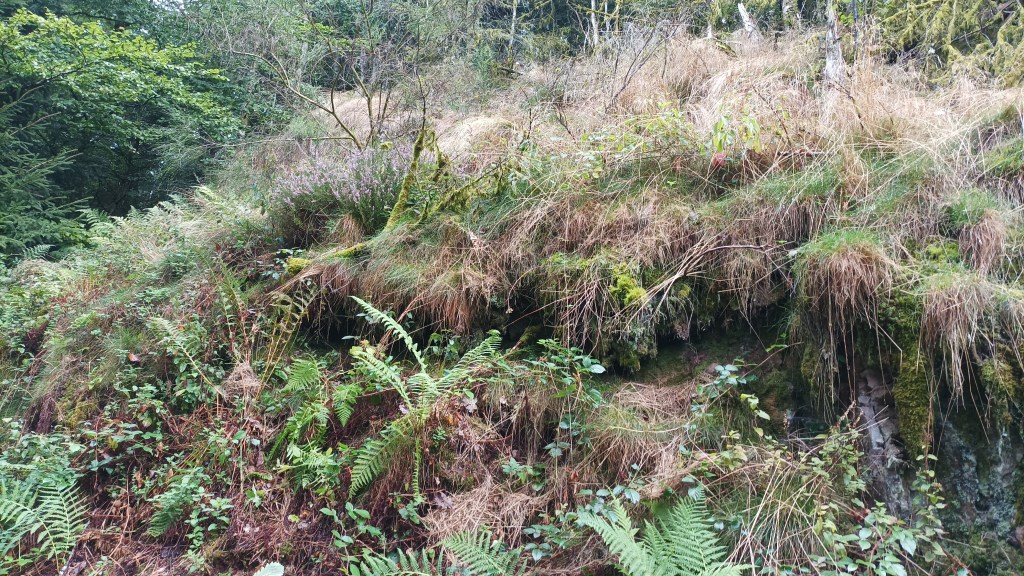
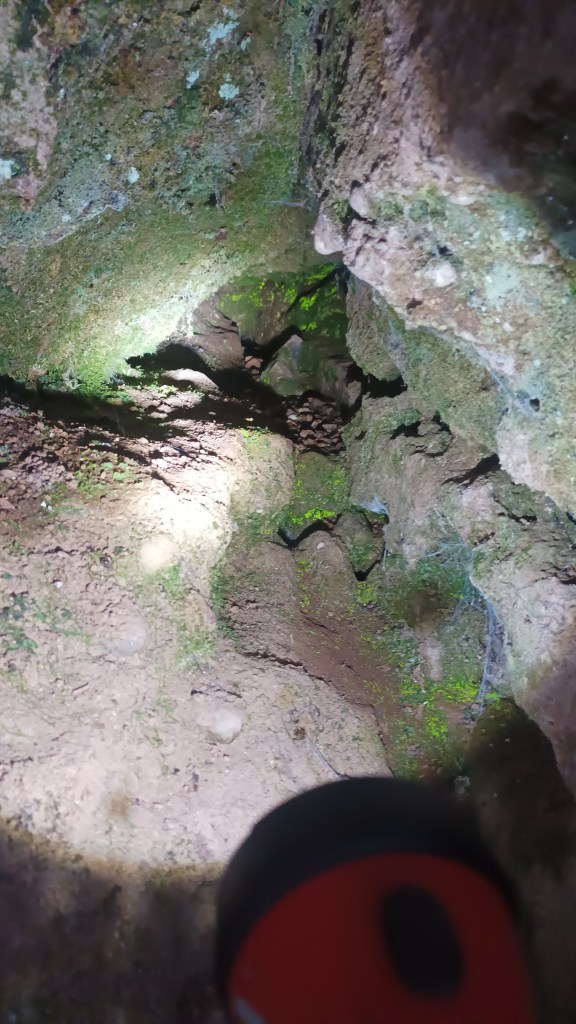
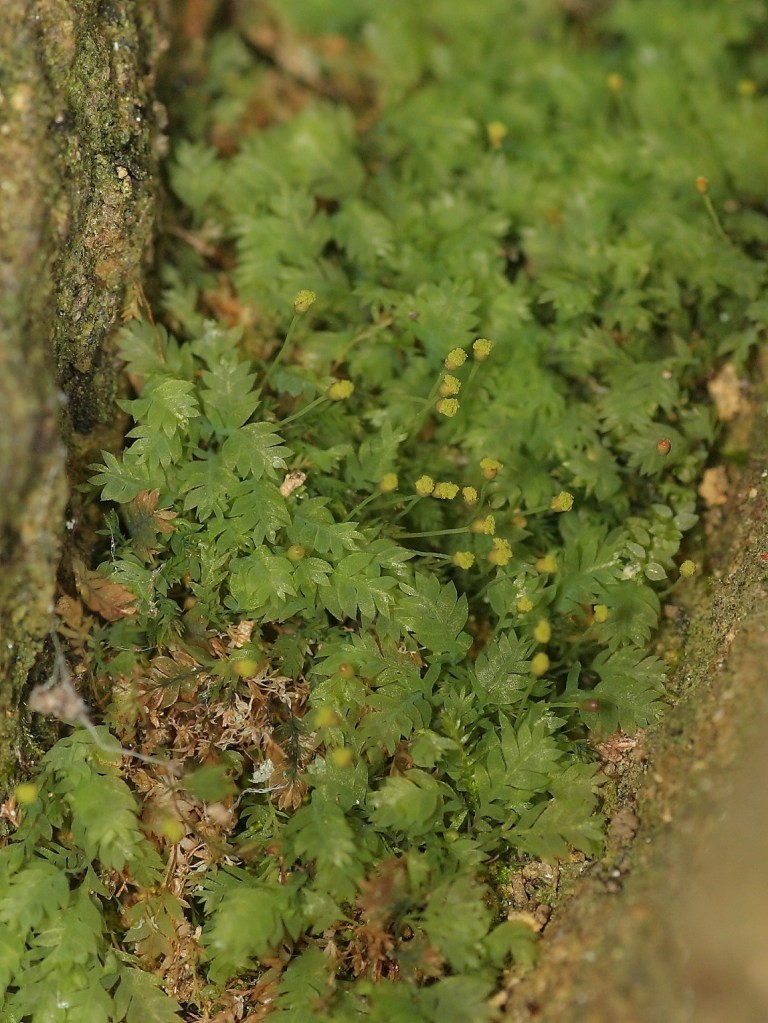
Bryophytes, perhaps due to their small size and indistinct characteristics, have rarely captured the human imagination; certainly far less so than vascular plants. However, there are a few exceptions to this general observation, and goblin gold is a perfect example. Schistostega pennata, its scientific name, is indeed a truly unique species that grows on cave walls, in rock crevices, and even at the entrances to burrows. Calcifuge, it particularly appreciates sandstone or granite substrates, where it can be found in rock shelters, rugged cliffs, low walls, or along embankments, taking advantage of the refuges provided by roots.
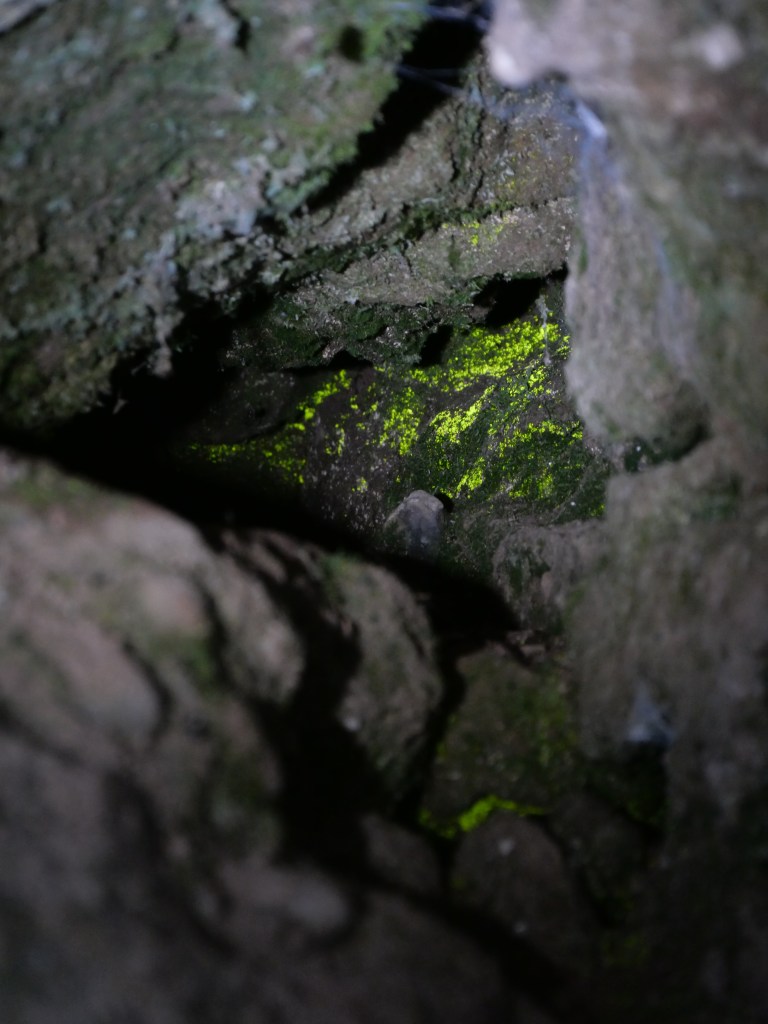
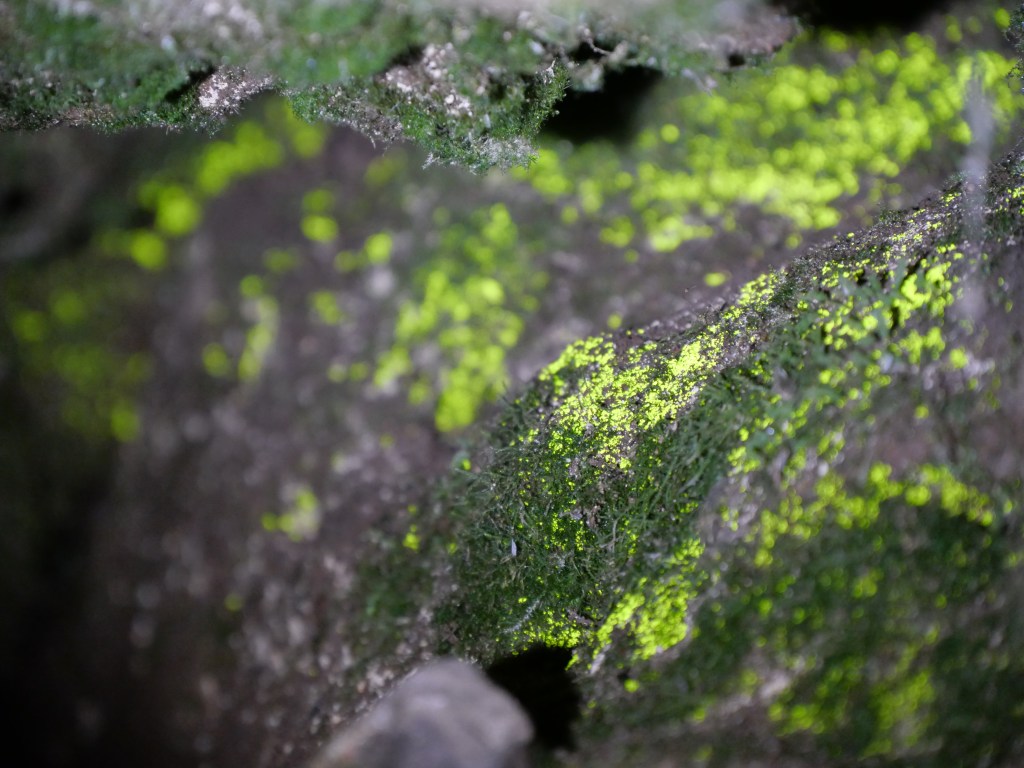
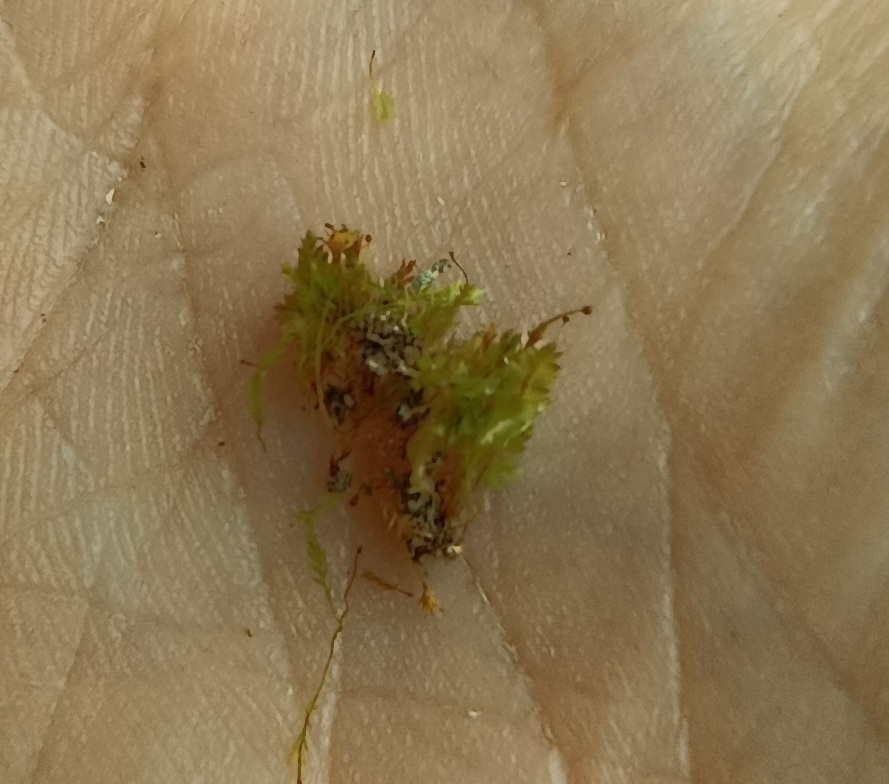
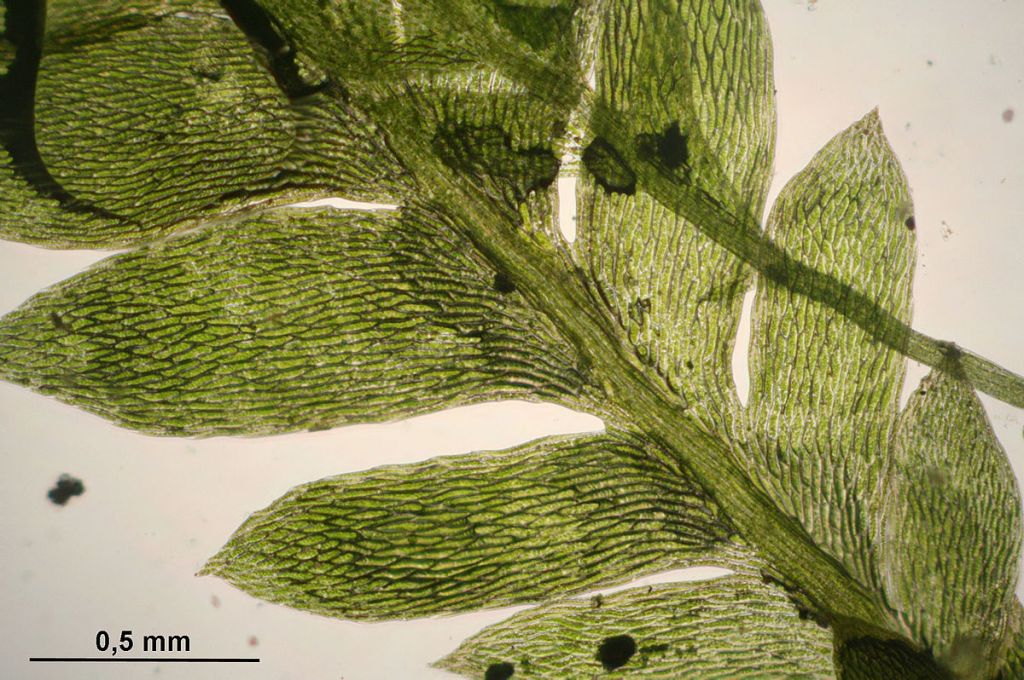
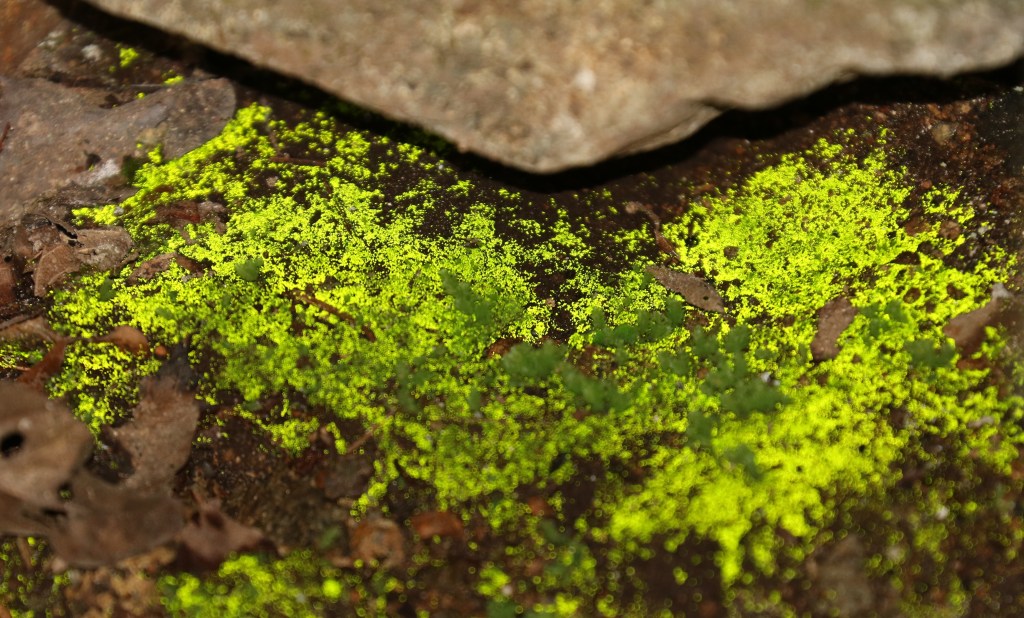
But the fascinating nature of Schistostega isn’t solely due to its ecology, nor its preference for dark places avoided by other moss species. No, what truly makes it fantastic, and magical in the fullest sense of the word, is its ability to glow in the dark, deep within cavities illuminated by a flashlight or candle flame. Indeed, its protonema—that is, the layer of chlorophyll-containing cells that constitutes its first stage of development—is made up of tiny spheres that reflect incident light like lenses, thus appearing « luminescent, » an extremely rare property in the plant kingdom.

That being said, what will interest us in this article is not so much the phenomenon itself, but rather what it has sparked in the human imagination. Through its etymology, as well as through accounts of its discoveries and its cultural significance, we will explore the long-standing and worldwide fascination this species inspires. But let’s not waste any more time: let’s equip ourselves with a flashlight, good shoes, and a magnifying glass, and set off in search of goblin gold!
Etymology: Language as a Witness to Magic

Our little luminescent moss was first described in 1785 by Dickson, who discovered it in Devon, in southern England. The species was then named Mnium osmundaceum, a reference to a known genus (Mnium), but also, and perhaps more importantly, to the royal fern (Osmunda regalis), that beautiful, large fern whose pinnate tips were thought to bear a certain resemblance to moss. A few years later, in 1801, the species was renamed Gymnostomum pennatum by Hedwig, the name again referring to the « pinnate » leaves of ferns. Amidst a tangle of descriptions and new names, the name Schistostega pennata finally appeared in 1803. The genus name literally means « whose operculum splits, » and is unfortunately rather inappropriate since it does not correspond to what is observed in this species[i].

That being said, we saw in the introduction that what makes our subject unique is not so much the shape of its leaves or the opening of its capsules, but rather its protonema, which sparkles in the twilight. It so happens that for some time, however, this was considered a distinct species, and not a developmental stage of Schistostega pennata. Thus, in 1826, a certain Bridel described it as an alga he named Catoptridium smaragdinum. We find in this the Greek root catoptris, meaning « mirror » or « image, » and smaragdinos, which evokes an « emerald green. » In Latin, catopritis mainly referred to « a kind of precious stone, » an appellation which takes on its full meaning when one knows that the species shines like nuggets in the heart of caverns[ii]… However, it was only in 1834 that the truth was restored by Unger: this alga is not one, but is rather the protonema of goblin gold[iii].
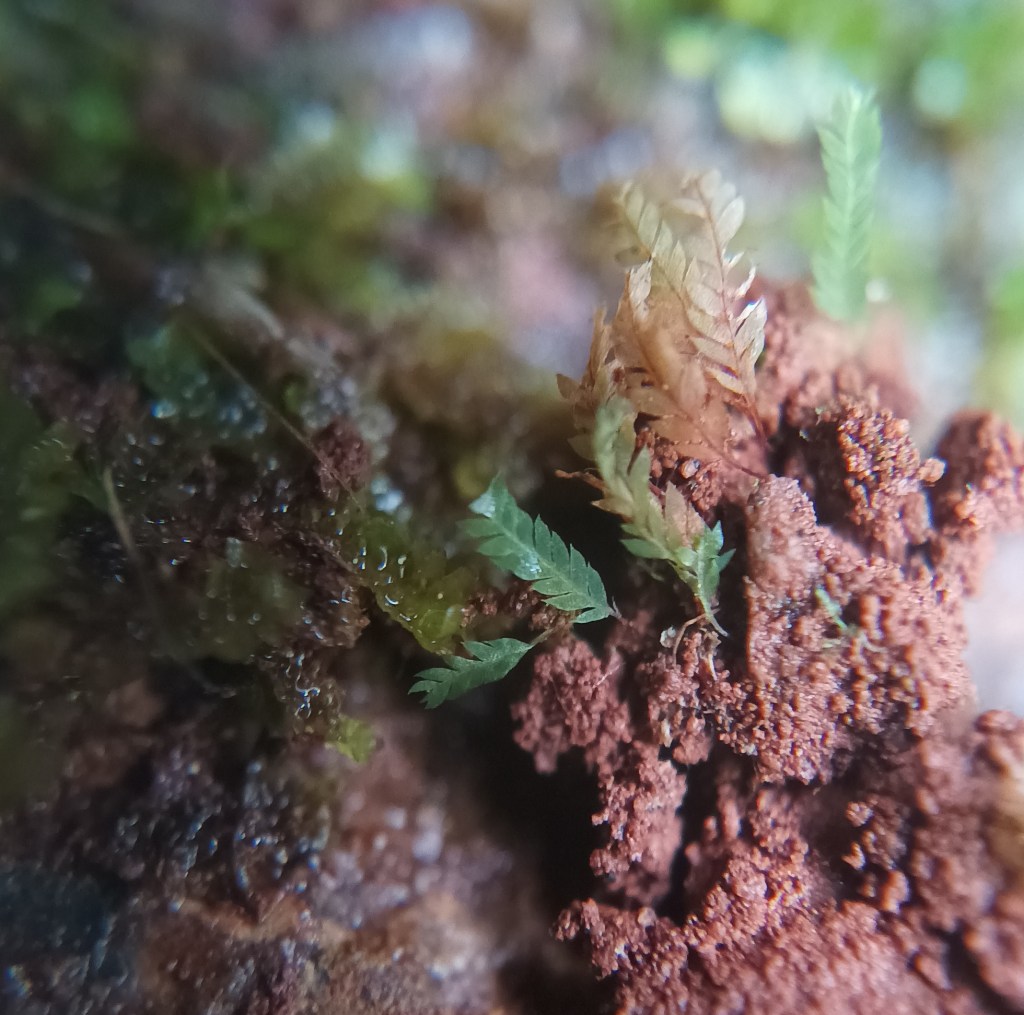
The way we describe the things around us reflects our interest—or, conversely, our disinterest—in them. However, it is rather rare for bryophytes to have the honor of a well-established and widespread common name. As the reader will have guessed, Schistostega pennata is one of the species that benefits from this privileged treatment. Even better, our moss of dark corners has numerous common names, and even regional names that attest to a certain popular affection.

Often, its names refer to its luminous quality, either directly or indirectly. In the first case, the species is simply called luminous moss, luminescent moss, or shining moss, with all the possible variations depending on the language: for example, luminous moss[iv] or luminescent moss[v] in English; lysmose in Norwegian[vi]; leuchtmoos in German[vii]; Musco luminoso in Spanish[viii]… This luminous quality sometimes lends itself to more original, even amusing, names, such as rabbit’s candle[ix], which is said to be used in Scotland, in the Edinburgh area[x].

But the etymology of Schistostega pennata also extends into the realm of gold and treasure… generally associating it with folkloric creatures inhabiting caves and caverns. Of course, its most common name is goblin’s gold, which in France is sometimes translated as lutin’s gold. We find it in English, with the name goblin’s gold[xi]. That being said, our luminescent moss is also placed under the protection of the dragon, a creature of caves as well, but a much more frightening one. Among its English names is dragon’s gold[xii], which is also found in Sweden, for example, where it is called drakguldmossa, meaning « dragon’s gold moss »[xiii]. In any case, our Schistostega is frequently compared to a treasure… This is explained, of course, by its shiny appearance and cave-dwelling habitat, but also undoubtedly by its general rarity. The species is indeed scattered, confined to rather acidic areas, and exhibits a particular ecology that often causes it to go unnoticed. While it can be quite common in certain suitable regions, it remains a taxon that bryologists always find with a touch of emotion… something I can personally attest to.

The Thrill of Discovery

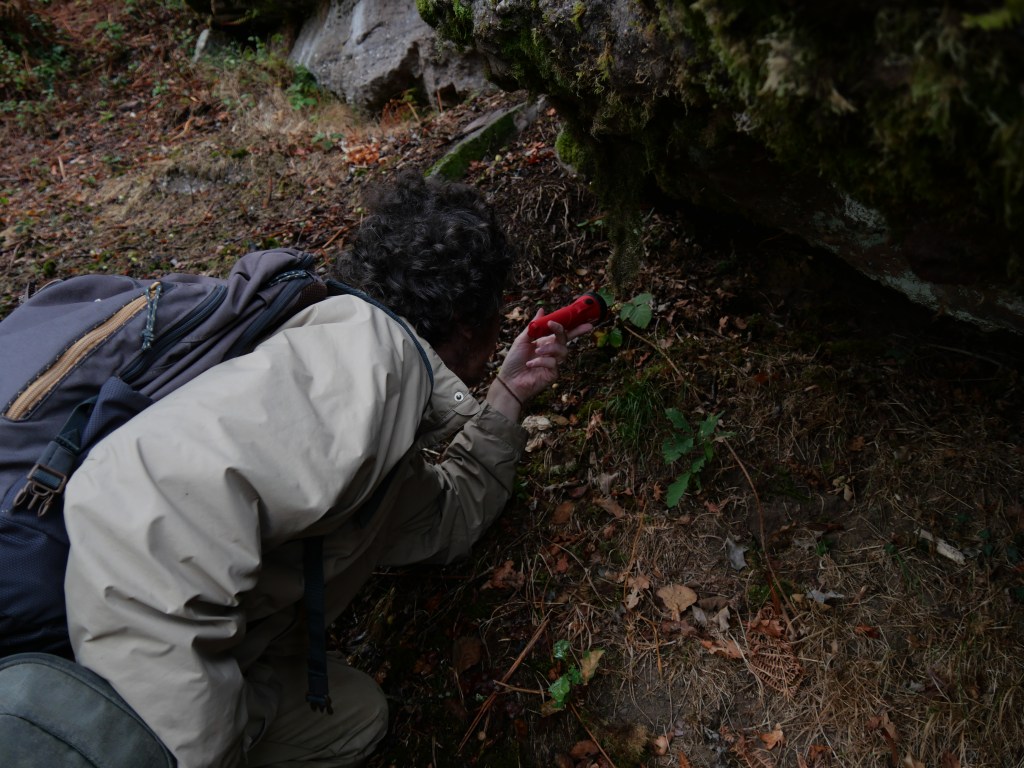
I remember my first encounter with Schistostega pennata as if it were yesterday. I was a young bryologist, still quite inexperienced, watching a wonderful, unsuspected world unfold before me: the world of mosses and liverworts, which I have never stopped exploring since. But if bryophytes are a fantastic universe in themselves, what can be said of this luminous moss, shimmering emerald green in the heart of hidden rocks; a natural treasure, revealing itself only to those passionate enough to venture into these seemingly useless crevices? That day, June 29, 2013, I had set out to explore the forests and streams of the Pays de Bitche, in Moselle, in the northernmost part of the Vosges Mountains (more precisely, in the commune of Sturzelbronn). Exploring the bryophyte flora of a rocky outcrop, I stumbled upon a small cave that plunged into darkness… It was then, under my magnifying glass, as I examined the species growing on the walls of the entrance, that I recognized the pinnate leaves of Schistostega. A smile bloomed on my lips, for it was a discovery for me, and it widened even further when, using my phone’s flashlight, I saw the emerald protonema gleaming in the dim light, a little further into the cavern… There weren’t many, just a few small spots here and there, but that was enough to make me happy. I found it very difficult to leave that place, for I had the overwhelming feeling of having unearthed a treasure; not a material treasure, but something far more precious, something to do with the heart and soul.

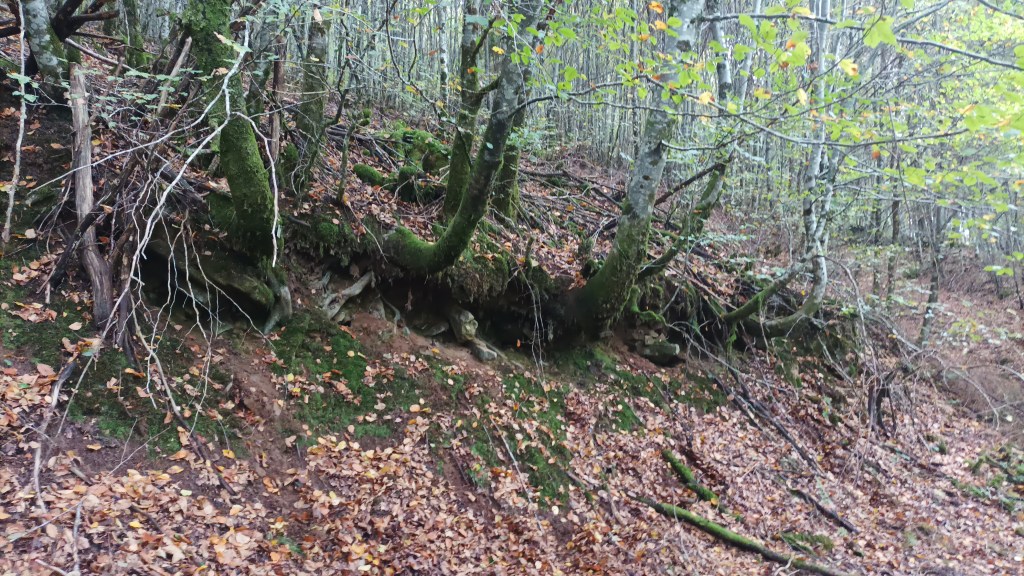
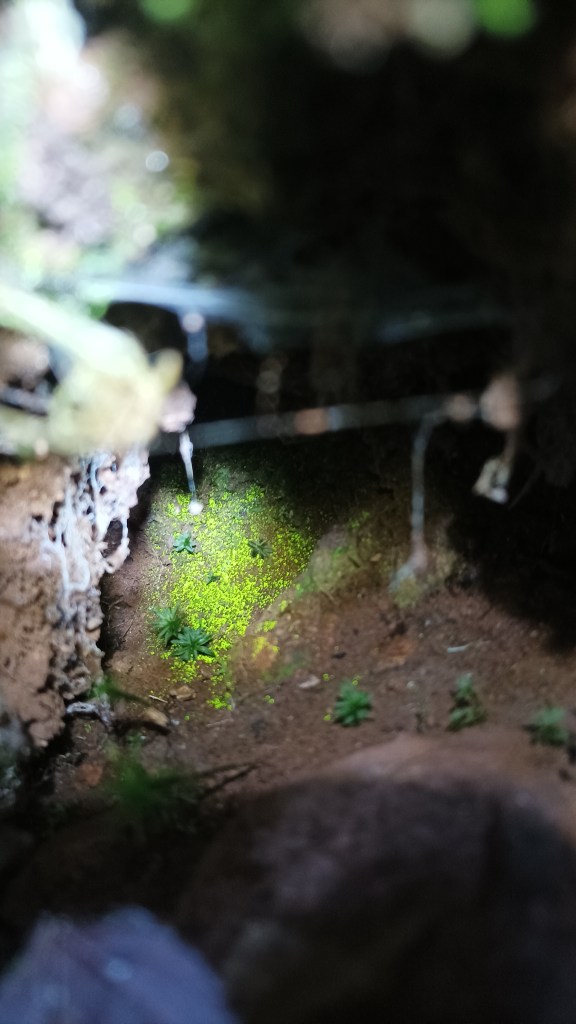
In the years that followed, I repeatedly came across the goblin’s gold during various outings in the Vosges Mountains, alone or with German and Alsatian bryologists. Each time, however, the sight of this shimmering species filled me with a feeling of euphoria, so much so that upon settling in the Vosges Saônoises region, I decided to resume my search for it, in order to better understand its distribution in my area. Considered very rare in Franche-Comté, the luminous moss is seldom mentioned in older literature and was then recorded in only two recently discovered locations. Armed with my flashlight, I scoured the landscapes, finally discovering it in several communes in the area. Sometimes I saw it shining in a cave, sometimes under the exposed roots of a tree on a bank… The same emotion overwhelmed me with each find, and when I looked into the accounts of the discovery of the species, I realized that this enthusiasm for Schistostega pennata was in fact widely shared.
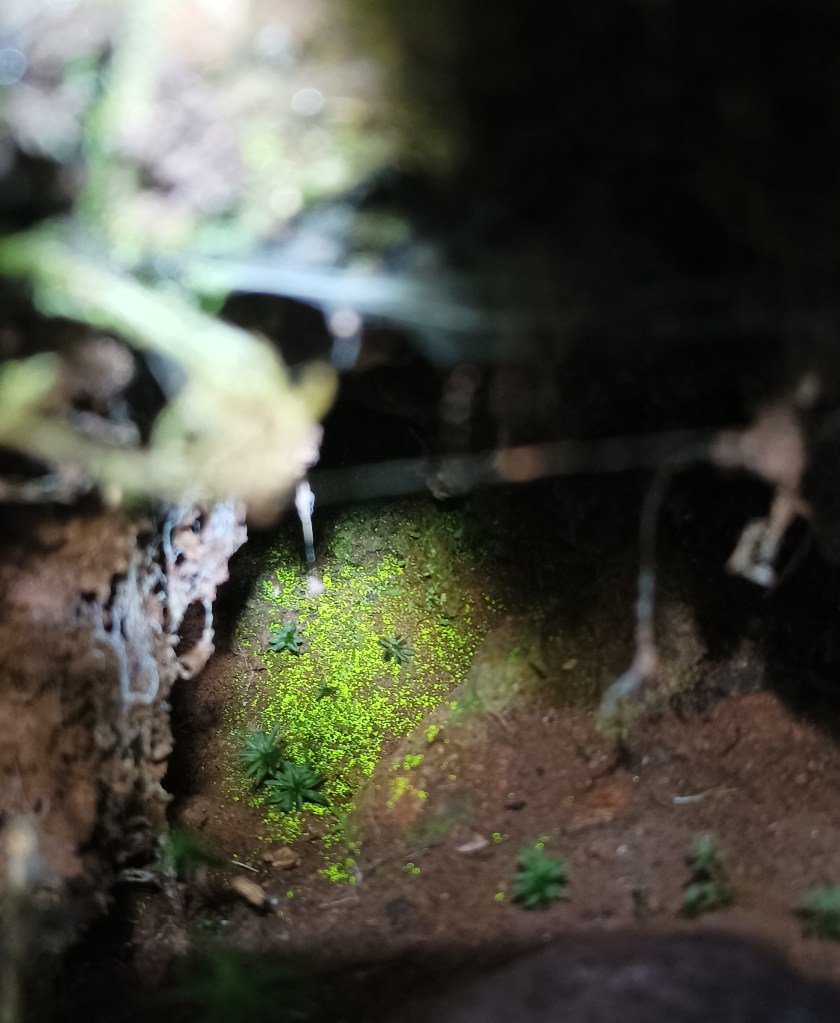
Goblin gold (Schistostega pennata), here under the roots of a tree at the edge of a bank. Personal photograph

Let us delve into some of these accounts, beginning with that of Anton Kerner von Marilaun. In 1863, in his work entitled Das Pflanzenleben der Donauländer (“The Flora of the Danube Country”), the Austrian botanist recounts the discovery of the species and justifies the legends and beliefs associated with it by its extraordinary properties. For when a fragment of this “gold” that glittered in the cave was taken, nothing remained in the daylight to convince us of its existence… In our hands, nothing but earth remained. Were we dreaming? Of course not, but the treasure possesses magical properties; we will return to this later. This, at least, is what Kerner von Marilaun says about it: “This phenomenon, that an object shines only in dark rocky crevices and immediately loses its luster in daylight, is so surprising that one can easily understand how the legends of fantastic gnomes and troglodyte goblins arose.”[xiv] We will not contradict him.

In 1921, G.B. Kaiser, an American bryologist, set out to search for the species in the Appalachians… The account of his discovery, which he himself provides in volume 24 of the journal *The Bryologist*, speaks for itself: “A cry escaped our lips!” Here, at last, lay the object of our search, the luminous moss: as our eyes explored the gloom, a faint glimmer seemed to grow and grow until it became the glow of « goblin gold »—a faint, yellow-green light that shone, sometimes steady, sometimes flickering, always exquisite, beneath our fascinated and delighted gaze. (…) Later that day, as we attempted to cross the edge of the woods to reach the rugged summit, the weather changed, vast expanses of cloud threatened us, and the wind blew mournfully: but we cared little for the coming storm! We carried in our hearts and minds a memory that would remain etched: we had succeeded in our quest, we had found the luminous moss, and even though since that day we have not been able to rediscover this object of so much wandering and wonder, this discovery led us to consider the word Schistostega as a magic word, a talisman, a lucky charm!« [xv] Thus, I am far from being the only one to whom this tiny moss brings comfort! Anyone who has the chance to observe it one day keeps within them a small treasure; a memory that is cherished and that accompanies us through trials like a blessing.

We could multiply the many more accounts of wonder relating to the discovery of our luminous moss, for example, by citing that of a certain Stephen Ward, who recounts his exploration of an area of ​​Scotland dotted with rabbit burrows. As the light faded, he glimpsed something shining in some of the holes: “magnificent emeralds that sparkled, like a glimpse of a veritable underground Ali Baba’s cave,”[xvi] he explained. Thus, Schistostega pennata is frequently compared to a treasure. It is therefore no surprise that it is the object of a singular fascination—if not veneration—which is particularly evident in contemporary culture.

A magical and revered plant

Schistostega pennata is a small botanical talisman, a visual marvel that brings a certain joy to find. Even fans of the video game Animal Crossing may be familiar with this species without realizing it… There, it is called glowing moss in the English version, and can be harvested in New Horizons, on certain mysterious islands accessible only by boat. Once in the player’s inventory, this bryophyte can be used to decorate their house or garden, and also to craft items that will then possess a luminous aura[xvii]…
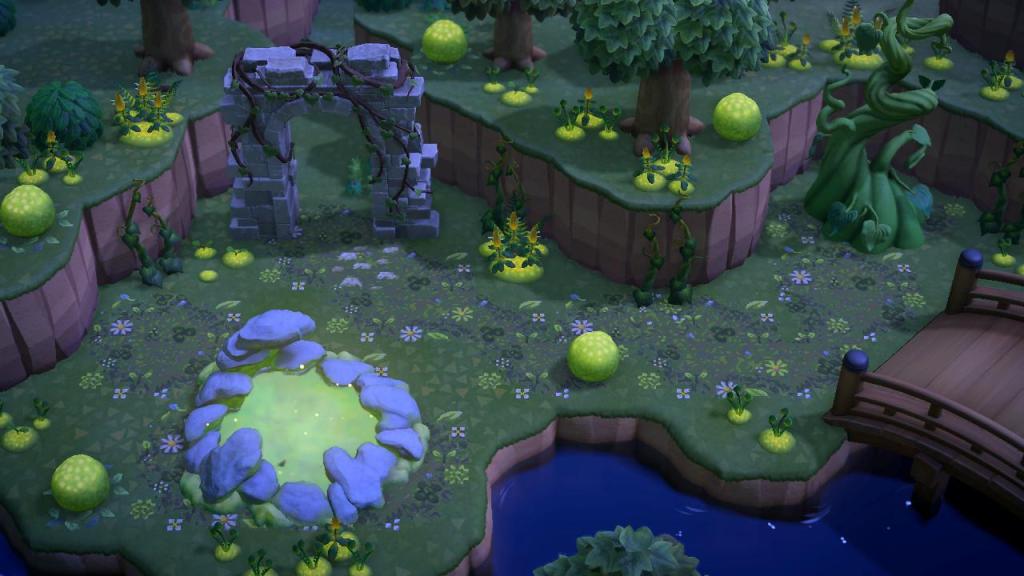
The glowing moss in the video game Animal Crossing.

The presence of Schistostega pennata in a Japanese video game is not so surprising, as the species enjoys a veritable cult following in the Land of the Rising Sun. Furthermore, it plays a central role in a book that even lends its title to the story: Hikarigoke (Luminous Moss) by Taijun Takeda, published in 1953.[xviii] The book tells the tale of sailors stranded by a snowstorm on the island of Hokkaido. Finding refuge in a cave, they are ultimately forced to resort to cannibalism to survive. The captain, the sole survivor, explains in court that those who had consumed human flesh possessed a phosphorescent green aura around them, which only those who remained healthy could see. It is understood that the cave was inhabited by Schistostega. The novel was adapted into an opera[xix], and also into a film under the title Luminous Moss.[xx] In the film version, the protagonist is a writer who one day discovers a cave entirely covered in this moss, shimmering before his bewildered eyes. Having heard a story of alleged cannibalism involving a crew of sailors shipwrecked on an island, he imagines a scenario in which the flesh-eaters would be betrayed by emerald halos around their heads, a souvenir of the moss he had observed…
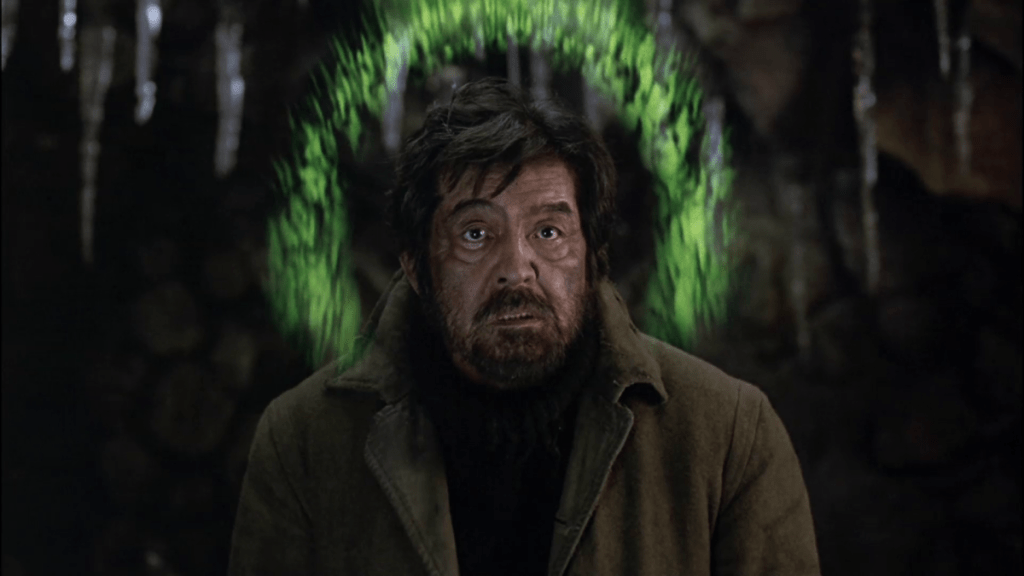
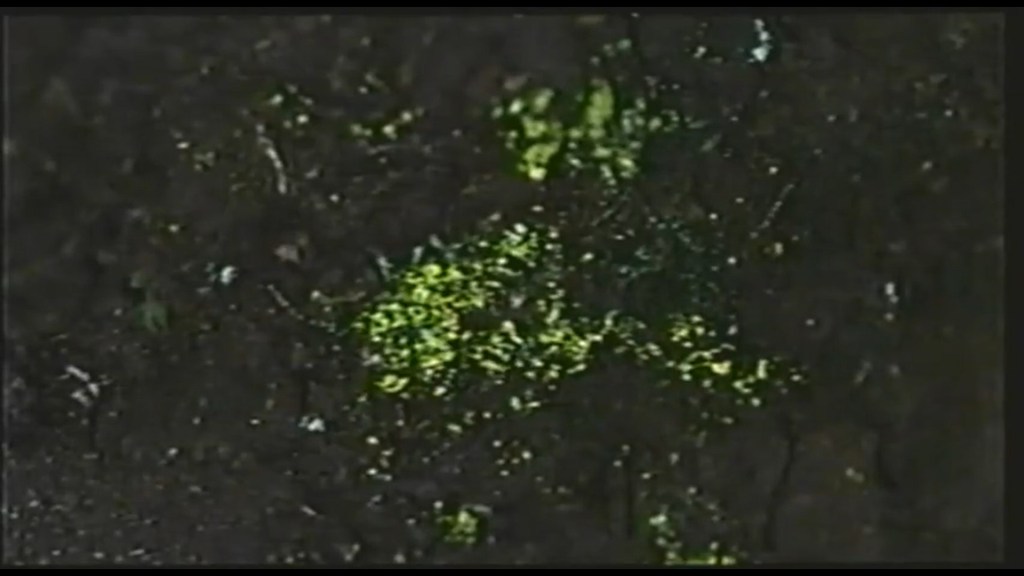
The fluorescence of goblin gold thus plays a sinister role here. But in Japan, it is also the object of more traditional veneration, to the point that a memorial is dedicated to it within a small cave located on the island of Hokkaido. Luminous moss covers a good part of the floor and walls of this cavern, where one can reflect and meditate, losing oneself in its singular phosphorescence.
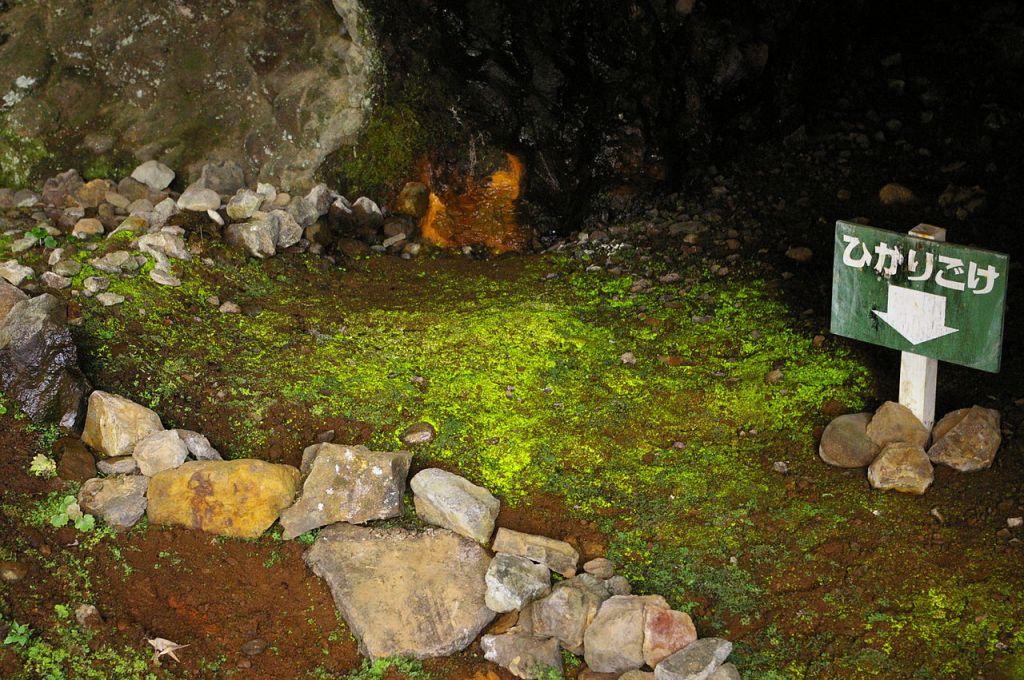
The Makkausu winery, on the island of Hokkaido, honoring Schistostega pennata.

We now turn to an archaeological mystery, which takes us back to Europe, and more specifically to England. In his book Bryophytes of the Pleistocene: The British Record and its Chorological and Ecological Implications, the scientist J.H. Dickson discusses a discovery that is nothing short of enigmatic… and extraordinary. He explains that a fragment of Schistostega pennata was identified in “the socket of an axe buried within a Bronze Age deposit” at Aylsham, Norfolk[xxi]. While it is already remarkable that the plant has remained identifiable after all this time, it is above all the location of its discovery that opens up fascinating perspectives. How did a fragment of luminous moss end up inside a weapon? Was it the result of chance or a deliberate act?

It goes without saying that, when studying materials from such distant periods, any attempt to provide definitive answers is illusory. Dickson opts for an accidental introduction into the handle, probably during the axe’s manufacture, and this hypothesis is indeed plausible given that Bronze Age tribes frequently gathered in caves that constitute the very habitat of our goblin gold. It should be noted, however, that the species is absent from Aylsham, and more generally from eastern Norfolk[xxii], and that, given the specific nature of its habitats, it is likely that its distribution has not changed much over time[xxiii]. This would therefore mean that the weapon was transported over a relatively long distance and was not manufactured where it was buried. That being said, while the possibility of accidental introduction into the axe socket is quite real, we cannot rule out the hypothesis of deliberate insertion into the tool. Was this species the object of particular veneration? Is it possible that magical properties were attributed to it, which would explain its presence in such a singular location?

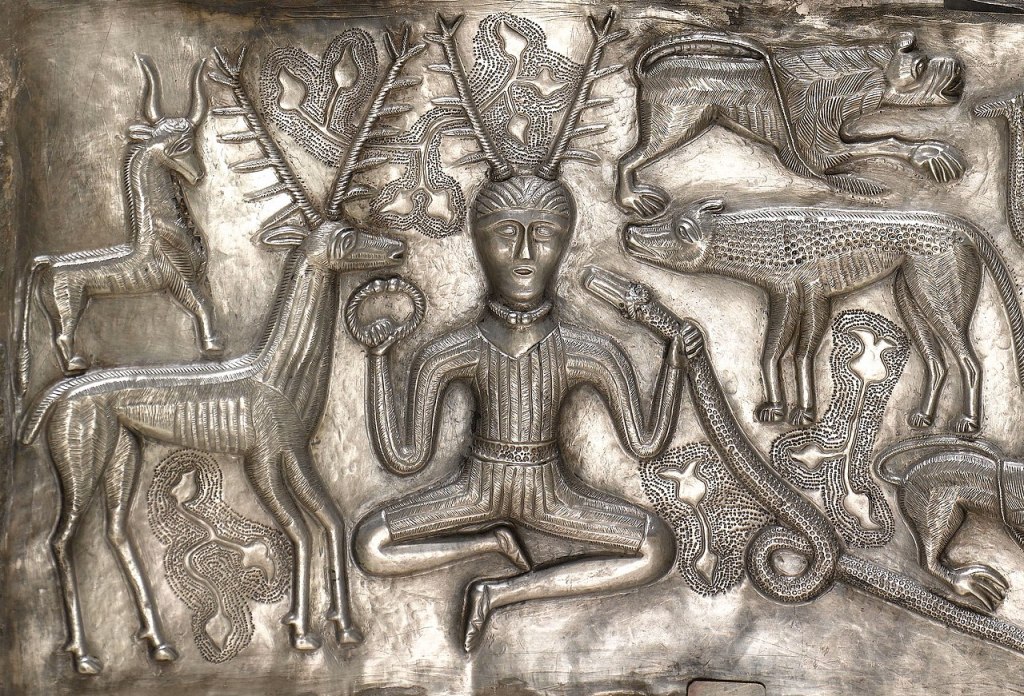
Let us remember which species we are talking about: luminous moss, goblin gold. The mere mention of its name evokes fantastical tales, so how can we imagine that it did not also fascinate the people of old, who saw it shimmering in caves by the light of their torches? Dickson himself does not entirely dismiss this theory: « The possibility remains that Schistostega had a magical significance » [xxiv]. Furthermore, it is interesting to note that the Celtic deities associated with fire are, in fact, also linked to the forge. This is undoubtedly the case with Belenos[xxv] and Bel, perhaps even with Lug. These too are solar deities, and therefore luminous gods, like our goblin gold protonemas. Let us now imagine our ancient craftsman, working on the making of weapons within some sandstone cavity, forging this axe over a fire that makes the surrounding walls gleam like gold… How could he not be troubled by such a phenomenon? Thus, perhaps Schistostega pennata was associated with solar deities, and therefore with the entities that governed the flames of the forge. Of course, we will never know for sure, but this fragment in the axe is nonetheless a highly intriguing element, opening up rich possibilities. Unfortunately, to this day, no similar discovery has been recorded.

The Ephemeral Gold of Goblins

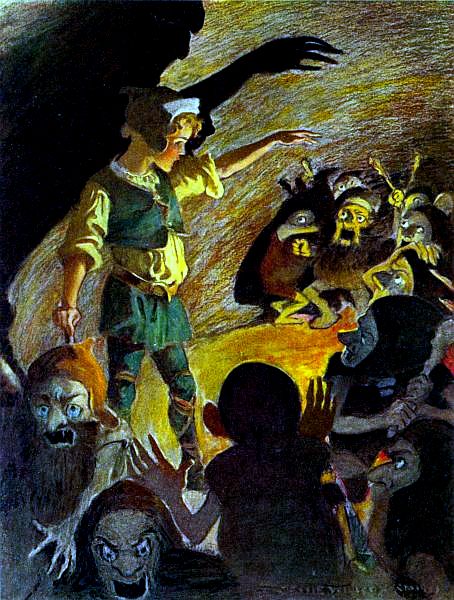
Thus, it is possible that Schistostega pennata stimulated the human imagination as early as prehistory. But our questions about it can easily be extended into the modern era. We have noted that bryophytes are rarely mentioned in imaginative works—no doubt due to their inconspicuous nature and their similarities to one another—but this does not mean that they could not have inspired certain motifs in our legends. In this case, Schistostega pennata, by its very etymology, is openly associated with subterranean treasures, and with the goblins who are often their guardians. Caves and caverns have always intrigued people, especially since veins of gold could sometimes be found there… Consequently, numerous stories and beliefs arose concerning riches hidden in the shadows, one of the most enduring of which is that they are made, or gathered, by those humanoid and somewhat unsettling creatures known as goblins. That being said, it is not surprising that a phosphorescent moss growing on the walls of caves has been linked to these mythological figures… We will not delve into the origin of goblins here – a topic that could fill an entire book – but it is worth recalling some of their most famous occurrences. In Germanic countries, they sometimes take on the guise of the Kobold, who can be benevolent towards miners, but also possessive and vengeful when it comes to their precious metal.[xxvi] They are also featured in contemporary culture, for example in the Harry Potter universe, where they once again appear avaricious and fascinated by riches.[xxvii] Guardians of Gringotts Bank, their vaults are scattered throughout underground labyrinths… Of course, they are also encountered in J.R.R. Tolkien’s Middle-earth, where they dwell in the heart of the mountains. In The Hobbit, Bilbo and his companions thus encounter them in the Misty Mountains, where the treasure guarded by the dragon Smaug is located;[xxviii] another creature associated with our Schistostega, as we have noted.
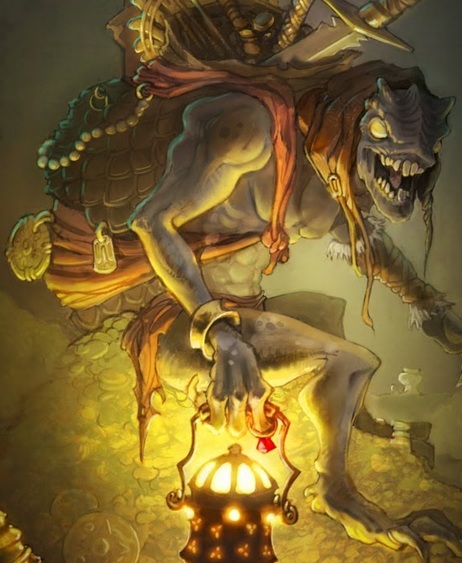
Up to this point, we can reasonably assume that it was real gold that inspired the folklore, more so than our luminous moss. Certainly, but in some stories, this coveted gold is linked to magical properties that cause it to vanish, or even crumble to dust, when touched… This motif is very interesting for our topic, because it is precisely what happens when one tries to grasp the phosphorescent protonema of the luminous moss: in the light of a torch or lamp, it resembles gold, dazzling… but anyone who scratches the surface and tries to reach the exit finds only dust or earth beneath their fingers, mixed with a rather innocuous little green carpet. Therefore, we can ask ourselves… Could Schistostega pennata have inspired some of these beliefs and legends relating to ephemeral gold, or gold that transforms under the fingers of its discoverer?

The first case, that of disappearing gold, is found in numerous tales, to the point of having been identified as a “classic motif” of folk literature by S. Thompson, under the code N562: “The treasure vanishes of its own accord from time to time / A magical illusion prevents men from seizing the treasures”[xxix]. Often, the said treasure appears only for a very short period, at a symbolic moment on the calendar, and sometimes even at a specific time of day. For example, many underground riches are revealed only on Christmas night, sometimes during Mass or at precisely midnight. Thus, in Maine, a cave inhabited by fairies is accessible only when the church bell in Lavaré rings… Inside, “a heap of gold and silver,” as well as “precious stones that sparkle so brightly they turn night into day,” await the adventurer who dares to enter[xxx]. He can take whatever he wants, but the rock closes again at the last chime of the bell. The phenomenon is similar with the treasure of the Fools of the Allier, accessible only during Christmas Mass or on Palm Sunday, when the priest knocks three times on the church door… but even then, one must have sold one’s soul to the Devil to be able to seize it.[xxxi] Among the other treasures that are revealed at Christmas, we can mention that of the Cave aux Bœufs (in the Sarthe region), or that of the Pyrome rocks (in the Deux-Sèvres region).[xxxii] In some cases, however, the visibility and accessibility of the treasure are even more ephemeral. On the path between Salvan and Fenestral, legend has it that a treasure hidden under a stone is only visible once every hundred years.[xxxiii]

What is interesting about all these stories is that the ephemeral nature of these treasures can echo the reproductive cycle of our luminous moss. The phosphorescent protonema of Schistostega pennata is theoretically observable year-round[xxxiv], but this does not mean that it is perpetually visible at any given site. Thus, we can easily imagine the wonder of a traveler camping in a cave that harbors it, followed by disappointment upon returning months or years later to find nothing dazzling. But beyond the biological cycle of this bryophyte, it is also important to remember that the protonema’s phosphorescence is only perceptible with a specific orientation and intensity of light. In other words, the shimmering effect visible in torchlight disappears when the protonema is moved away from the light source, or when returning in the middle of the day. Furthermore, some Schistostega sites can naturally glow in sunlight at certain times of day, when the sun enters the cave at the right angle. The observer who is lucky enough to be there then sees the goblins’ gold appear… but an ephemeral gold, which disappears in just a few minutes, perhaps inspiring these stories of lost riches.

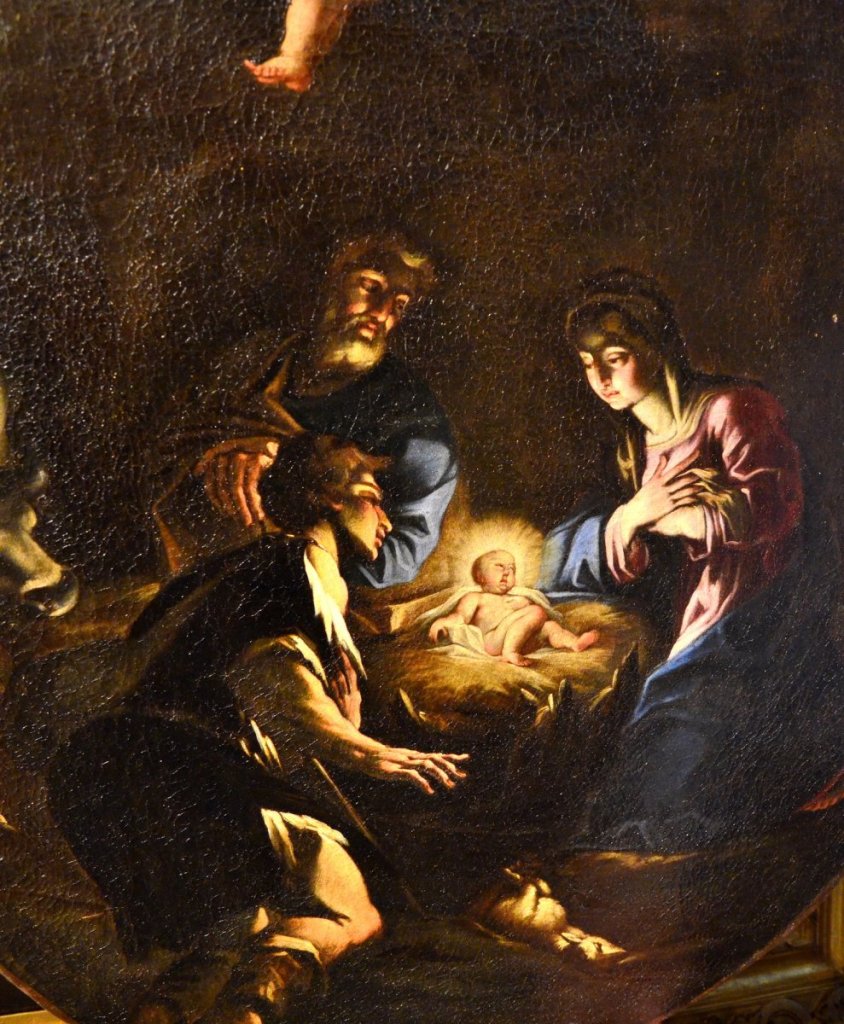
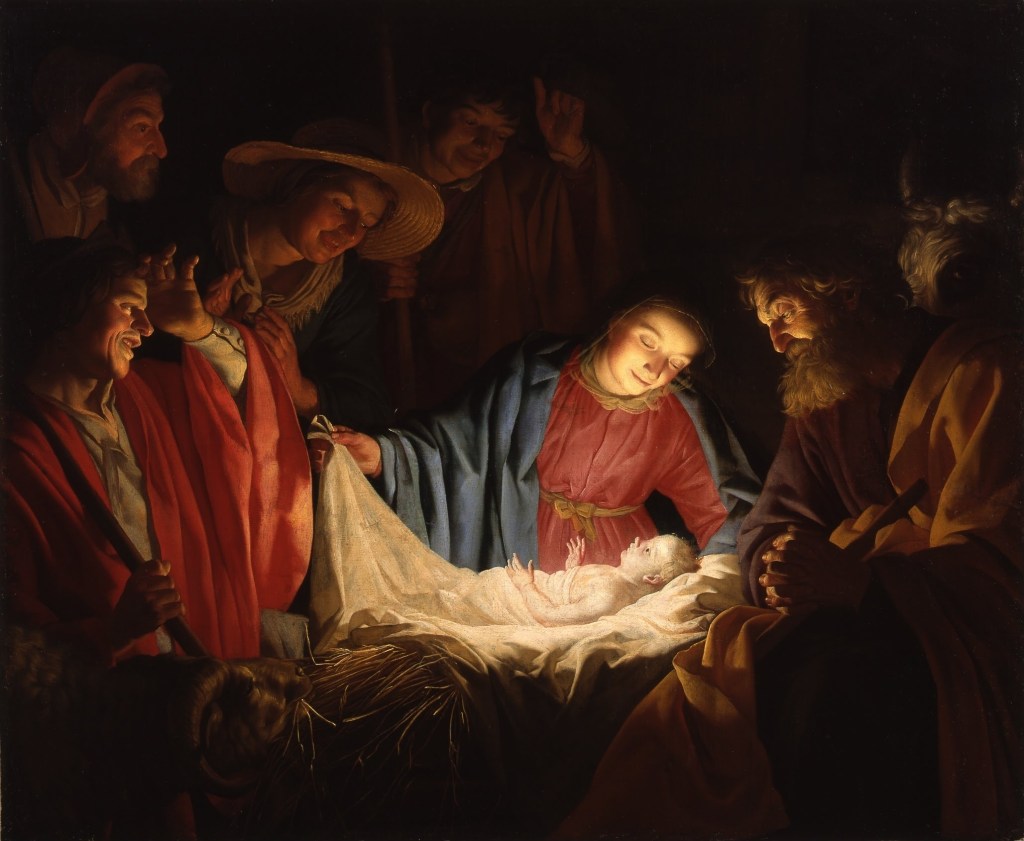
Within these legends, one last point, and not the least important, deserves our attention: the special moment when these hidden treasures are revealed. This moment generally corresponds to Christmas, which is, of course, a highly symbolic date. That the child-light, Jesus, upon his birth, should bring forth light within the caves is, all things considered, quite logical, and it is understandable that the legends have favored this particular night for this phenomenon. Furthermore, this date also corresponds, more or less, to the winter solstice, which marks the lengthening of the days. Symbolically, it is therefore the advent of light that is celebrated on this date… and its victory over the winter darkness. Now, isn’t this precisely what Schistostega pennata embodies when it twinkles in the heart of the twilight? It represents the glimmer that persists in the heart of the night, like the hope that remains even in the darkest corners of existence. Given its luminous nature, it would not have been surprising if this Bronze Age blacksmith had used it as an emblem of his solar deity, whatever it may have been.
The Treasure That Turns to Dust

That being said, let us return to our modern legends, in which another motif deserves our attention. For while gold sometimes simply disappears, it also frequently turns to dust beneath the fingers of its discoverer, or transforms into mere debris, earth or plant matter. This phenomenon is found in many beliefs, and not only in France. Thus, Mare Kalda, a doctor of philosophy, mentions legends relating to the discovery of a « glow of treasure, » some of which are found in Estonia. In these stories, people gathered around a fire may receive earth or coals to light their pipes… which ultimately turn out to be gold after some time. But the opposite phenomenon is at least as widespread: the treasure passed on transforms into a substance that ultimately has no value: earth, leaves, ashes[xxxv]… Is it because the fire around which the gathering was held went out? The luminous moss was goblin gold as long as the flames made its protonema sparkle, but it became tiny moss embedded in earth once night fell.

This same motif appears in the North American tale « The Crumbling Silver. » It tells of shining nodules on the rock, which arouse the covetousness of a man named Gardiner. Unwilling to share anything with anyone, he ends up killing the Montauks Indian who had shown him the spot… but in doing so, he unleashes a curse. Returning home by candlelight, he discovers that what he has taken no longer shines as it should. The next morning, in his cellar, he finds only a pile of gray dust flecked with a few coppery reflections[xxxvi]… The treasure has been transformed into a worthless thing. It no longer shines, like the protonema of Schistostega brought into the light of day, or by the light of a poorly positioned lamp. Thus, the precious object that deteriorates and ceases to shine is an intercultural motif, found from Estonia to the United States. Of course, it is also encountered in Western Europe, for example in connection with the famous leprechauns. Their treasure is reputed to be unattainable, protected by enchantments and well-kept secrets. If by chance someone manages to seize it, it can transform into leaves, into earth, or simply disintegrate at lightning speed, especially if certain rules are not followed (do not raise your voice, do not look back, do not reveal the location…). The same is sometimes true of the fairies’ hoardings, or even of the riches that witches believe they obtain from the devil. In many witchcraft trials, the person seduced by the Devil receives a kind of payment in exchange for their soul, in the form of gold or coins. But generally, this money ends up disappearing, or more precisely, transforming into something worthless; sometimes earth, but more often oak leaves.[xxxvii]

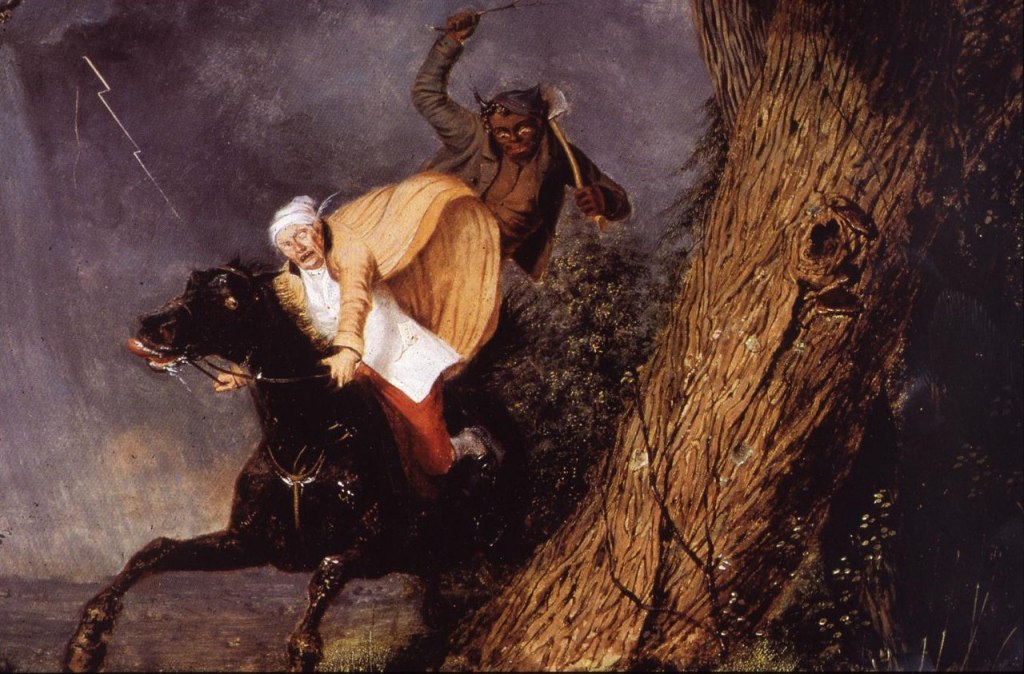
This motif of gold that metamorphoses once taken is found in a tale by the Brothers Grimm: « The Gifts of the Little People. » A tailor and a goldsmith, traveling in the dead of night, discover a gathering of merry elves, join them, and obtain coal from them, filling their pockets. The next morning, waking up in an inn, the two companions are pleased to find that it has turned into gold… But the story doesn’t end there, for the goldsmith then decides to find the little people again to obtain even more of their gold. As the reader will have guessed, his greed is punished, and the coal remains coal this time. Worse still, the gold he initially obtained has also reverted to mere scrap.[xxxviii] Contemporary literature has also seized upon this concept. For example, in his short story « The Devil and Tom Walker, » Washington Irving features an individual to whom a mysterious figure reveals the location of Captain Kidd’s treasure. Since the treasure is cursed and protected by the devil himself, the man becomes rich at the expense of his soul, but ultimately ends up ruined by a supernatural process in which the gold and silver he had unearthed are transformed into wood chips.[xxxix]
A similar phenomenon occurs in the English folktale « The Hedley Kow« , but with a more favorable outcome for the protagonist. An old woman finds a pot filled with gold, but on her way home, glancing inside, she realizes the gold has turned into silver. A little later, she notices the pot contains iron, then rock. Yet, the woman takes each of these transformations with optimism, even when the pot’s contents finally become the Hedley Kow, a strange, mischievous little creature that runs away laughing. She considers herself lucky to have witnessed such a supernatural being and returns home pleased with her good fortune[xl]… much like bryologists discovering Schistostega by the light of their flashlight. True treasures, ultimately, are never material.

The fact remains that the motif of ephemeral gold, or gold that turns out to be nothing more than a worthless heap of debris, is actually extremely common in the collective imagination. Often, wealth is merely an illusion, temporary, like the protonema of Schistostega pennata, which appears as gold in illuminated caves but becomes hopelessly ordinary once brought into the light of day… at least for those unfamiliar with bryology. In Gascony, it was said that gold was likely to rot and turn red underground, so goblins had to display their treasure at the entrance of caves for an hour on New Year’s Eve to ensure it retained its full luster.[xli] The mention of the color red is interesting when one considers that it often characterizes sandstone, a favorite habitat of bioluminescent moss. The species is also present in Gascony, which leads us to highlight another interesting aspect of all these beliefs and legends: their location.

Indeed, by examining these tales of ephemeral gold or treasure that transforms once taken, we find that many of them originate from regions where goblin gold is actually known. This is the case in the Pyrénées-Atlantiques, certainly, but also in Brittany and Wales, territories renowned for their legends relating to the Little People. It should be noted, however, that the species is absent from Ireland, that is to say, the original homeland of leprechauns, even though the creature has subsequently become part of the imagination of other countries. Furthermore, the species is present in Estonia, Scotland, and also in the majority of the northeastern states of the United States.[xlii] It is also found in Northumberland, England, the origin of the legend of The Hedley Cow[xliii].

It is also found in southern Germany, particularly in the Fichtelgebirge (a mountain range in northeastern Bavaria), where folklore mentions strange elf-like figures entirely covered in moss, including a famous « moss lady » who may appear to hikers. In one of the legends associated with her, the creature asks for the strawberries that a little girl picked for her sick mother, which the mother agrees to. Upon returning home, however, the little girl discovers that her basket is now filled with golden strawberries… But it is not so much the story itself that interests us as the description sometimes given of this “foam lady,” if we are to believe Richard Folkard: “The little woman’s moss dress is described as being golden in color, which shone, seen from a distance, like pure gold, but which, up close, lost all its luster”[xliv]. In other words, this fairy’s garment sparkles when viewed from a certain angle… but becomes dull upon closer inspection. We can even imagine that the moss lady is luminescent as long as she remains in the dim light of the fir trees or the rocks, but that she loses her glow when she reveals herself in the daylight, for example, when she moves into the clearing to meet the walker… In any case, we can legitimately wonder if her attire might not be made up – at least in part – of Schistostega pennata… even if other plant species have been suggested, such as clubmosses. Folkard, moreover, writes something about them that could also apply quite well (and perhaps even more so) to the luminous moss: “It is thought that many of the stories of hidden treasure circulating about the Fichtelgebirge are due to the presence of this curious plant species in the massif”[xlv].

That being said, the purpose of this article is by no means to claim that all these legends and beliefs stem directly from the luminous nature of Schistostega pennata. They may well have been inspired by many other natural phenomena, of course, as well as by psychological, philosophical, or even moral considerations. These tales bear witness to humanity’s age-old obsession with hidden riches and its fear of seeing acquired wealth vanish. They also illustrate the dangers of reckless greed by punishing the avaricious. Finally, these stories often highlight the illusory nature of earthly riches, which spiritual values ​​ultimately supersede. Nevertheless, it is striking to note how perfectly the phosphorescent phenomenon of the protonema of our moss, which disappears in daylight, fits these motifs. Therefore, it is not out of the question that some local stories may have been inspired by these unsettling observations. by this luminous moss within remote caves, which became nothing more than soil once removed. In any case, it is highly improbable that such an extraordinary phenomenon would not have stimulated the human mind… How can one imagine children remaining stoic while exploring a cave by torchlight, surrounded by patches of phosphorescent emerald green? Little by little, through word of mouth, these observations could become rumors, then, in the hands of a storyteller, transform into a tale, ultimately amended and distorted over the centuries until it reaches us…

CONCLUSION

Schistostega pennata is therefore a truly extraordinary bryophyte. The luminescent property of its protonema has endowed it with a unique place in the human imagination, which is expressed in various ways. Its etymology, first of all, testifies to the fantastical dimension it inspires: rabbit candle, goblin gold, dragon gold… It must be said that the species, shining at the entrance of caves like a hidden treasure, creates all the conditions for an epic adventure for the bryologists who discover it, as we can see from the enthusiastic accounts they have given us. That being said, the luminous moss doesn’t just move naturalists: it also inspires in ordinary people a veneration expressed through films, video games, and even monuments erected in its honor. Finally, we might even wonder if it hasn’t inspired certain legends and popular beliefs, particularly those relating to ephemeral treasures or those that crumble to dust… In any case, Schistostega pennata is a treasure in itself, and one of the most beautiful there is. She is a marvel of nature, a touch of magic in this world. Anyone lucky enough to observe her receives a lucky talisman, which will accompany them wherever they go, nestled deep in their heart, and which is therefore infinitely more precious than all the chests filled with diamonds.
Pablo Behague. « Sous le feuillage des âges ». Novembre 2025.


[i] Isabelle Charissou, 2015, La mousse lumineuse Schistostega pennata (Hedw.) F. Weber & D. Mohr en France et en Europe, vol. 45, Bulletin de la Société botanique du Centre-Ouest.

[ii] Charissou, 2015, op. cit.

[iii] Leonard Thomas Ellis et Michelle Judith Price, 2012, Typification of Schistostega pennata (Hedw.) F.Weber & D.Mohr (Schistostegaceae), vol. 34, Journal of Bryology.

[iv] Sean R. Edwards, 2012, English Names for British Bryophytes, British Bryological Society, British Bryological Society Special Volume.

[v] USDA Forest Service, s. d., Gotchen Risk Reduction and Restoration Project.

[vi] Arne A. Frisvoll et al., 1995, Sjekkliste over norske mosar, Norsk institutt for naturforsking.

[vii] Martin Nebel et Georg Philippi, s. d., Die Moose – Baden-Württembergs, Ulmer, vol. 2.

[viii] C. Casas et al., 2000, Flore Briofitica Iberica. Referencas Bibliograficas., Institut Botanic de Barcelona, vol. 17.

[ix] Edwards, 2012, English Names for British Bryophytes, op. cit.

[x] royvickery, 2016, QUERY: Rabbit’s candle, plant-lore.com.

[xi] Edwards, 2012, English Names for British Bryophytes, op. cit.

[xii] J.M. Glime et Magdalena Turzanska, 2017, Bryophyte Ecology – Light : Reflection and Fluorescence, Michigan Technological University and the International Association of Bryologists.

[xiii] Lunds Botaniska Forening, 2001, Botaniska notiser, vol. 134‑1.

[xiv] Anton Kerner von Marilaun, 1863, Das Pflanzenleben der Donauländer.

[xv] George B. Kaiser, 1921, Little journeys into mossland, IV : Luminous moss., vol. 24, Bryologist; Charissou, 2015, La mousse lumineuse Schistostega pennata (Hedw.) F. Weber & D. Mohr en France et en Europe, op. cit.

[xvi] royvickery, 2016, QUERY: Rabbit’s candle, op. cit.

[xvii] Hisashi Nogami et Aya Kyogoku, 2020, Animal Crossing: New Horizons, Nintendo.

[xviii] Taijun Takeda, 1953, Hikarigoke (Mousse lumineuse).

[xix] Ikuma Dan et Taijun Takeda, 1972, Hikarigoke (Mousse lumineuse) – Opéra.

[xx] Kei Kumai et Taijun Takeda, 1992, Hikarigoke (Mousse lumineuse) – Film.

[xxi] James Holms Dickson, 1973, Bryophytes of the Pleistocene: the British record and its chorological and ecological implications, Cambridge University Press.

[xxii] Ian D.M. Atherton, Sam D.S. Bosanquet, et Mark Lawley, 2010, Mosses and liverworts of Britain and Ireland – a field guide, British Bryological Society.

[xxiii] Dickson, 1973, Bryophytes of the Pleistocene: the British record and its chorological and ecological implications, op. cit.

[xxiv] Dickson, 1973, op. cit.

[xxv] Tim Holt-Wilson, 2013, Our Vital Earth : Goblin’s Gold, storvaxt.blogspot.com.

[xxvi] Rossana Berretta, Ilaria Spada, et Amedeo De Santis, 2007, Les créatures fantastiques, Piccolia.

[xxvii] J.K. Rowling, 1997, Harry Potter and the Philosopher’s Stone, Bloomsbury.

[xxviii] J.R.R. Tolkien, 1937, The Hobbit, or There and Back Again, George Allen&Unwin.

[xxix] S. Thompson, 1955, Motif-index of folk-literature : a classification of narrative elements in folktales, ballads, myths, fables, medieval romances, exempla, fabliaux, jest-books, and local legends., Bloomington : Indiana University Press.

[xxx] Paul Sébillot, 1904_1907, Croyances, mythes et légendes des pays de France – Le folk-lore de France, E. Guilmoto, Omnibus.

[xxxi] Sébillot, 1904_1907, op. cit.

[xxxii] Sébillot, 1904_1907, op. cit.

[xxxiii] Sébillot, 1904_1907, op. cit.

[xxxiv] Charissou, 2015, La mousse lumineuse Schistostega pennata (Hedw.) F. Weber & D. Mohr en France et en Europe, op. cit.

[xxxv] Kalda, Mare, 2014, Hidden Treasure Lore in Estonian Folk Tradition, EKM Teaduskirjastus; Mare Kalda, 2023, Reality as Presented in Estonian Legends of Hidden Treasure, Yearbook of Balkan and Baltic studies.

[xxxvi] Auteur inconnu, 2021, The Crumbling Silver (North American Folk Tale), en. derevo-kazok.org, Fairy Tales Tree.

[xxxvii] Philippe Jéhin, 2002, Les aveux d’une sorcière en 1619, Dialogues transvosgiens; Maurice Foucault, 1907, Les procès de sorcellerie dans l’ancienne France devant les juridictions séculières, Bonvalot-Jouve; Alexandre Tuetey, 1886, La sorcellerie dans le Pays de Montbéliard, A. Vernier-Arcelin; Frédéric Delacroix, 1894, Les procès de sorcellerie au XVIIe siècle; Charles-Emmanuel Dumont, 1848, Justice criminelle des duchés de Lorraine et de Bar, du Bassigny et des trois évêchés.

[xxxviii] Jacob Grimm et Wilhelm Grimm, 1850, Les Présents du peuple menu, Kinder- und Hausmärchen – Contes de l’enfance et du foyer.

[xxxix] Washington Irving, 1824, The Devil and Tom Walker, John Murray.

[xl] Joseph Jacobs, 1894, The Hedley Kow, More English Fairy Tales.

[xli] Sébillot, 1904_1907, Croyances, mythes et légendes des pays de France – Le folk-lore de France, op. cit.

[xlii] Charissou, 2015, La mousse lumineuse Schistostega pennata (Hedw.) F. Weber & D. Mohr en France et en Europe, op. cit.; Departement of Natural Resources, Rare Species Guide – Schistostega pennata (Hedw.) Web. & Mohr (www.dnr.state.mn.us, 2025).

[xliii] Atherton, Bosanquet, et Lawley, 2010, Mosses and liverworts of Britain and Ireland – a field guide, op. cit.

[xliv] Richard Folkard, 1884, Plant Lore, Legends and Lyrics.

[xlv] Folkard, 1884, op. cit.
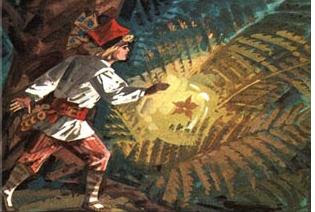
The Fern Flower: In the Footsteps of a Popular Fantasy

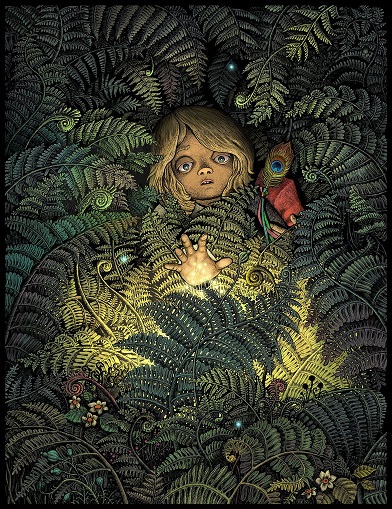
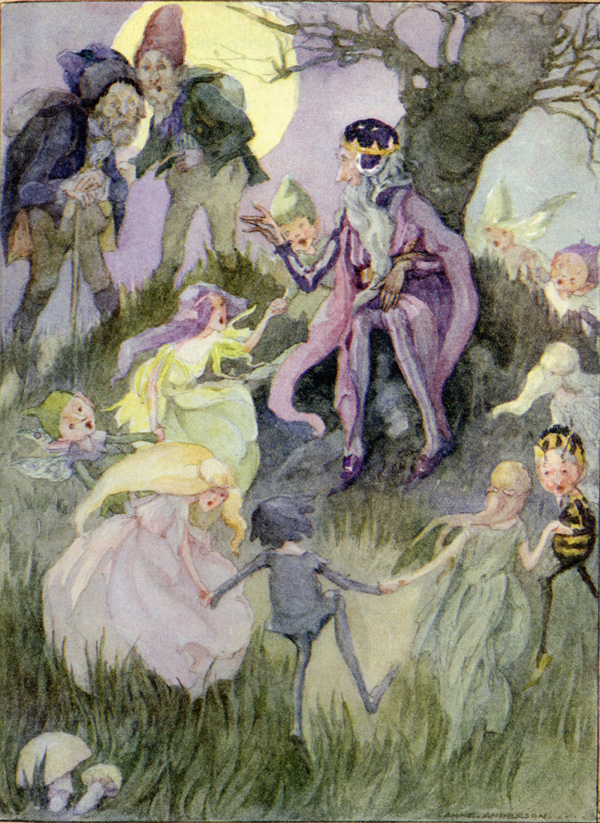
Maria Orłowska-Gabryś (1925-1988). Illustration for a children’s book.

Ferns are unique plants in our ecosystems. While most of the plants around us reproduce through flowers and fruits, these adopt a different strategy, based on spores, which is now well known, but which remained enigmatic for a long time. This specificity, it goes without saying, was scientifically translated by the classification of ferns within an original taxonomic group, namely the division of Pteridophytes, which also includes horsetails and lycopods. But while we now understand how they work, ferns have long been a source of incomprehension. How could they reproduce without flowers and seeds? In the Middle Ages, for example, people did not understand why it was possible to find young fern plants, but never a single seed anywhere. Only one solution could explain this phenomenon: that the seeds of the fern are invisible. One deduction leading to another, since fern seeds were invisible, there must also be invisible flowers… which would therefore be capable – according to a logic quite typical of the time – of making invisible whoever found or consumed them (1) ! This was all it took for the popular imagination to unfold, and make the mythical fern flower a sort of plant Grail, an extremely rare marvel endowed with extraordinary properties. The fact is that the legend of the fern flower is extremely widespread throughout Europe, presenting quite astonishing similarities.

The fern flower across Europe

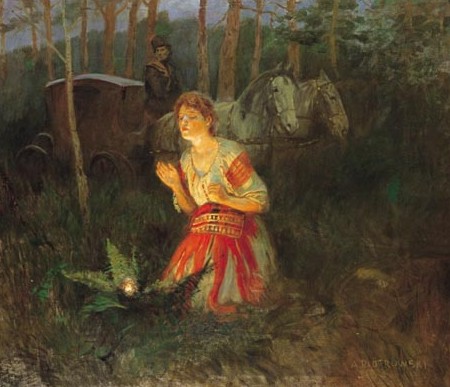
In fact, the fern flower is not perpetually invisible, for then it would simply be impossible to find. On the other hand, it only appears at a specific moment in the calendar, at a well-defined hour in the middle of the night, very briefly, and in a particularly remote and inaccessible place in the forests. One of the main common points in the legends relating to the fern flower is indeed its dated appearance. In the vast majority of cases, the famous night of flowering is that of Midsummer, or immediately before or after; in any case related to the summer solstice. The belief is particularly widespread in the northern and eastern countries of Slavic tradition, where the fern flower is said to develop during a night from June 21 to 24. This is the case in Poland, Estonia, Lithuania, Finland and Latvia. It is therefore linked to the celebrations of the solar cycle, of pre-Christian origins, but which have merged with the festivals of Saint John. In Finland, for example, we speak of the festival of « Juhannus, » or that of « Jani » in Latvia, or « Rasos » in Lithuania. It should be noted that in Poland, the fern flower could be observed not only at the summer solstice, but also at the time of the winter solstice (2). In any case, we understand that it appears on emblematic dates strongly linked to the influence of our luminous star.

While the belief is particularly strong in Eastern and Northern countries, it also exists in Western Europe. In England, it is said that on the eve of Saint John (once again), in the dead of night, the fern produced a single flower and that the villagers would then spread a sheet underneath to collect the seeds. No one ever became invisible, but the legend continued to be believed, to the point of performing rituals in the forest during the fateful night, until the church came to put an end to these obviously pagan practices. However, F.E. Corne mentions the testimony of a gentleman named Mr. Heath who, in 1779, still claimed to have participated several times in fern seed harvesting ceremonies during the nights of Saint John. And the man added that there were, however, disappointments, « because the fairies often stole the seeds » (3). Thus, we see that the fern flower is not a fantasy specific to Eastern countries. Moreover, what about the French tradition? Here again, we find local anecdotes or legends that refer to the concept. For example, Paul Sébillot tells us about traditions of this type, again linked to Saint John’s Day, in Lower Normandy, Touraine, and Brittany (4). He also attests to several songs and anecdotes evoking the harvest of the hypothetical « fern seed. »

Flowering always takes place in the middle of the night, never during the day. In many cases, it even occurs at a precise and symbolic time, and over an extremely short period of time. Thus, in Sweden, it blooms at midnight and immediately fades (5). The same is true in Polish traditions, where it is said to appear at midnight at the same time as a sound sometimes described as a crack, a crash, or a thunderclap is heard (6). In Lower Normandy as well, it blooms at midnight, and its seed must be harvested before it falls to the ground to benefit from its properties (7). A second later, the flower is no longer discernible (8). It is also at midnight that it can be found in Touraine, or at least it is at this time that it produces its seeds, at the same time as the clovers develop additional leaves to have four or five leaves (9). Furthermore, Paul Sébillot transcribes a very interesting Renaissance shepherd’s song: « In a bag the fern seed / That at midnight we gathered in the past / Denis and I, the eve of Saint-Jean » (10).

So now we know where and when to look for the fern flower, depending on local traditions and customs… However, we still don’t know what it looks like. What is it? The question is eminently complex, since its rarity makes it, by nature, a phenomenon never observed by most mortals. Beliefs in the fern flower attribute to it a multitude of characteristics, sometimes contradictory, but which generally make it an absolutely sumptuous spectacle. Thus, Slavic traditions imagine it to be red, gold or violet (11). In England, rumors rather evoke the birth of a pale blue flower, which quickly transforms into a golden seed (12). Reviewing the pictorial representations of the fern flower will convince us of its great heterogeneity: it can sometimes have five petals, sometimes many more; it can be imposing or on the contrary tiny; it can be found at the top of a long stem, but also be hidden under the leaves, at ground level; It can be palpable or resemble a phantom organ… Yet, the attentive observer will notice a commonality among all these images: the mysterious inflorescence is always depicted in a golden halo, surrounded by a dazzling glow that seems to burst from its petals. Does this stem from its unique relationship with the sun? Indeed, it is only visible in most legends at the time of the summer solstice. Of course, this detail also underlines its supernatural character. The fern flower seems to have sprung from another world, fallen from paradise, like a sacred relic protected by grace.

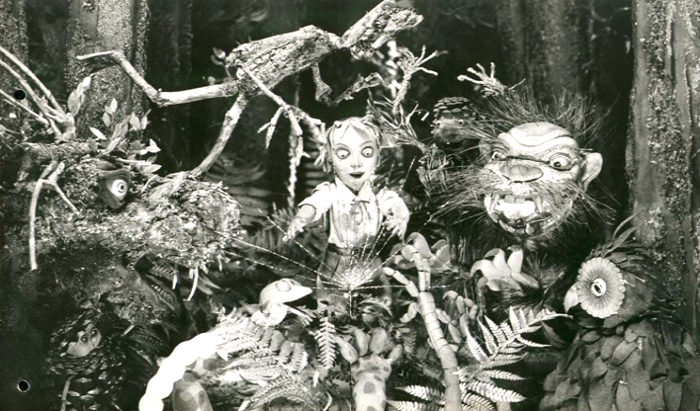
Such a treasure could only stimulate the imagination, and it is therefore not surprising that the fern flower is used in works of fiction. In addition to popular legends, we find books mentioning it, particularly in Eastern countries where it occupies an important place. The legend is mentioned in a book by the Finnish Aino Kallas, dealing with ancient folklore: The Wolf’s Bride (13). It is also cited by Andrus Kivirähk. In The Man Who Knew the Language of Snakes, the Estonian author mocks it, presenting it as a naive belief (14). In Poland, the fern flower is sometimes the subject of poems, such as that of Adam Asnyk (Kwiat paproci) some of whose verses can be translated as follows: « A strange fern flower blooms in the forests / For a moment in the mysterious shadow / The whole world is gilded with a magic light / But you can only touch it in your dreams » (15). Henri Pourrat, a French writer, collected the legend orally in Auvergne and transcribed it in Contes et légendes du Livradois, released in 1989 (16). Finally, there is a short animated film dedicated to the fern flower, produced by Ladislas and Irène Starewitch in 1949 (17). It features a little boy named Jeannot, who decides to go in search of the treasure on the night of Saint John’s Eve…

Screenshot from the animated film « Fern Flower » by Ladislas and Irene Starewitch. 1949.

The Powers of the Fern Flower

As we have already touched on, the fern flower is coveted because it is believed to possess extraordinary properties. The most widespread of these is to bring its possessor incredible wealth. This is the most material version of the myth, which sees the discoverer living in abundance for the rest of his life, surrounded by jewels and chests overflowing with gold. For example, the fern flower brings fortune in Estonian traditions, but also among the Poles (18) and France. In Upper Brittany, it is said that fern seeds collected on Midsummer Night must be thrown onto a field to reveal the location of the treasures (19). In many legends, however, and as we will soon see in detail, the fortune gained is a curse, punishing the seeker’s greed.

When it is not specifically wealth that our mythical flower brings, it is more generally luck. This motif is also extremely common, from Russia to France. In Poland, it was sometimes believed that the fern flower was the Ophioglossum (Ophioglossum vulgatum). It was then said to bring success in love. In our countries, the ferns harvested on the night of Saint John, and a fortiori the hypothetical flowers of these ferns, were supposed to make you win at all games (20).

« bubug » on Deviant Art. Jack and the Fern Flower.

Here and there, the fern flower brings magical powers to the discoverer; extraordinary abilities that tend to blur the line between tale and reality. As mentioned in the introduction, since the fern flower is invisible most of the time, it has sometimes been assumed that it could itself confer invisibility (21). This is a way of thinking quite typical of the Middle Ages, and which is not without evoking the theory of signatures which states that a plant resembling an organ has an action on it (the liverwort, whose leaf shape recalled the liver, should thus be able to heal it). In any case, this property was attributed to the fern flower in Poland, but also to its seed in Lower Normandy. In Poland, it was also said that the fern flower could unlock any lock, but also bring clairvoyance to its possessor. This echoes another Norman rumor, which held that the seed allowed one to know the secrets of the present and the future (22). It has also been suggested that it gave one the ability to move from one place to another as quickly as the wind, or to speak to animals (23).

As a sexual organ, the fern flower is also a provider of fertility, and it has been used metaphorically to evoke carnal love. This point brings us to the symbolic implications of this mysterious treasure of nature which, far more than a simple popular belief, hides between its petals profound considerations about human nature and its vagaries.

Symbolic significance of the fern flower

First of all, and as we have just noted, the fern flower is in some places a symbol of love. Midsummer Night, placed under the auspices of the sun, has always been marked by the idea of ​​encounter and seduction, as well as by fertility rituals that concern the earth, certainly, but also people. In the Baltic countries, young couples would go to have fun in the woods and it was said that they were going to « look for the fern flower » (24). In reality, it was a much less hypothetical flower that was picked: that of love. Moreover, it can be suggested that the true enchanted seed, growing from this famous fern flower, is allegorically the one that would, about nine months later, give birth to a new being. This night was indeed magical and, it was believed, propitious to procreation. From then on, the fern flower represents in some way the mystery of life; the primordial magic of existence and of the entire cosmos. A symbol of fertility, it’s no surprise that it gave its name to a Latvian NGO promoting sexuality education (Papardes zieds).

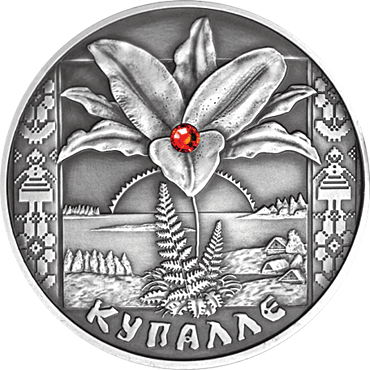
This conception of the mysterious inflorescence is still observed among Slavic peoples, where Midsummer’s Day corresponds to « Kupala Night » (25). Young people are seen there delving into the woods during the night, searching for the hypothetical « fern flower, » with girls wearing plant crowns in their hair. If a boy emerges from the thickets brandishing one of these, it means that the couple is engaged and that a marriage will soon take place. Here again, the fern flower takes on a metaphorical meaning; an allusion to romantic union and probably to carnal relations in nature. This tradition is in keeping with the holiday in question, since Kupala is an ancestral goddess of herbs and magic, but also of sex. Furthermore, linguists believe that its etymology may have a connection, albeit distant, with the Latin word « cupido, » meaning « desire » and relating to the well-known god, Cupid, who delivers his arrows of love into hearts.

But the fern flower is also and above all a symbol of the unattainable, like the mythical Grail so ardently sought and never discovered. It is the object of a romantic and passionate quest, where the journey and the trials seem to matter as much, if not more, than the treasure that motivates them. For, in fact, the fern flower is reputed to be impossible to pick, and even to observe. In Poland, it is said to be nestled in a remote and wild place, a thousand miles from any civilization, since one must not be able to hear the slightest bark of a dog there (26). Moreover, it is difficult to access simply because of its rarity. Often, legends imply that the fern flower is unique… Thus, the seeker would have to be precisely at the place where it grows, and at precisely the right time due to the ephemeral nature of its flowering; in Sweden, it is sometimes said that it only occurs at midnight sharp (27). It therefore takes a rather crazy set of circumstances to get one’s hands on this plant treasure. Worse still, some traditions believe that anyone looking for it has no chance of finding it, for the simple reason that it can only be discovered accidentally… or in dreams as in the poetry of Adam Asnyk (28).

As if all these insoluble parameters were not enough, the fern flower is often protected by supernatural means. In Poland, it grows in the heart of uroczyska, natural spaces endowed with magical power and generally linked to ancient pagan cults (29). It is also protected from various enchantments in Swedish legends, for example. In many cases, it is explicitly the forces of the devil that guard it, an idea found in the French countryside. Polish traditions often place it in places where witches roam, but also creatures typical of local folklore such as bies or czart (demons) (30). This explains the Christian venerations that, it is often said, must be practiced by anyone wishing to approach the fern flower. Prayers must be said, of course, but the adventurer must also have blessed artifacts, such as a rosary or a white tablecloth taken from the church altar. However, the rituals performed are sometimes much more bizarre and strange. It is believed that one can approach the mythical flower by arming oneself with mugwort and stripping naked (31). To take it with oneself, it is also said that one must absolutely forbid any backward glance, under penalty of suffering great misfortune; like Lot and his wife in the Old Testament, whom the angels formally forbade from turning around when Sodom is subjected to a deluge of fire (32).

From this, it is clear that the fern flower is a kind of plant Grail; an archetype of inaccessible preciousness, and consequently a passionate, mysterious, and unfathomable fantasy. But as such, it also embodies the dark side of dreams, like a symbol of the vain obsession leading Man to the fall. Like the sun burning the wings of Icarus trying to climb too high, the sacred inflorescence lowers the pride of those who think they are clever enough to pick it without fear. To illustrate this idea, traditions often specify that the fern flower certainly allows one to obtain fortune, but that it cannot be shared without it suddenly evaporating. The discoverers then see their family and friends sink into poverty, while they achieve a prosperous existence… but oh so unhappy. They suffer jealousy, and above all realize that, to paraphrase the famous phrase from Christopher McCandless’s notebook in Into the Wild, « happiness is only real if it is shared » (33). In some versions, the futile obsession with material wealth leads to an even more tragic outcome. We see the protagonist embark on his quest by denying his friends and family, cutting all ties with his humanity, and finally finding the fern flower deep in the woods. He then believes he is living in glory, blazing with wealth, then suddenly realizes what really matters to him and finally returns home. But of course, as expected, there is no one to welcome him back to his home village. On the other hand, he reads the names of those he loves on the crosses in the cemetery (34)… Here again, the fern flower is thus adorned as a cursed artifact, leading the greedy man to loss and suffering.

A vehicle for moral reflection, the legends of the fern flower often help to put the importance of earthly wealth into perspective, by drawing parallels with values ​​such as friendship, love, piety, or spirituality. In a Polish oral tale, for example, there is a story about a young shepherd who loses a cow he loves very much in the woods. He naturally sets out to find it and, in the dead of night, so obsessed with his animal, fails to notice the strange flower he stumbles upon, a petal of which gets stuck in his shoe. Sumptuous visions then invade his mind, revealing hidden treasures and various paths leading to chests filled with gold. Of course, he also spots his beloved cow, and suddenly knows where to go to find it. He then returns with her and, exhausted, goes to bed, promising himself to go and find all the riches of his dreams the next morning… But at that moment, he takes off his shoe and drops the fern petal, which fades during the night and loses all its powers, making him completely forget in the early morning what seemed so clear to him the day before. The little shepherd, however, does not make a big deal of it, and that is the moral of the story: he has found his cow, and that is all that matters to him (35). A wise character, he knows that fortune would not have made him happier. Thus, through these few examples, we see that there is much more behind the fern flower than a simple imaginary treasure; it is an element rich in symbols, and among other things an incarnation of the vain and futile quest, of the thoughtless and pretentious obsession that distances one from appeasement.

***

The fern flower is therefore an absolutely fascinating motif in several respects. It testifies to human obsession with the unknown and mystery, and more generally with everything that escapes the distressing materiality of everyday life. It also shows the major role that nature plays in popular traditions, and therefore in people’s imagination and dreams. Moreover, the existence of fern flowers in both Slavic and English beliefs shows us once again the incredible cultural transfers that take place between peoples, even at a time still devoid of modern means of communication. Finally, the case of the fern flower also reveals the great diversity of interpretations that a simple myth can generate. The plant relic can be a romantic or sexual metaphor, but also symbolize the inaccessible and punish human vanity. It also reveals the divine fantasy that drives us, leading us to dream of magical powers, teleportation, invisibility, or animal communication.

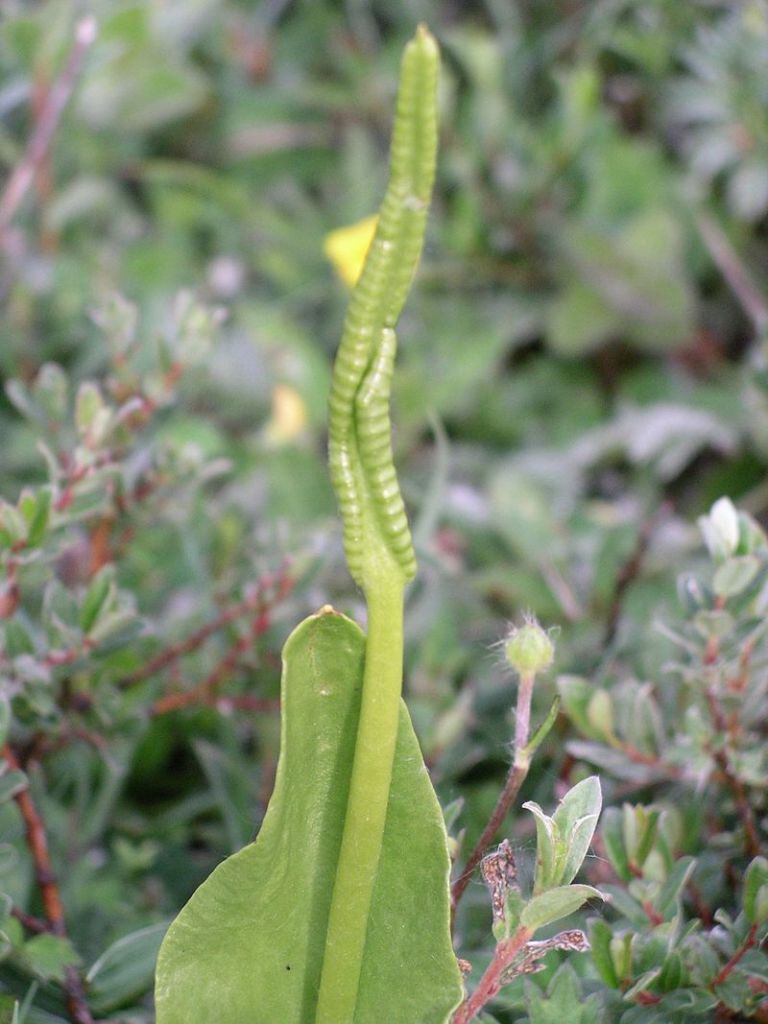
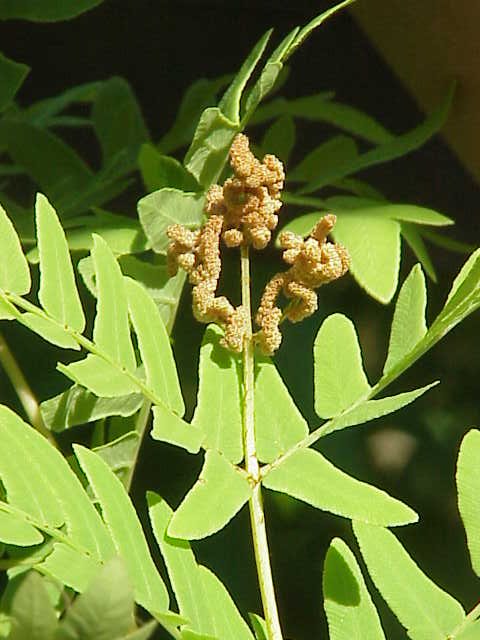
However, could the fern flower be nothing more than a pure fabrication of the mind? Could it find no basis in the everyday observations of ancient inhabitants? We have already had the opportunity to outline an answer to this question, showing that the myth stemmed from a simple observation: that ferns did not produce visible flowers, unlike « classic » plants. Nevertheless, some pteridophytes sometimes display atypical organs, or exhibit shapes that could be likened to inflorescences. Thus, could the inspiration for the fern flower be the « spikes » of the tropic flower (Ophioglossum vulgatum)? This plant could be relevant due to its rarity. Could it not also be the fertile fronds of the German fern (Matteuccia struthiopteris), forming upright clumps that the imagination can quickly liken to a strange flower? And what about those of the royal fern (Osmunda regalis), sprouting from the tips of tall, even more impressive stems? In this case, the species is entirely characteristic of humid forests, and could therefore be at home in the remote valleys described in legends…

Of course, all these questions will remain forever unanswered, and that’s undoubtedly for the best. The fern flower will always be a mystery, a fantasy, a marvelous belief in the minds of men, allowing them to escape the material world. Who knows? Perhaps it does indeed unfold in the heart of a dense and unexplored forest, somewhere on our Earth, hidden from view, during a few blessed moments of a summer night. In any case, it is certain that it blooms within us, in our heads and in our hearts, as do all our wildest dreams.

Pablo Behague, « Sous le feuillage des âges ». Décembre 2024.

**

1 F.E. Corne, 1924, Ferns : Facts and Fancies about Them : II.
2 Lamus Dworski, 2016, Polish legends: the Fern Flower.
3 Corne, 1924, Ferns : Facts and Fancies about Them : II, op. cit.
4 Paul Sébillot, 1904, Croyances, mythes et légendes des pays de France.
5 Gustaf Ericsson, 1877, Folklivet i Åkers och Rekarne härader.
6 Dworski, 2016, Polish legends: the Fern Flower, op. cit.
7 Sébillot, 1904, Croyances, mythes et légendes des pays de France, op. cit.
8 Louis Dubois, 1980, Recherches sur la Normandie.
9 Sébillot, 1904, Croyances, mythes et légendes des pays de France, op. cit.
10 Sébillot, 1904, op. cit.
11 Brendan Noble, 2021, The Fern Flower – Magical Flower of the Slavic Solstice – Slavic Mythology Saturday.
12 Corne, 1924, Ferns : Facts and Fancies about Them : II, op. cit.
13 Aino Kallas, 1928, Sudenmorsian (La Fiancée du loup).
14 Andrus Kivirähk, 2007, Mees, kes teadis ussisõnu (L’Homme qui savait la langue des serpents).
15 Adam Asnyk, 1880, Kwiat paproci (Fleur de fougère).
16 Henri Pourrat, 1989, Contes et récits du Livradois.
17 Ladislas Starewitch et Irène Starewitch, 1949, Fleur de fougère.
18 Dworski, 2016, Polish legends: the Fern Flower, op. cit.
19 Sébillot, 1904, Croyances, mythes et légendes des pays de France, op. cit.
20 Sébillot, 1904, op. cit.
21 Corne, 1924, Ferns : Facts and Fancies about Them : II, op. cit.
22 Sébillot, 1904, Croyances, mythes et légendes des pays de France, op. cit.
23 23 juin 2011, « Paparčio žiedo legenda – būdas kiekvienam pasijusti herojumi », Delfi.
24 Adam Rang, 22 juin 2022, « Fire, flower crowns and fern blossoms: Midsummer night in Estonia explained », Estonian world.
25 Ullrich R. Kleinhempel, 2022, Seeking the Fern Flower on Ivan Kupala (St. John’s Night).
26 Dworski, 2016, Polish legends: the Fern Flower, op. cit.
27 Ericsson, 1877, Folklivet i Åkers och Rekarne härader, op. cit.
28 Asnyk, 1880, Kwiat paproci (Fleur de fougère), op. cit.
29 Dworski, 2016, Polish legends: the Fern Flower, op. cit.
30 Dworski, 2016, op. cit.
31 Dworski, 2016, op. cit.
32 Auteur inconnu, VIIIe-IIe s. av. J.-C., Bible – Ancien Testament.
33 Jon Krakauer, 1996, Into the Wild.
34 Dworski, 2016, Polish legends: the Fern Flower, op. cit.
35 Dworski, 2016, op. cit.

You can follow my news on Instagram: https://www.instagram.com/sous.le.feuillage.des.ages/

The deer: an animal from the Otherworld

Mostly discreet, the deer becomes the noisiest and most boisterous inhabitant of the forests in September. Its roar then resounds at nightfall or dawn, sometimes during the day, making the few humans who wander nearby shudder. There is something deeply mysterious, almost supernatural, in this hoarse and intense cry, which, like thunder in the heart of darkness, seems to emerge from the very bowels of the earth. With a little imagination, one could quite easily believe it came from a parallel dimension, from an unknown and unexplored country… in short, from the Other World dear to Celtic mythology. That being said, it is not surprising that this « king of the forests » has been considered, from Antiquity to the present day, as a symbol of passage between life and death, and more generally between reality and the unreal. We then speak of a « psychopomp » animal, that is to say, one that allows the transfer between worlds, the journey of souls from Earth to the Beyond. It is precisely this aspect of the deer that we will try to clarify, through wanderings that will take us from Celtic Ireland and lead us to Hogwarts.

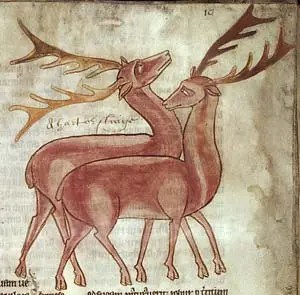
Two deer in an English bestiary. Circa 1220-1230.

The Pursuit of a Stag to the Otherworld: A Classic Motif.

We must first address an extremely common narrative pattern, in which a character sets out in pursuit of a stag that, more or less subtly, leads him astray until he reaches another world. Very often, this encounter takes place during a hunt, during which the hero becomes separated from his companions without realizing it. This motif is observed repeatedly in Celtic mythology, both Irish and Welsh.

Regarding the first, we can consider the story of Oisin, son of the famous Finn. He is hunting with his father, chasing stags, when, in the middle of the forest, he spots a young woman of supernatural beauty, riding a dazzling white horse. The lady in question turns out to come from a distant kingdom called the « Land of Youth » and, in love with Oisin, she invites him to join her there. After an emotional farewell to his people, our hero sets off with the beautiful stranger on his steed. However, during their travels, several clues are scattered throughout the manuscript to indicate to the reader a gradual passage towards the sidh, that is to say towards the land of the Tuatha-de-Danann, who are the Celtic gods. For example, they see « a young girl at the top of a wave on a brown steed, holding a golden apple in her right hand. » However, the apple is a marker of paradise, of which one will be convinced by thinking of the Garden of Eden or King Arthur’s final resting place, the Isle of Avallon. But above all, and this is precisely the detail that interests us, they see a « hornless doe leaping nimbly while a white dog barks behind her. »[i] Thus, the animal symbolically leads Oisin to the Otherworld, twice: first by leading him to Niamh, then by accompanying him to the « Land of Youth. » After a few years, however, Oisin begins to miss the landscapes of Ireland, and he decides to leave despite his wife’s warnings. Upon returning to his homeland, he recognizes nothing. Three hundred years have in fact passed, and when he realizes it, the unfortunate mortal falls from his horse, dead.

In Welsh mythology, too, it is the hunt for a deer that leads Pwyll, lord of the kingdom of Dyfell, to come into contact with the Otherworld. While wandering through the woods, he hears dogs that don’t belong to him barking nearby. Approaching, he discovers a deer in a clearing, which a mysterious pack of white animals with red ears is attacking. Pwyll scares them off and sets his own hounds on the prey, until he sees a rider coming towards him. This rider is a man named Arawn who, as the color of his dogs suggests, comes from the Otherworld. He accuses Pwyll of not respecting the rules of the hunt by stealing the deer he was chasing. Therefore, to atone for this affront, he offers him a pact: the two will have to trade places for a year. In addition, Pwyll will have to face a certain Havgan, Arawn’s enemy. In this myth, from the first branch of the Mabinogion, Pwyll is led to the Other World by the pursuit of a deer, which leads him to meet a supernatural being who opens the door for him[ii].

This encounter with a marvelous knight through a deer hunt is found in the Lai de Tyolet, an anonymous poem from the Middle Ages that fits into the framework of Arthurian legends[iii]. It depicts a young man living with his widowed mother in the forest, and to whom a fairy gave at birth the ability to attract animals by whistling. But one day, he sees a deer that does not approach and which he therefore decides to follow. This one leads him to a second deer, then crosses a river. Tyolet then loses interest and kills the newcomer. However, when he raises his head, he realizes with amazement that the first deer has transformed into a knight, who is watching him from the other side of the river. Having never seen such an individual, he asks him a multitude of questions, until his interlocutor orders him to return home to don his father’s armor. Afterward, Tyolet goes to Arthur’s court where he experiences new adventures, culminating in his marriage to a mysterious princess. Thus, it is once again the trail of the deer that leads our hero to the supernatural, in this case to a shapeshifting knight, the incarnation of the Otherworld and magic.

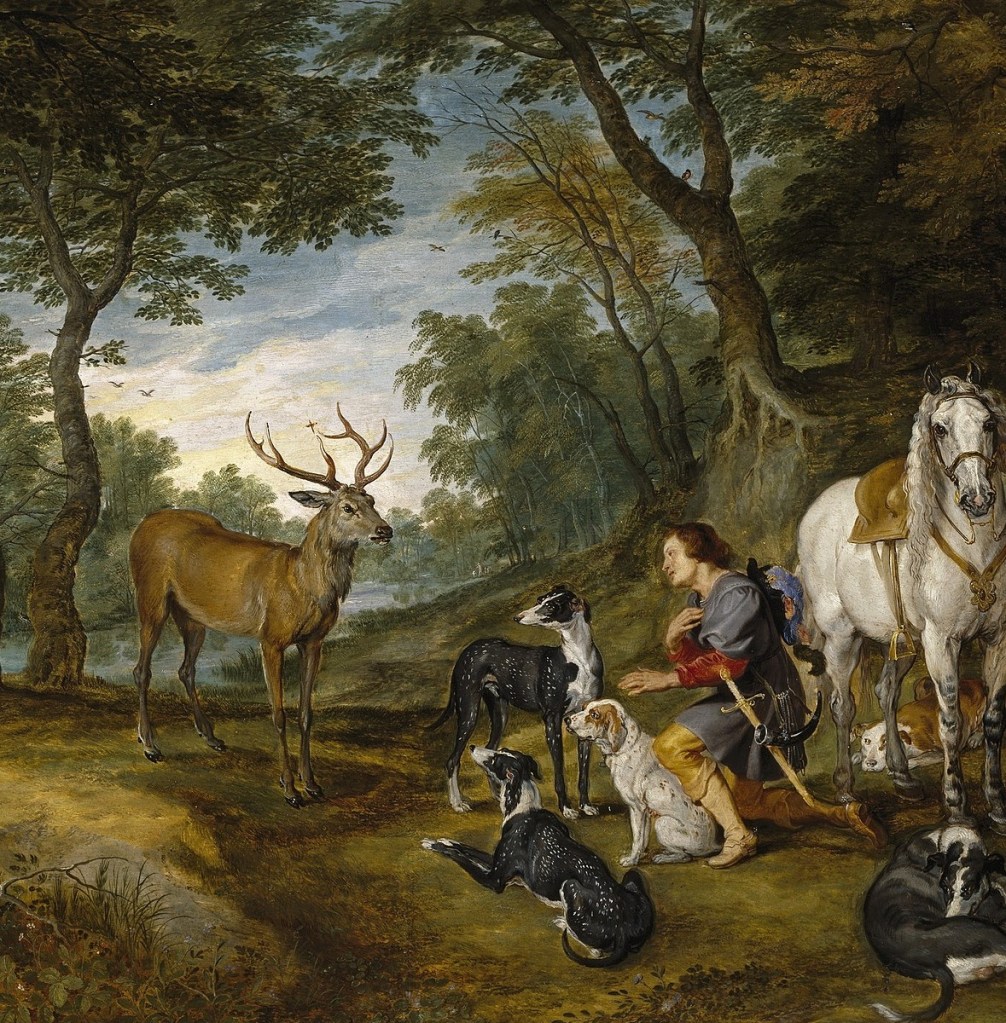
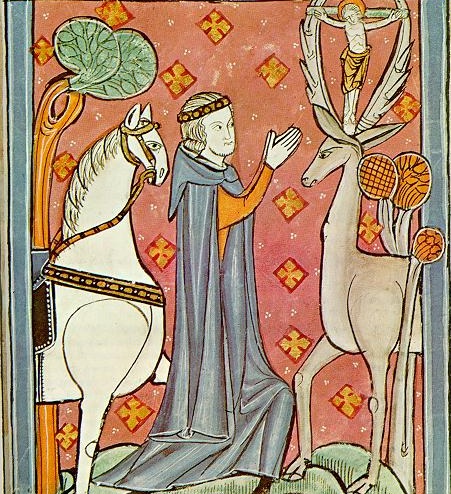
The Christian imagination is not lacking in this regard, and even offers us a quite unique psychopomp figure: that of the crucified deer, an allegory of Christ and the divine light illuminating man. This enigmatic creature is found as much in the Legendary Lives of Saints Hubert and Eustace as in a tale about a Scottish king named David. The first, Hubert, was a lord so passionate about hunting that he forgot his moral obligations. His sin is such that he even goes so far as to practice his favorite activity on Good Friday (that is, on the date commemorating the death of Jesus). It is precisely on this day that he encounters a deer that immediately strikes him as extraordinary: it is completely white and bears a glittering cross between its antlers. Hubert begins by tracking the animal, but is abruptly interrupted when a voice rises from nowhere and addresses him in these terms: « How long will you pursue beasts in the forests? How long will this vain passion make you forget the salvation of your soul? » The lord ends up prostrating himself and following the advice given to him, converting and dedicating his life to the Church[iv]. The motif is more or less the same in the story of Saint Eustace. As a Roman general, he was chasing a herd of deer when he noticed that one of them was clearly more beautiful and larger than the others. He decided to chase it until it caught up with him and saw a crucifix between its antlers. The animal then spoke to Eustace and claimed to have come to save him, leading him to the one God[v]. Finally, as for David, the Scottish king, he was already a Christian in 1128 when he crossed paths with the Christ-like deer. It attacked him and forced him to defend himself by grabbing its antlers. It was only then that he saw the cross, which would later inspire him to found Halyrood Abbey (whose etymology comes from « holy cross » in Scots)[vi].

In the three cases we have just discussed, the deer therefore leads the characters to the beyond, the immaterial spheres of existence, in this case by leading them to God. It encourages them to abandon human futilities to join something greater and more spiritual, an « other world » in short. The Christian allegory represented by the deer owes nothing to chance. Let us recall that this animal has the particularity of losing its antlers every year… but also of seeing them grow back. In this respect, it is the image of the cycle of death and resurrection, which of course brings us back to Jesus. Thus, the deer, like Hermes in Greek mythology, is the messenger and ferryman between the world of the living and that of the dead; between material reality and the mystical dimension.

The legendary figure of the white stag.

We have observed that, in most of the episodes narrated above, psychopomp stags are distinguished more or less subtly from their fellow creatures by physical or behavioral characteristics: they can be larger, more agile, more beautiful, faster, transform into knights, or even carry a dazzling crucifix between their antlers. But the most widespread and reliable criterion that allows us to suspect a world-crossing stag is its color. In many cases, in fact, the creature in question is white, either entirely or partially. In Celtic mythology, this singularity is specific to all animals from the Otherworld, and it is sometimes accompanied by red portions, such as the eyes or ears (remember, for example, the dogs of Arawn). The Middle Ages, however, continued this tradition by focusing more on the deer than on other mammals.

Thus, we find the mention of a white stag in the Lancelot-Grail, this cycle of novels related to the Knights of the Round Table and the quest for the legendary chalice. However, this mysterious creature once again merges with the figure of Christ, intimately linked to the Grail since it is believed to be the container used during the Last Supper. It is first Lancelot, the knight-sinner, who sees the animal. He wears a gold chain around his neck and is surrounded by six lions, « who guarded him as preciously as a mother her child. » Guinevere’s lover encounters the same procession a little later, this time in the company of the magician Mordred, and both try to follow him before being interrupted by two knights who throw them to the ground. It is finally Galahad, the knight with the pure heart, escorted by Perceval and Bohort, who manages to accompany him to a hermitage where an old man is saying mass. Then a phenomenon occurs which proves beyond doubt the supernatural character of the white stag, and its connection with the Other World: « The Stag indeed seemed to them to become a man and, on the altar, he took his place in a magnificent seat. » The four wild beasts then transform into four winged creatures representing the evangelists – the human, the lion, the ox and the eagle – and leave carrying the seated individual. It is finally a voice from the beyond which reveals the true nature of the said individual: « It is thus, » she says, « that the Son of God descended into the Virgin Mary, without her losing her virginity. »[vii] The white stag is therefore Christ. The animal symbolically leads to God, as much for Hubert, Eustace and King David as for Galahad and his companions.

Lancelot and Mordred crossing the white stag escorted by lions. 13th century.

However, this strange mammal is not always surrounded by biblical sanctity. In the Lay of Graelent, for example, a medieval text written by Marie de France, the white doe does not lead the knight to God, but to a beautiful naked woman bathing in a fountain with two maids. Graelent, having just rejected the queen’s advances, becomes passionately infatuated with her, stealing the clothes she had hung on a tree. A rape scene ensues, leading incomprehensibly to a consensual love affair. But we learn a little later that the lady is not entirely human, since she offers to appear to Graelent wherever and whenever he wishes. In reality, she is more like a fairy, which the pursuit of the white stag could easily have led us to believe. She ends up taking Graelent to the Otherworld, from where he will never return.[viii]

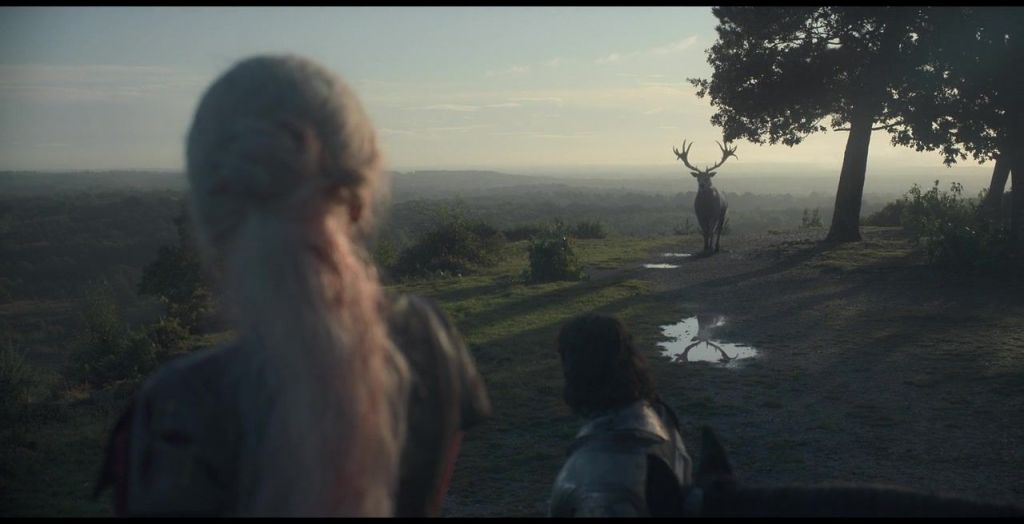
It is interesting to note that the figure of the white stag crosses the centuries, and is found in contemporary works that are familiar to us. Often, it appears to the protagonists in the context of a hunt, which underlines the persistence of the same motif from Celtic Antiquity to the present day. However, those who are lucky enough to cross its path are not necessarily inveterate hunters, but rather singular, gentle beings, whose temperament contrasts precisely with the noise and fury of the hunt. For example, in House of the Dragon, which is a series focusing on the reign of the Targaryens more than 150 years before the birth of the famous Daenerys of Games of Thrones, there is talk of a hunting party organized by King Viserys[ix]. However, this is linked to the rumor that a white stag is found in the surrounding forests. It is then considered that the mammal could be used to decide between the heirs who are fighting over the future throne, namely Rhanyra and her half-brother Aegon. However, when the former finally meets the mythical animal, she simply refuses to harm it. They observe each other for a long time, and this interaction alone convinces her that she is indeed the rightful heir. Here, the stag thus plays its role as « king of the forest »; it chooses the future monarch. However, it also takes on an obvious supernatural character, which the stag’s staging emphasizes in various ways. The young girl is in fact isolated with Sir Criston at the moment of the meeting, while a large crowd is participating in the hunt. Moreover, the scene is calm and silent, and thus contrasts with those that precede and follow, where the din of dogs, shouts and horns resounds from all sides. Finally, it takes place in an open area, with a bright setting, which is distinguished from the dark forest where the men are riding [x].

The White Stag Encounter in House of the Dragon. Season 1, Episode 3. 2022.

The motif of the white stag hunt is also found in The Chronicles of Narnia, but this time the animal plays the opposite role from the one we usually know it for. While the creature usually escorts humans to the wonderful world, here it is the one who leads the children out of the parallel kingdom and back to their rooms. At the end of the first volume, in fact, when Peter, Susan, Edmund and Lucy have become kings and queens of Narnia, they learn of rumors about a white stag wandering the forests of the country; a white stag capable of fulfilling the wishes of whoever can catch it. They go hunting and eventually spot its trail. But the white stag does not let itself be captured so easily and leads them deep into the thick undergrowth… until they reach a street lamp. There, they regain the memories of their previous lives and find themselves, unwittingly, in the wardrobe that had once led them to Narnia. [xi] From then on, the stag once again plays the role of ferryman between worlds… but in an unusual way, as it dispels magic to escort the children back into modern society.

In the video game The Elder Scrolls V: Skyrim, a quest also involves hunting a white stag in order to communicate with a spectral and supernatural creature named Hircine. This creature cursed a certain Sinding, causing him to become an uncontrollable werewolf who tore a little girl to pieces and was imprisoned. The origin of this spell is the theft of a ring, which the player must return to Hircine to free Sinding. However, there is only one way to contact him: to do so, one must find and kill the mythical white stag. Thus, the deer is once again an intermediary between worlds, a bridge between reality and the spectral dimension inhabited by Hircine; which, incidentally, appears in the form of a ghostly stag. [xii]

Let us note, in conclusion, that the white stag is, in fiction, a fantastical, fairy-like animal, like the unicorn, to which it is symbolically very close. However, unlike the latter, it has a real existence attested by science. Indeed, our forests are indeed populated by white stags, which are in fact affected by leucism; this pathology causes paleness in various parts of the body, including the skin and hair. It goes without saying that these individuals are exceptional, and they often become famous in the region where they live. The Isle of Arran in Scotland, for example, was said to have been home to a white deer in the 1960s, and legend has it that others have been spotted since. In any case, the animal is now the mascot of the island and the brand of whisky produced there.

The deer between life and death.

In the Camonica Valley, in Lombardy, lies one of the largest collections of petroglyphs in the world. However, a study of the discovered figures shows that the deer already occupied a privileged place in the human imagination in prehistoric times. The animal is depicted being hunted, certainly, but also in the form of anthropomorphic creatures with antlers, which could correspond to deities. [xiii] This strong representation of the deer in rock art is common to most of the major known sites, and one can therefore wonder about the symbolic role played by this animal. It is not impossible that it already occupied a psychopomp function, allowing the passage of deceased souls to the divine spheres.

A prehistoric deer on the rocks of the Camonica Valley.

While penetrating the minds of such remote times, and in possession of such limited sources, is utopian, it can be affirmed that the deer of the Celtic era forged a unique relationship with the world of the dead. Moreover, the deer that became our « king of the forests » was associated with the concept of eternity, as if the notions of life and death did not interfere with the existence of this pure and enchanted being, who straddled the border connecting the two states. In this regard, it is worthwhile to examine a particular deer from the Irish tale of Culhwch and Olwen.

This story features a young man named Culhwch who, due to a curse from his stepmother, falls in love with a certain Olwen, the only woman he can marry, but who, to his great misfortune, is the daughter of the terrible giant Yspaddaden. The monstrous stepfather in fact conditions his protégé’s hand in a series of seemingly impossible tests, some of which can only be achieved with the support of a supernatural being named Mabon, « divine son. » But it turns out that Mabon was abducted at the age of three by his mother and that no one knows where he is. Culhwch then gets help from a certain Gwrhyr, who has the particularity of being able to speak to animals and who begins to investigate among the inhabitants of the forest. Now, one of them is the Redynvre stag, who explains to Gwrhyr that when he arrived at this place, there were no trees except for a young oak, which has since grown to become an « oak with a hundred branches, » then perished, becoming nothing more than a dried-up stump[xiv]… It goes without saying that the cervid’s mention of the tree is intended to emphasize the immense span of time that has passed, especially since it refers to the life cycle of an oak tree, renowned for its longevity. Thus, the stag symbolizes supernatural old age, eternity beyond death… It does not pass away and straddles the boundary that separates the world of the living from the world of wonder.

This immortal quality, of course, testifies to a magical essence. Indeed, it is found in the most famous magician of the Middle Ages, and perhaps even of all time: Merlin. Indeed, despite the fact that there is a « Merlin’s tomb » in the forest of Brocéliande, the wise protector of the Round Table generally does not die in the stories we know about him. Better still, his extraordinary old age and fantastic longevity are frequently emphasized in the manuscripts. Born of magic, he is a supernatural being and therefore presumed to be imperishable. Furthermore, the magician’s favorite tree, the one under which he divulges his prophecies, is the apple tree, the tree of the Otherworld, but also of the eternity that results from it. In the most widespread version, that of the Lancelot-Grail, Merlin ends up being imprisoned by the fairy Viviane, in an enigmatic place where he will have to survive until the end of time. On the other hand, there is never any question of death in the sense that we understand it. But what does the deer have to do with it? Well, Merlin shows a particular relationship with the animal that interests us. Not only is he able to communicate with it (as with the other animals of the forest), but he also happens to transform into a deer on occasion. For example, in the Lancelot-Grail, a series of anonymous works dating from the 13th century that is also called the « Vulgate Cycle », the sorcerer finds himself in the form of a deer in the forests of Rome, then in the palace of Julius Caesar, whom he helps in the interpretation of his dreams[xv]. Thus, through Merlin, the deer once again shows a strange relationship with the river of death, which he crosses without even getting wet. He crosses the ages above mortal souls, like a symbol of eternity that no one can reach.

Merlin, transformed into a deer, discusses with the Emperor. Manuscript of the « Vulgate Suite ». 1286.

However, if the marvelous stag symbolizes immortality, it nonetheless always plays its role as a ferryman of souls to the afterlife. Thus, if it does indeed cross this famous river between life and death, it often does so with someone on its back. In fact, stags are frequently mentioned in places that constitute an interface, or an airlock to the Otherworld. In Germano-Scandinavian mythology, for example, there is a stag named Eikthyrnir, who according to Storri Sturluson’s Prose Edda « stands near the father’s hall and bites the branches of Læradr »[xvi]. Now, this famous « father’s hall » is none other than Valhalla, that is to say the palace where Odin welcomes the warriors fallen in battle, who are invited to feast and train there while waiting for Ragnarök. Eikthyrnir thus perfectly embodies the psychopomp dimension of the stag, which here welcomes humans into the world of the gods after their passing.

In many cases, there is also talk of a psychopomp deer god, working to ensure the smooth passage of souls to the realm of the dead. When we think of such an entity, the image of Cernunnos naturally comes to mind. This Gallic deity adorned with horns on his head is indeed linked to the idea of ​​a cycle, and therefore of a journey between life and death; something that the loss and regrowth of antlers may suggest. Nevertheless, the paucity of sources available on this figure forces us to remain at the stage of conjecture. However, the iconography offers us some very interesting clues that point in this direction, such as the fact that the god is sometimes depicted as young and beardless, and sometimes as a bearded old man, as if his existence were an eternal renewal. In any case, contemporary fiction has not hesitated to make Cernunnos a psychopomp being, favoring the passage of the living towards the post-mortem spheres. For example, in the series Zone Blanche, he is responsible for several murders aimed at preserving the forest in which he resides, but he is also the guardian of the border leading to the afterlife, choosing those who should or should not cross it. The beginning of season 2 thus sees him take care of the main character of Laurène Weiss, and even resurrect her by burying her underground after she was shot dead[xvii]. From then on, Cernunnos occupies the interface between the two states, and plays with them by passing souls from one side or the other as he sees fit.

Depiction of Cernunnos on the Gundestrup cauldron. 1st century BC.

The scene of the antlered god caring for the hero in a sanctuary in the heart of nature is reminiscent of another well-known contemporary work: Hayao Miyazaki’s animated film Princess Mononoke[xviii]. Indeed, in this film, it is about a forest threatened by the human economy, generating a conflict in which the action of the main characters Ashitaka and San (the « Princess Mononoke ») takes place. The forest is embodied in a « Spirit », a mysterious entity surrounded by a mythical and divine character, which takes the form of a large peaceful deer with an anthropomorphic face. However, the film includes a scene during which Ashitika is on the verge of death following a gunshot wound sustained in a fight in the forge village. He is then led into the forest sanctuary by San, then placed in the grass where he receives a visit from the Spirit, who escorts him back to the world of the living. Everything is staged to demonstrate the deer’s power to grant life… or, on the contrary, to take it away. Thus, when it approaches, each of its steps makes the vegetation bloom in the place it has trodden. Conversely, just before healing Ashitika, the Spirit causes a plant to wither with its mere gaze. From then on, this enigmatic being perfectly represents the psychopomp dimension of the deer, capable of dispensing both life and death; fertile abundance and arid decrepitude. It embodies the cosmic force par excellence, deciding the subsistence or, on the contrary, the decline of each of us. The Spirit accompanies souls in this troubled zone that separates presence and absence, life and death; it serves as their guide. If it allows Ashitika to return to the shore of existence, it conversely shortens the suffering of a cursed boar by leading it to death. Finally, let us note an interesting detail: the Spirit of the forest is capable of walking on water… as Jesus did[xix], who can manifest himself precisely through the figure of the deer, as we have shown.

The forest spirit in « Princess Mononoke. » 1997.

Let’s conclude this brief overview of psychopomp deer by discussing a very famous work: the Harry Potter saga. Indeed, it is marked by two major encounters with the deer, each of which is consistent with the idea of ​​a pivotal animal, connecting the real and the supernatural, guarding the border between life and death. First, Harry and his friends see a large white deer in the third book, devoted to « The Prisoner of Azkaban »[xx]. It miraculously appears in the Forbidden Forest and thus allows them to put to flight the dementors who were sucking out their souls. From then on, the deer manifests itself as a protector of life. But better still, Harry initially imagines that the animal comes directly from the world of the dead. Indeed, he suggests to his friends that the deer could be his father, James Potter, who as an Animagus was capable of metamorphosis. It turns out that the apparition was actually Harry’s own Patronus, duplicated through time travel. However, the stag in question in no way betrays the symbolism associated with it; it effectively connects worlds, enabling the junction between two divergent time dimensions.

Without revisiting the various Patronuses produced by Harry in the intervening volumes, let’s now turn to the final book, in which the second crucial encounter with a mysterious white stag takes place. Harry, accompanied by Ron and Hermione, is then searching for Horcruxes, that is, objects containing a fragment of Voldemort’s soul. Standing guard in front of the tent in the middle of a winter evening, he encounters a phenomenon that is, to say the least, disturbing: he first distinguishes a light between the trees, before realizing that it is in fact « a silvery white doe, bright as the moon and dazzling »[xxi]. Everything then seems to indicate a ghostly apparition, from the time of its occurrence to the description of the animal, supernaturally pale and leaving no trace on the snow. The doe finally leads him to a pond at the bottom of which he finds the sword of Gryffindor. Of course, the trio wonders about this strange event… and as in the previous example, they initially hypothesize that this deer could be a post-mortem manifestation. Indeed, they suggest that this deer could have been sent by Dumbledore himself, despite the fact that he had already been dead for several months… Thus, the deer would have played its symbolic role as a ferryman between worlds, an intermediary with the afterlife. However, the reader will eventually learn that the deer was once again only a patronus: that of Severus Snape who was trying to help them without being discovered. In any case, the deer does indeed appear as the expression of hidden dimensions, especially when it adopts a pale coat making it look like a ghost wandering on Earth.

The appearance of the white stag in the film « Harry Potter and the Prisoner of Azkaban ». 2004.

__

At the end of this brief overview, we can see that the psychopomp character of the deer is widespread and timeless. From ancient Celtic myths to recent films and books, it presents a coherent symbolism and is attributed well-defined roles. The deer guides souls to the Otherworld, guards the border between life and death, and more generally relates to the notion of passage. It goes without saying that exhaustiveness is impossible within the framework of such a subject, but I hope that the examples mentioned will allow readers to observe the deer with a different eye… or to listen to its bellow while taking into account the mystery surrounding this legendary animal, which has always fascinated man. In this deep, guttural sound, anyone who listens closely can perceive the echoes of distant and hidden worlds; worlds where mortal souls can sometimes get lost if they start following the hoof prints.

Pablo Behague. « Sous le feuillage des âges ». Octobre 2024.


[i] Auteur inconnu, XVIIe s., Oisín ar Tír na n-Óg.

[ii] Auteur inconnu, XIVe s., Mabinogion, première branche.

[iii] Auteur inconnu, XIIe-XIIIe s., Lai de Tyolet.

[iv] Hubert le Prévost, XVe s., Vie de saint Hubert.

[v] Auteur inconnu, Ve-VIIe s., Vie et Passion de saint Eustache.

[vi] Halfdan Ozurrson, 2018, The Great Hunt: The Historical Perspective and Themes in the Mythology of the White Stag.

[vii] Auteur inconnu, XIIIe s., Le Lancelot – Lancelot-Graal.

[viii] Marie de France, XIIe s., Lai de Graelent.

[ix] George R. R. Martin et Ryan Condal, 2022, House of the Dragon – S.1, E.3.

[x] Florie Maurin, 2022, Cerfs blancs à l’écran : résurgences et reconfigurations d’un motif médiéval dans quelques productions de fantasy.

[xi] Clive Staples Lewis, 1950, The Chronicles of Narnia – The Lion, the Witch and the Wardrobe.

[xii] 2011, The Elder Scrolls V : Skyrim – jeu vidéo.

[xiii] Cindy Cadoret, 2020, La chasse comme rite initiatique dans la mythologie irlandaise : la formation du guerrier et l’action préliminaire à la découverte et à la rencontre surnaturelle.

[xiv] Auteur inconnu, vers le XIe s., Culhwch ac Olwen.

[xv] Auteur inconnu, XIIIe s., L’Estoire de Merlin – Lancelot-Graal.

[xvi] Snorri Sturluson, XIIIe s., Edda en prose.

[xvii] Mathieu Missoffe, 2019, Zone Blanche – S2, E1.

[xviii] Hayao Miyazaki, 1997, Princesse Mononoké.

[xix] Auteur inconnu, Ier s. – IIe s, Bible – Nouveau Testament.

[xx] J.K. Rowling, 1999, Harry Potter and the Prisoner of Azkaban.

[xxi] J.K. Rowling, 2007, Harry Potter and the Deathly Hallows.

You can follow my news on Instagram: https://www.instagram.com/sous.le.feuillage.des.ages/