The Fern Flower: In the Footsteps of a Popular Fantasy

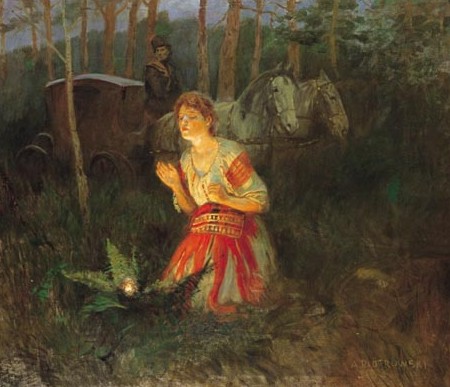
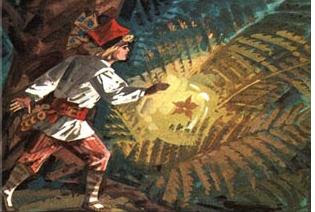
Maria Orłowska-Gabryś (1925-1988). Illustration for a children’s book.

Ferns are unique plants in our ecosystems. While most of the plants around us reproduce through flowers and fruits, these adopt a different strategy, based on spores, which is now well known, but which remained enigmatic for a long time. This specificity, it goes without saying, was scientifically translated by the classification of ferns within an original taxonomic group, namely the division of Pteridophytes, which also includes horsetails and lycopods. But while we now understand how they work, ferns have long been a source of incomprehension. How could they reproduce without flowers and seeds? In the Middle Ages, for example, people did not understand why it was possible to find young fern plants, but never a single seed anywhere. Only one solution could explain this phenomenon: that the seeds of the fern are invisible. One deduction leading to another, since fern seeds were invisible, there must also be invisible flowers… which would therefore be capable – according to a logic quite typical of the time – of making invisible whoever found or consumed them (1) ! This was all it took for the popular imagination to unfold, and make the mythical fern flower a sort of plant Grail, an extremely rare marvel endowed with extraordinary properties. The fact is that the legend of the fern flower is extremely widespread throughout Europe, presenting quite astonishing similarities.

The fern flower across Europe

In fact, the fern flower is not perpetually invisible, for then it would simply be impossible to find. On the other hand, it only appears at a specific moment in the calendar, at a well-defined hour in the middle of the night, very briefly, and in a particularly remote and inaccessible place in the forests. One of the main common points in the legends relating to the fern flower is indeed its dated appearance. In the vast majority of cases, the famous night of flowering is that of Midsummer, or immediately before or after; in any case related to the summer solstice. The belief is particularly widespread in the northern and eastern countries of Slavic tradition, where the fern flower is said to develop during a night from June 21 to 24. This is the case in Poland, Estonia, Lithuania, Finland and Latvia. It is therefore linked to the celebrations of the solar cycle, of pre-Christian origins, but which have merged with the festivals of Saint John. In Finland, for example, we speak of the festival of « Juhannus, » or that of « Jani » in Latvia, or « Rasos » in Lithuania. It should be noted that in Poland, the fern flower could be observed not only at the summer solstice, but also at the time of the winter solstice (2). In any case, we understand that it appears on emblematic dates strongly linked to the influence of our luminous star.

While the belief is particularly strong in Eastern and Northern countries, it also exists in Western Europe. In England, it is said that on the eve of Saint John (once again), in the dead of night, the fern produced a single flower and that the villagers would then spread a sheet underneath to collect the seeds. No one ever became invisible, but the legend continued to be believed, to the point of performing rituals in the forest during the fateful night, until the church came to put an end to these obviously pagan practices. However, F.E. Corne mentions the testimony of a gentleman named Mr. Heath who, in 1779, still claimed to have participated several times in fern seed harvesting ceremonies during the nights of Saint John. And the man added that there were, however, disappointments, « because the fairies often stole the seeds » (3). Thus, we see that the fern flower is not a fantasy specific to Eastern countries. Moreover, what about the French tradition? Here again, we find local anecdotes or legends that refer to the concept. For example, Paul Sébillot tells us about traditions of this type, again linked to Saint John’s Day, in Lower Normandy, Touraine, and Brittany (4). He also attests to several songs and anecdotes evoking the harvest of the hypothetical « fern seed. »

Flowering always takes place in the middle of the night, never during the day. In many cases, it even occurs at a precise and symbolic time, and over an extremely short period of time. Thus, in Sweden, it blooms at midnight and immediately fades (5). The same is true in Polish traditions, where it is said to appear at midnight at the same time as a sound sometimes described as a crack, a crash, or a thunderclap is heard (6). In Lower Normandy as well, it blooms at midnight, and its seed must be harvested before it falls to the ground to benefit from its properties (7). A second later, the flower is no longer discernible (8). It is also at midnight that it can be found in Touraine, or at least it is at this time that it produces its seeds, at the same time as the clovers develop additional leaves to have four or five leaves (9). Furthermore, Paul Sébillot transcribes a very interesting Renaissance shepherd’s song: « In a bag the fern seed / That at midnight we gathered in the past / Denis and I, the eve of Saint-Jean » (10).
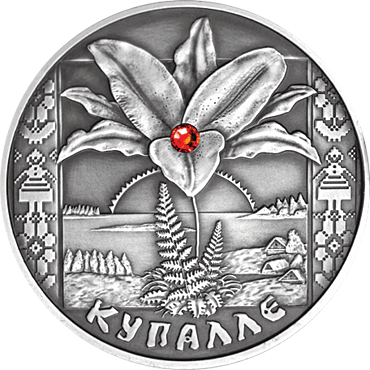
So now we know where and when to look for the fern flower, depending on local traditions and customs… However, we still don’t know what it looks like. What is it? The question is eminently complex, since its rarity makes it, by nature, a phenomenon never observed by most mortals. Beliefs in the fern flower attribute to it a multitude of characteristics, sometimes contradictory, but which generally make it an absolutely sumptuous spectacle. Thus, Slavic traditions imagine it to be red, gold or violet (11). In England, rumors rather evoke the birth of a pale blue flower, which quickly transforms into a golden seed (12). Reviewing the pictorial representations of the fern flower will convince us of its great heterogeneity: it can sometimes have five petals, sometimes many more; it can be imposing or on the contrary tiny; it can be found at the top of a long stem, but also be hidden under the leaves, at ground level; It can be palpable or resemble a phantom organ… Yet, the attentive observer will notice a commonality among all these images: the mysterious inflorescence is always depicted in a golden halo, surrounded by a dazzling glow that seems to burst from its petals. Does this stem from its unique relationship with the sun? Indeed, it is only visible in most legends at the time of the summer solstice. Of course, this detail also underlines its supernatural character. The fern flower seems to have sprung from another world, fallen from paradise, like a sacred relic protected by grace.

Such a treasure could only stimulate the imagination, and it is therefore not surprising that the fern flower is used in works of fiction. In addition to popular legends, we find books mentioning it, particularly in Eastern countries where it occupies an important place. The legend is mentioned in a book by the Finnish Aino Kallas, dealing with ancient folklore: The Wolf’s Bride (13). It is also cited by Andrus Kivirähk. In The Man Who Knew the Language of Snakes, the Estonian author mocks it, presenting it as a naive belief (14). In Poland, the fern flower is sometimes the subject of poems, such as that of Adam Asnyk (Kwiat paproci) some of whose verses can be translated as follows: « A strange fern flower blooms in the forests / For a moment in the mysterious shadow / The whole world is gilded with a magic light / But you can only touch it in your dreams » (15). Henri Pourrat, a French writer, collected the legend orally in Auvergne and transcribed it in Contes et légendes du Livradois, released in 1989 (16). Finally, there is a short animated film dedicated to the fern flower, produced by Ladislas and Irène Starewitch in 1949 (17). It features a little boy named Jeannot, who decides to go in search of the treasure on the night of Saint John’s Eve…
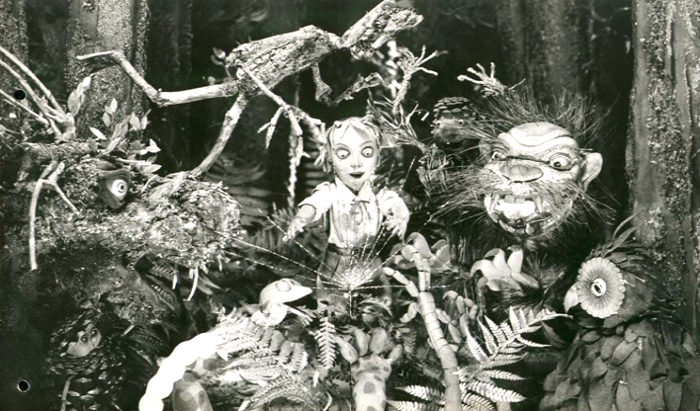
Screenshot from the animated film « Fern Flower » by Ladislas and Irene Starewitch. 1949.

The Powers of the Fern Flower

As we have already touched on, the fern flower is coveted because it is believed to possess extraordinary properties. The most widespread of these is to bring its possessor incredible wealth. This is the most material version of the myth, which sees the discoverer living in abundance for the rest of his life, surrounded by jewels and chests overflowing with gold. For example, the fern flower brings fortune in Estonian traditions, but also among the Poles (18) and France. In Upper Brittany, it is said that fern seeds collected on Midsummer Night must be thrown onto a field to reveal the location of the treasures (19). In many legends, however, and as we will soon see in detail, the fortune gained is a curse, punishing the seeker’s greed.

When it is not specifically wealth that our mythical flower brings, it is more generally luck. This motif is also extremely common, from Russia to France. In Poland, it was sometimes believed that the fern flower was the Ophioglossum (Ophioglossum vulgatum). It was then said to bring success in love. In our countries, the ferns harvested on the night of Saint John, and a fortiori the hypothetical flowers of these ferns, were supposed to make you win at all games (20).
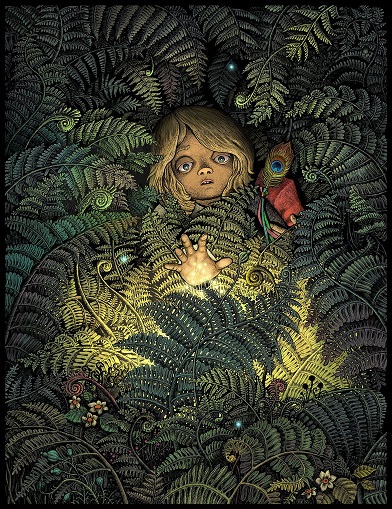
« bubug » on Deviant Art. Jack and the Fern Flower.

Here and there, the fern flower brings magical powers to the discoverer; extraordinary abilities that tend to blur the line between tale and reality. As mentioned in the introduction, since the fern flower is invisible most of the time, it has sometimes been assumed that it could itself confer invisibility (21). This is a way of thinking quite typical of the Middle Ages, and which is not without evoking the theory of signatures which states that a plant resembling an organ has an action on it (the liverwort, whose leaf shape recalled the liver, should thus be able to heal it). In any case, this property was attributed to the fern flower in Poland, but also to its seed in Lower Normandy. In Poland, it was also said that the fern flower could unlock any lock, but also bring clairvoyance to its possessor. This echoes another Norman rumor, which held that the seed allowed one to know the secrets of the present and the future (22). It has also been suggested that it gave one the ability to move from one place to another as quickly as the wind, or to speak to animals (23).

As a sexual organ, the fern flower is also a provider of fertility, and it has been used metaphorically to evoke carnal love. This point brings us to the symbolic implications of this mysterious treasure of nature which, far more than a simple popular belief, hides between its petals profound considerations about human nature and its vagaries.

Symbolic significance of the fern flower

First of all, and as we have just noted, the fern flower is in some places a symbol of love. Midsummer Night, placed under the auspices of the sun, has always been marked by the idea of ​​encounter and seduction, as well as by fertility rituals that concern the earth, certainly, but also people. In the Baltic countries, young couples would go to have fun in the woods and it was said that they were going to « look for the fern flower » (24). In reality, it was a much less hypothetical flower that was picked: that of love. Moreover, it can be suggested that the true enchanted seed, growing from this famous fern flower, is allegorically the one that would, about nine months later, give birth to a new being. This night was indeed magical and, it was believed, propitious to procreation. From then on, the fern flower represents in some way the mystery of life; the primordial magic of existence and of the entire cosmos. A symbol of fertility, it’s no surprise that it gave its name to a Latvian NGO promoting sexuality education (Papardes zieds).

This conception of the mysterious inflorescence is still observed among Slavic peoples, where Midsummer’s Day corresponds to « Kupala Night » (25). Young people are seen there delving into the woods during the night, searching for the hypothetical « fern flower, » with girls wearing plant crowns in their hair. If a boy emerges from the thickets brandishing one of these, it means that the couple is engaged and that a marriage will soon take place. Here again, the fern flower takes on a metaphorical meaning; an allusion to romantic union and probably to carnal relations in nature. This tradition is in keeping with the holiday in question, since Kupala is an ancestral goddess of herbs and magic, but also of sex. Furthermore, linguists believe that its etymology may have a connection, albeit distant, with the Latin word « cupido, » meaning « desire » and relating to the well-known god, Cupid, who delivers his arrows of love into hearts.

But the fern flower is also and above all a symbol of the unattainable, like the mythical Grail so ardently sought and never discovered. It is the object of a romantic and passionate quest, where the journey and the trials seem to matter as much, if not more, than the treasure that motivates them. For, in fact, the fern flower is reputed to be impossible to pick, and even to observe. In Poland, it is said to be nestled in a remote and wild place, a thousand miles from any civilization, since one must not be able to hear the slightest bark of a dog there (26). Moreover, it is difficult to access simply because of its rarity. Often, legends imply that the fern flower is unique… Thus, the seeker would have to be precisely at the place where it grows, and at precisely the right time due to the ephemeral nature of its flowering; in Sweden, it is sometimes said that it only occurs at midnight sharp (27). It therefore takes a rather crazy set of circumstances to get one’s hands on this plant treasure. Worse still, some traditions believe that anyone looking for it has no chance of finding it, for the simple reason that it can only be discovered accidentally… or in dreams as in the poetry of Adam Asnyk (28).
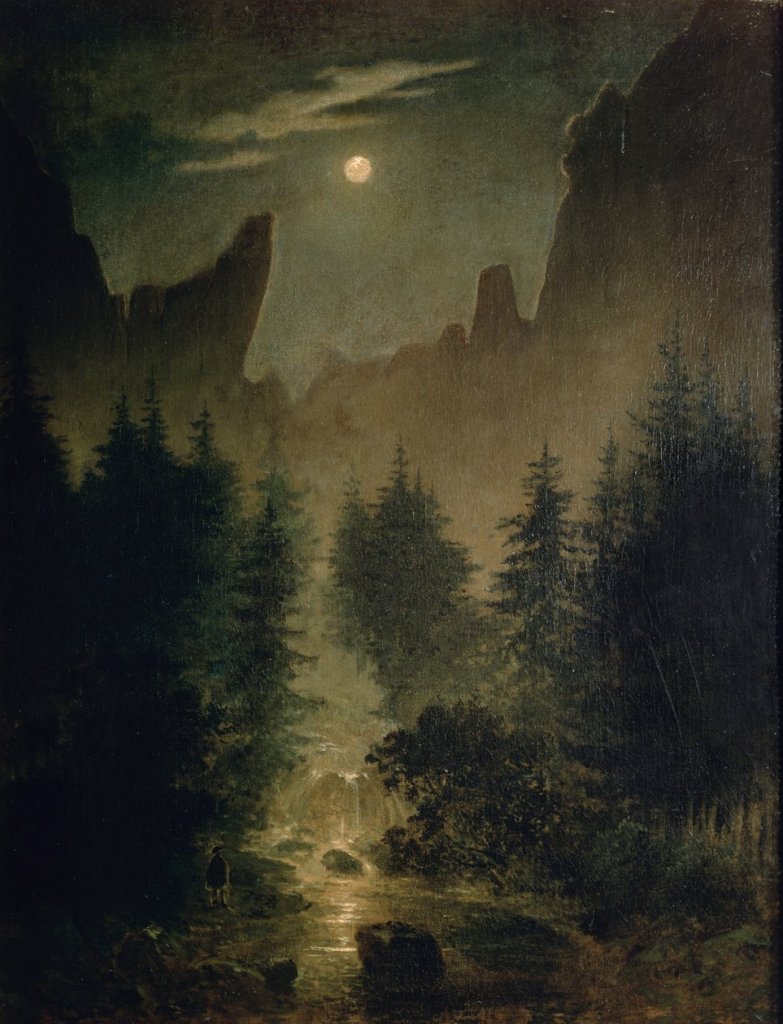
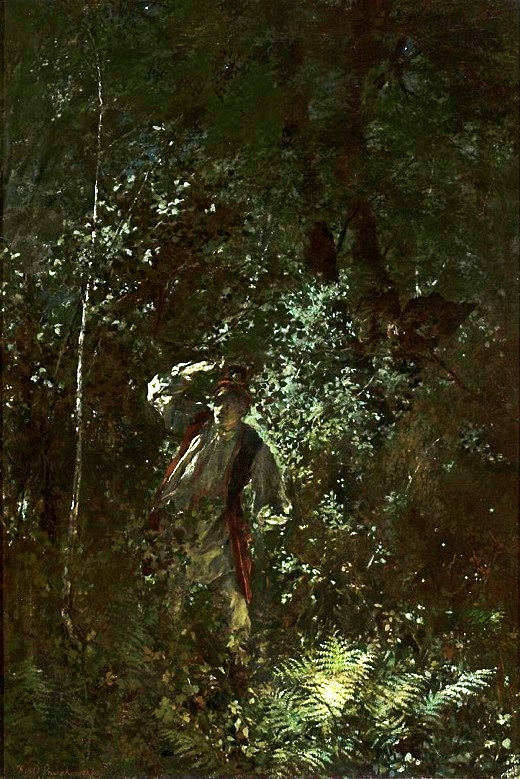
As if all these insoluble parameters were not enough, the fern flower is often protected by supernatural means. In Poland, it grows in the heart of uroczyska, natural spaces endowed with magical power and generally linked to ancient pagan cults (29). It is also protected from various enchantments in Swedish legends, for example. In many cases, it is explicitly the forces of the devil that guard it, an idea found in the French countryside. Polish traditions often place it in places where witches roam, but also creatures typical of local folklore such as bies or czart (demons) (30). This explains the Christian venerations that, it is often said, must be practiced by anyone wishing to approach the fern flower. Prayers must be said, of course, but the adventurer must also have blessed artifacts, such as a rosary or a white tablecloth taken from the church altar. However, the rituals performed are sometimes much more bizarre and strange. It is believed that one can approach the mythical flower by arming oneself with mugwort and stripping naked (31). To take it with oneself, it is also said that one must absolutely forbid any backward glance, under penalty of suffering great misfortune; like Lot and his wife in the Old Testament, whom the angels formally forbade from turning around when Sodom is subjected to a deluge of fire (32).

From this, it is clear that the fern flower is a kind of plant Grail; an archetype of inaccessible preciousness, and consequently a passionate, mysterious, and unfathomable fantasy. But as such, it also embodies the dark side of dreams, like a symbol of the vain obsession leading Man to the fall. Like the sun burning the wings of Icarus trying to climb too high, the sacred inflorescence lowers the pride of those who think they are clever enough to pick it without fear. To illustrate this idea, traditions often specify that the fern flower certainly allows one to obtain fortune, but that it cannot be shared without it suddenly evaporating. The discoverers then see their family and friends sink into poverty, while they achieve a prosperous existence… but oh so unhappy. They suffer jealousy, and above all realize that, to paraphrase the famous phrase from Christopher McCandless’s notebook in Into the Wild, « happiness is only real if it is shared » (33). In some versions, the futile obsession with material wealth leads to an even more tragic outcome. We see the protagonist embark on his quest by denying his friends and family, cutting all ties with his humanity, and finally finding the fern flower deep in the woods. He then believes he is living in glory, blazing with wealth, then suddenly realizes what really matters to him and finally returns home. But of course, as expected, there is no one to welcome him back to his home village. On the other hand, he reads the names of those he loves on the crosses in the cemetery (34)… Here again, the fern flower is thus adorned as a cursed artifact, leading the greedy man to loss and suffering.

A vehicle for moral reflection, the legends of the fern flower often help to put the importance of earthly wealth into perspective, by drawing parallels with values ​​such as friendship, love, piety, or spirituality. In a Polish oral tale, for example, there is a story about a young shepherd who loses a cow he loves very much in the woods. He naturally sets out to find it and, in the dead of night, so obsessed with his animal, fails to notice the strange flower he stumbles upon, a petal of which gets stuck in his shoe. Sumptuous visions then invade his mind, revealing hidden treasures and various paths leading to chests filled with gold. Of course, he also spots his beloved cow, and suddenly knows where to go to find it. He then returns with her and, exhausted, goes to bed, promising himself to go and find all the riches of his dreams the next morning… But at that moment, he takes off his shoe and drops the fern petal, which fades during the night and loses all its powers, making him completely forget in the early morning what seemed so clear to him the day before. The little shepherd, however, does not make a big deal of it, and that is the moral of the story: he has found his cow, and that is all that matters to him (35). A wise character, he knows that fortune would not have made him happier. Thus, through these few examples, we see that there is much more behind the fern flower than a simple imaginary treasure; it is an element rich in symbols, and among other things an incarnation of the vain and futile quest, of the thoughtless and pretentious obsession that distances one from appeasement.

***

The fern flower is therefore an absolutely fascinating motif in several respects. It testifies to human obsession with the unknown and mystery, and more generally with everything that escapes the distressing materiality of everyday life. It also shows the major role that nature plays in popular traditions, and therefore in people’s imagination and dreams. Moreover, the existence of fern flowers in both Slavic and English beliefs shows us once again the incredible cultural transfers that take place between peoples, even at a time still devoid of modern means of communication. Finally, the case of the fern flower also reveals the great diversity of interpretations that a simple myth can generate. The plant relic can be a romantic or sexual metaphor, but also symbolize the inaccessible and punish human vanity. It also reveals the divine fantasy that drives us, leading us to dream of magical powers, teleportation, invisibility, or animal communication.

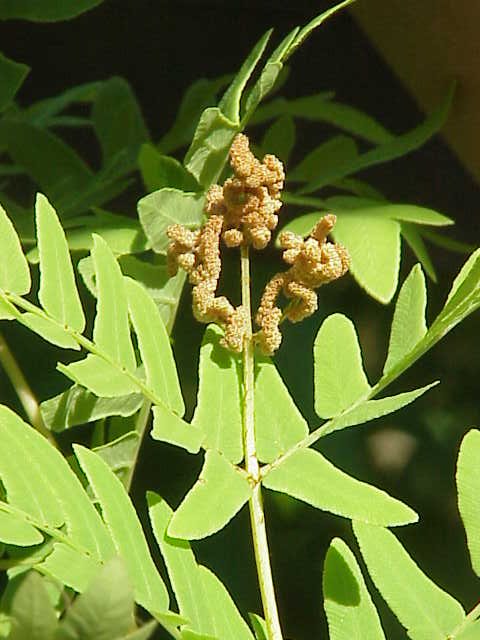
However, could the fern flower be nothing more than a pure fabrication of the mind? Could it find no basis in the everyday observations of ancient inhabitants? We have already had the opportunity to outline an answer to this question, showing that the myth stemmed from a simple observation: that ferns did not produce visible flowers, unlike « classic » plants. Nevertheless, some pteridophytes sometimes display atypical organs, or exhibit shapes that could be likened to inflorescences. Thus, could the inspiration for the fern flower be the « spikes » of the tropic flower (Ophioglossum vulgatum)? This plant could be relevant due to its rarity. Could it not also be the fertile fronds of the German fern (Matteuccia struthiopteris), forming upright clumps that the imagination can quickly liken to a strange flower? And what about those of the royal fern (Osmunda regalis), sprouting from the tips of tall, even more impressive stems? In this case, the species is entirely characteristic of humid forests, and could therefore be at home in the remote valleys described in legends…

Of course, all these questions will remain forever unanswered, and that’s undoubtedly for the best. The fern flower will always be a mystery, a fantasy, a marvelous belief in the minds of men, allowing them to escape the material world. Who knows? Perhaps it does indeed unfold in the heart of a dense and unexplored forest, somewhere on our Earth, hidden from view, during a few blessed moments of a summer night. In any case, it is certain that it blooms within us, in our heads and in our hearts, as do all our wildest dreams.

Pablo Behague, « Sous le feuillage des âges ». Décembre 2024.

**

1 F.E. Corne, 1924, Ferns : Facts and Fancies about Them : II.
2 Lamus Dworski, 2016, Polish legends: the Fern Flower.
3 Corne, 1924, Ferns : Facts and Fancies about Them : II, op. cit.
4 Paul Sébillot, 1904, Croyances, mythes et légendes des pays de France.
5 Gustaf Ericsson, 1877, Folklivet i Åkers och Rekarne härader.
6 Dworski, 2016, Polish legends: the Fern Flower, op. cit.
7 Sébillot, 1904, Croyances, mythes et légendes des pays de France, op. cit.
8 Louis Dubois, 1980, Recherches sur la Normandie.
9 Sébillot, 1904, Croyances, mythes et légendes des pays de France, op. cit.
10 Sébillot, 1904, op. cit.
11 Brendan Noble, 2021, The Fern Flower – Magical Flower of the Slavic Solstice – Slavic Mythology Saturday.
12 Corne, 1924, Ferns : Facts and Fancies about Them : II, op. cit.
13 Aino Kallas, 1928, Sudenmorsian (La Fiancée du loup).
14 Andrus Kivirähk, 2007, Mees, kes teadis ussisõnu (L’Homme qui savait la langue des serpents).
15 Adam Asnyk, 1880, Kwiat paproci (Fleur de fougère).
16 Henri Pourrat, 1989, Contes et récits du Livradois.
17 Ladislas Starewitch et Irène Starewitch, 1949, Fleur de fougère.
18 Dworski, 2016, Polish legends: the Fern Flower, op. cit.
19 Sébillot, 1904, Croyances, mythes et légendes des pays de France, op. cit.
20 Sébillot, 1904, op. cit.
21 Corne, 1924, Ferns : Facts and Fancies about Them : II, op. cit.
22 Sébillot, 1904, Croyances, mythes et légendes des pays de France, op. cit.
23 23 juin 2011, « Paparčio žiedo legenda – būdas kiekvienam pasijusti herojumi », Delfi.
24 Adam Rang, 22 juin 2022, « Fire, flower crowns and fern blossoms: Midsummer night in Estonia explained », Estonian world.
25 Ullrich R. Kleinhempel, 2022, Seeking the Fern Flower on Ivan Kupala (St. John’s Night).
26 Dworski, 2016, Polish legends: the Fern Flower, op. cit.
27 Ericsson, 1877, Folklivet i Åkers och Rekarne härader, op. cit.
28 Asnyk, 1880, Kwiat paproci (Fleur de fougère), op. cit.
29 Dworski, 2016, Polish legends: the Fern Flower, op. cit.
30 Dworski, 2016, op. cit.
31 Dworski, 2016, op. cit.
32 Auteur inconnu, VIIIe-IIe s. av. J.-C., Bible – Ancien Testament.
33 Jon Krakauer, 1996, Into the Wild.
34 Dworski, 2016, Polish legends: the Fern Flower, op. cit.
35 Dworski, 2016, op. cit.

You can follow my news on Instagram: https://www.instagram.com/sous.le.feuillage.des.ages/
The deer: an animal from the Otherworld

Mostly discreet, the deer becomes the noisiest and most boisterous inhabitant of the forests in September. Its roar then resounds at nightfall or dawn, sometimes during the day, making the few humans who wander nearby shudder. There is something deeply mysterious, almost supernatural, in this hoarse and intense cry, which, like thunder in the heart of darkness, seems to emerge from the very bowels of the earth. With a little imagination, one could quite easily believe it came from a parallel dimension, from an unknown and unexplored country… in short, from the Other World dear to Celtic mythology. That being said, it is not surprising that this « king of the forests » has been considered, from Antiquity to the present day, as a symbol of passage between life and death, and more generally between reality and the unreal. We then speak of a « psychopomp » animal, that is to say, one that allows the transfer between worlds, the journey of souls from Earth to the Beyond. It is precisely this aspect of the deer that we will try to clarify, through wanderings that will take us from Celtic Ireland and lead us to Hogwarts.

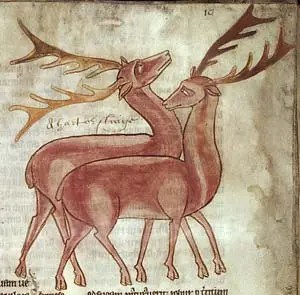
Two deer in an English bestiary. Circa 1220-1230.

The Pursuit of a Stag to the Otherworld: A Classic Motif.

We must first address an extremely common narrative pattern, in which a character sets out in pursuit of a stag that, more or less subtly, leads him astray until he reaches another world. Very often, this encounter takes place during a hunt, during which the hero becomes separated from his companions without realizing it. This motif is observed repeatedly in Celtic mythology, both Irish and Welsh.

Regarding the first, we can consider the story of Oisin, son of the famous Finn. He is hunting with his father, chasing stags, when, in the middle of the forest, he spots a young woman of supernatural beauty, riding a dazzling white horse. The lady in question turns out to come from a distant kingdom called the « Land of Youth » and, in love with Oisin, she invites him to join her there. After an emotional farewell to his people, our hero sets off with the beautiful stranger on his steed. However, during their travels, several clues are scattered throughout the manuscript to indicate to the reader a gradual passage towards the sidh, that is to say towards the land of the Tuatha-de-Danann, who are the Celtic gods. For example, they see « a young girl at the top of a wave on a brown steed, holding a golden apple in her right hand. » However, the apple is a marker of paradise, of which one will be convinced by thinking of the Garden of Eden or King Arthur’s final resting place, the Isle of Avallon. But above all, and this is precisely the detail that interests us, they see a « hornless doe leaping nimbly while a white dog barks behind her. »[i] Thus, the animal symbolically leads Oisin to the Otherworld, twice: first by leading him to Niamh, then by accompanying him to the « Land of Youth. » After a few years, however, Oisin begins to miss the landscapes of Ireland, and he decides to leave despite his wife’s warnings. Upon returning to his homeland, he recognizes nothing. Three hundred years have in fact passed, and when he realizes it, the unfortunate mortal falls from his horse, dead.

In Welsh mythology, too, it is the hunt for a deer that leads Pwyll, lord of the kingdom of Dyfell, to come into contact with the Otherworld. While wandering through the woods, he hears dogs that don’t belong to him barking nearby. Approaching, he discovers a deer in a clearing, which a mysterious pack of white animals with red ears is attacking. Pwyll scares them off and sets his own hounds on the prey, until he sees a rider coming towards him. This rider is a man named Arawn who, as the color of his dogs suggests, comes from the Otherworld. He accuses Pwyll of not respecting the rules of the hunt by stealing the deer he was chasing. Therefore, to atone for this affront, he offers him a pact: the two will have to trade places for a year. In addition, Pwyll will have to face a certain Havgan, Arawn’s enemy. In this myth, from the first branch of the Mabinogion, Pwyll is led to the Other World by the pursuit of a deer, which leads him to meet a supernatural being who opens the door for him[ii].

This encounter with a marvelous knight through a deer hunt is found in the Lai de Tyolet, an anonymous poem from the Middle Ages that fits into the framework of Arthurian legends[iii]. It depicts a young man living with his widowed mother in the forest, and to whom a fairy gave at birth the ability to attract animals by whistling. But one day, he sees a deer that does not approach and which he therefore decides to follow. This one leads him to a second deer, then crosses a river. Tyolet then loses interest and kills the newcomer. However, when he raises his head, he realizes with amazement that the first deer has transformed into a knight, who is watching him from the other side of the river. Having never seen such an individual, he asks him a multitude of questions, until his interlocutor orders him to return home to don his father’s armor. Afterward, Tyolet goes to Arthur’s court where he experiences new adventures, culminating in his marriage to a mysterious princess. Thus, it is once again the trail of the deer that leads our hero to the supernatural, in this case to a shapeshifting knight, the incarnation of the Otherworld and magic.

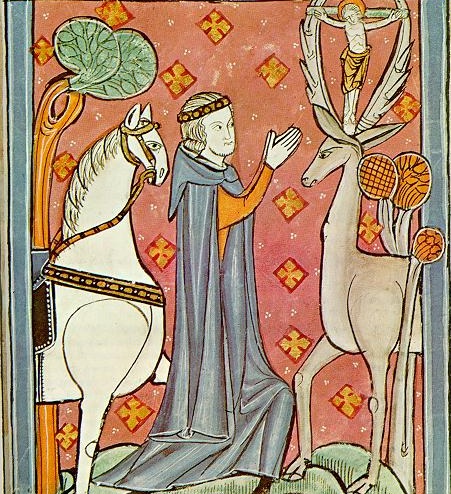
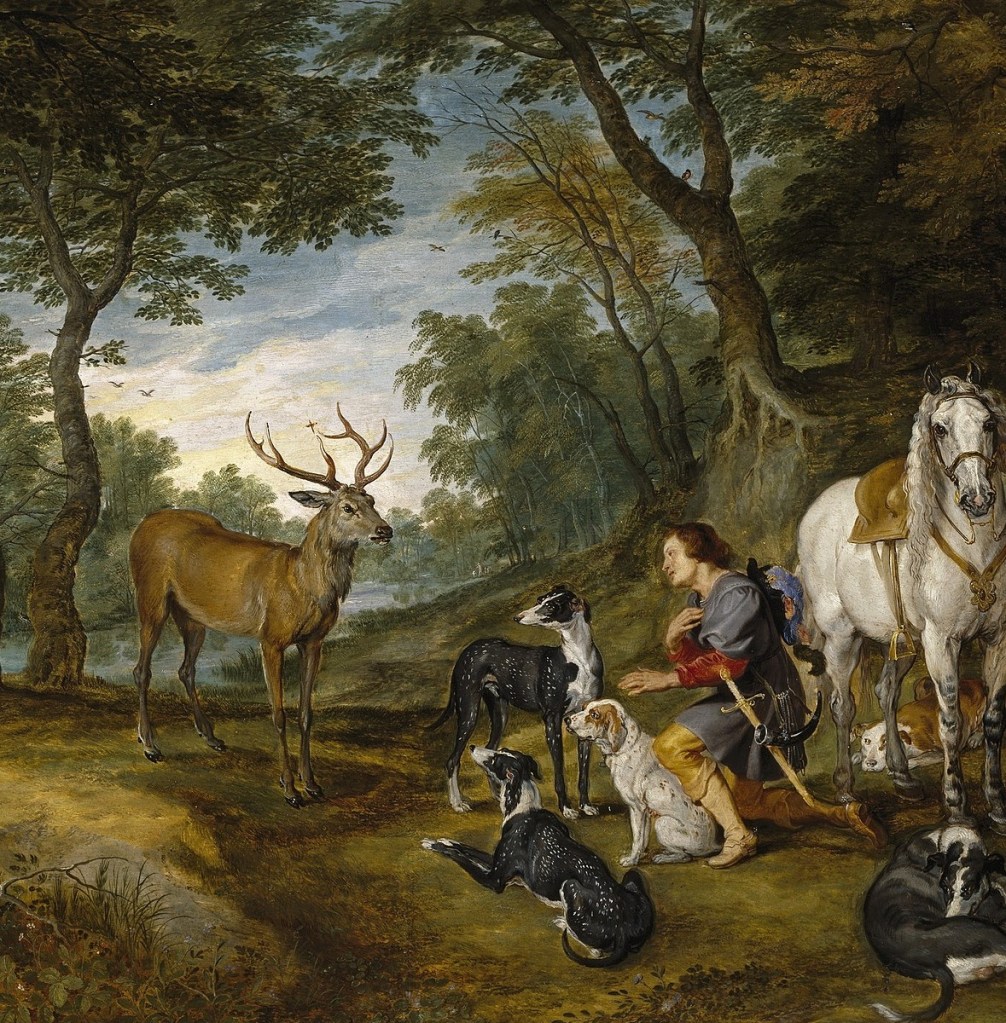
The Christian imagination is not lacking in this regard, and even offers us a quite unique psychopomp figure: that of the crucified deer, an allegory of Christ and the divine light illuminating man. This enigmatic creature is found as much in the Legendary Lives of Saints Hubert and Eustace as in a tale about a Scottish king named David. The first, Hubert, was a lord so passionate about hunting that he forgot his moral obligations. His sin is such that he even goes so far as to practice his favorite activity on Good Friday (that is, on the date commemorating the death of Jesus). It is precisely on this day that he encounters a deer that immediately strikes him as extraordinary: it is completely white and bears a glittering cross between its antlers. Hubert begins by tracking the animal, but is abruptly interrupted when a voice rises from nowhere and addresses him in these terms: « How long will you pursue beasts in the forests? How long will this vain passion make you forget the salvation of your soul? » The lord ends up prostrating himself and following the advice given to him, converting and dedicating his life to the Church[iv]. The motif is more or less the same in the story of Saint Eustace. As a Roman general, he was chasing a herd of deer when he noticed that one of them was clearly more beautiful and larger than the others. He decided to chase it until it caught up with him and saw a crucifix between its antlers. The animal then spoke to Eustace and claimed to have come to save him, leading him to the one God[v]. Finally, as for David, the Scottish king, he was already a Christian in 1128 when he crossed paths with the Christ-like deer. It attacked him and forced him to defend himself by grabbing its antlers. It was only then that he saw the cross, which would later inspire him to found Halyrood Abbey (whose etymology comes from « holy cross » in Scots)[vi].

In the three cases we have just discussed, the deer therefore leads the characters to the beyond, the immaterial spheres of existence, in this case by leading them to God. It encourages them to abandon human futilities to join something greater and more spiritual, an « other world » in short. The Christian allegory represented by the deer owes nothing to chance. Let us recall that this animal has the particularity of losing its antlers every year… but also of seeing them grow back. In this respect, it is the image of the cycle of death and resurrection, which of course brings us back to Jesus. Thus, the deer, like Hermes in Greek mythology, is the messenger and ferryman between the world of the living and that of the dead; between material reality and the mystical dimension.

The legendary figure of the white stag.

We have observed that, in most of the episodes narrated above, psychopomp stags are distinguished more or less subtly from their fellow creatures by physical or behavioral characteristics: they can be larger, more agile, more beautiful, faster, transform into knights, or even carry a dazzling crucifix between their antlers. But the most widespread and reliable criterion that allows us to suspect a world-crossing stag is its color. In many cases, in fact, the creature in question is white, either entirely or partially. In Celtic mythology, this singularity is specific to all animals from the Otherworld, and it is sometimes accompanied by red portions, such as the eyes or ears (remember, for example, the dogs of Arawn). The Middle Ages, however, continued this tradition by focusing more on the deer than on other mammals.

Thus, we find the mention of a white stag in the Lancelot-Grail, this cycle of novels related to the Knights of the Round Table and the quest for the legendary chalice. However, this mysterious creature once again merges with the figure of Christ, intimately linked to the Grail since it is believed to be the container used during the Last Supper. It is first Lancelot, the knight-sinner, who sees the animal. He wears a gold chain around his neck and is surrounded by six lions, « who guarded him as preciously as a mother her child. » Guinevere’s lover encounters the same procession a little later, this time in the company of the magician Mordred, and both try to follow him before being interrupted by two knights who throw them to the ground. It is finally Galahad, the knight with the pure heart, escorted by Perceval and Bohort, who manages to accompany him to a hermitage where an old man is saying mass. Then a phenomenon occurs which proves beyond doubt the supernatural character of the white stag, and its connection with the Other World: « The Stag indeed seemed to them to become a man and, on the altar, he took his place in a magnificent seat. » The four wild beasts then transform into four winged creatures representing the evangelists – the human, the lion, the ox and the eagle – and leave carrying the seated individual. It is finally a voice from the beyond which reveals the true nature of the said individual: « It is thus, » she says, « that the Son of God descended into the Virgin Mary, without her losing her virginity. »[vii] The white stag is therefore Christ. The animal symbolically leads to God, as much for Hubert, Eustace and King David as for Galahad and his companions.

Lancelot and Mordred crossing the white stag escorted by lions. 13th century.

However, this strange mammal is not always surrounded by biblical sanctity. In the Lay of Graelent, for example, a medieval text written by Marie de France, the white doe does not lead the knight to God, but to a beautiful naked woman bathing in a fountain with two maids. Graelent, having just rejected the queen’s advances, becomes passionately infatuated with her, stealing the clothes she had hung on a tree. A rape scene ensues, leading incomprehensibly to a consensual love affair. But we learn a little later that the lady is not entirely human, since she offers to appear to Graelent wherever and whenever he wishes. In reality, she is more like a fairy, which the pursuit of the white stag could easily have led us to believe. She ends up taking Graelent to the Otherworld, from where he will never return.[viii]

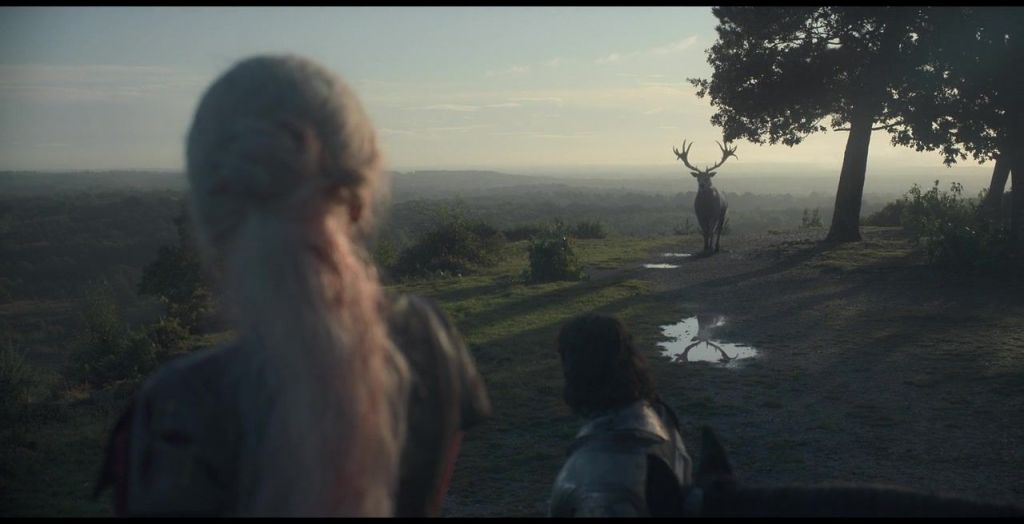
It is interesting to note that the figure of the white stag crosses the centuries, and is found in contemporary works that are familiar to us. Often, it appears to the protagonists in the context of a hunt, which underlines the persistence of the same motif from Celtic Antiquity to the present day. However, those who are lucky enough to cross its path are not necessarily inveterate hunters, but rather singular, gentle beings, whose temperament contrasts precisely with the noise and fury of the hunt. For example, in House of the Dragon, which is a series focusing on the reign of the Targaryens more than 150 years before the birth of the famous Daenerys of Games of Thrones, there is talk of a hunting party organized by King Viserys[ix]. However, this is linked to the rumor that a white stag is found in the surrounding forests. It is then considered that the mammal could be used to decide between the heirs who are fighting over the future throne, namely Rhanyra and her half-brother Aegon. However, when the former finally meets the mythical animal, she simply refuses to harm it. They observe each other for a long time, and this interaction alone convinces her that she is indeed the rightful heir. Here, the stag thus plays its role as « king of the forest »; it chooses the future monarch. However, it also takes on an obvious supernatural character, which the stag’s staging emphasizes in various ways. The young girl is in fact isolated with Sir Criston at the moment of the meeting, while a large crowd is participating in the hunt. Moreover, the scene is calm and silent, and thus contrasts with those that precede and follow, where the din of dogs, shouts and horns resounds from all sides. Finally, it takes place in an open area, with a bright setting, which is distinguished from the dark forest where the men are riding [x].

The White Stag Encounter in House of the Dragon. Season 1, Episode 3. 2022.

The motif of the white stag hunt is also found in The Chronicles of Narnia, but this time the animal plays the opposite role from the one we usually know it for. While the creature usually escorts humans to the wonderful world, here it is the one who leads the children out of the parallel kingdom and back to their rooms. At the end of the first volume, in fact, when Peter, Susan, Edmund and Lucy have become kings and queens of Narnia, they learn of rumors about a white stag wandering the forests of the country; a white stag capable of fulfilling the wishes of whoever can catch it. They go hunting and eventually spot its trail. But the white stag does not let itself be captured so easily and leads them deep into the thick undergrowth… until they reach a street lamp. There, they regain the memories of their previous lives and find themselves, unwittingly, in the wardrobe that had once led them to Narnia. [xi] From then on, the stag once again plays the role of ferryman between worlds… but in an unusual way, as it dispels magic to escort the children back into modern society.

In the video game The Elder Scrolls V: Skyrim, a quest also involves hunting a white stag in order to communicate with a spectral and supernatural creature named Hircine. This creature cursed a certain Sinding, causing him to become an uncontrollable werewolf who tore a little girl to pieces and was imprisoned. The origin of this spell is the theft of a ring, which the player must return to Hircine to free Sinding. However, there is only one way to contact him: to do so, one must find and kill the mythical white stag. Thus, the deer is once again an intermediary between worlds, a bridge between reality and the spectral dimension inhabited by Hircine; which, incidentally, appears in the form of a ghostly stag. [xii]

Let us note, in conclusion, that the white stag is, in fiction, a fantastical, fairy-like animal, like the unicorn, to which it is symbolically very close. However, unlike the latter, it has a real existence attested by science. Indeed, our forests are indeed populated by white stags, which are in fact affected by leucism; this pathology causes paleness in various parts of the body, including the skin and hair. It goes without saying that these individuals are exceptional, and they often become famous in the region where they live. The Isle of Arran in Scotland, for example, was said to have been home to a white deer in the 1960s, and legend has it that others have been spotted since. In any case, the animal is now the mascot of the island and the brand of whisky produced there.

The deer between life and death.

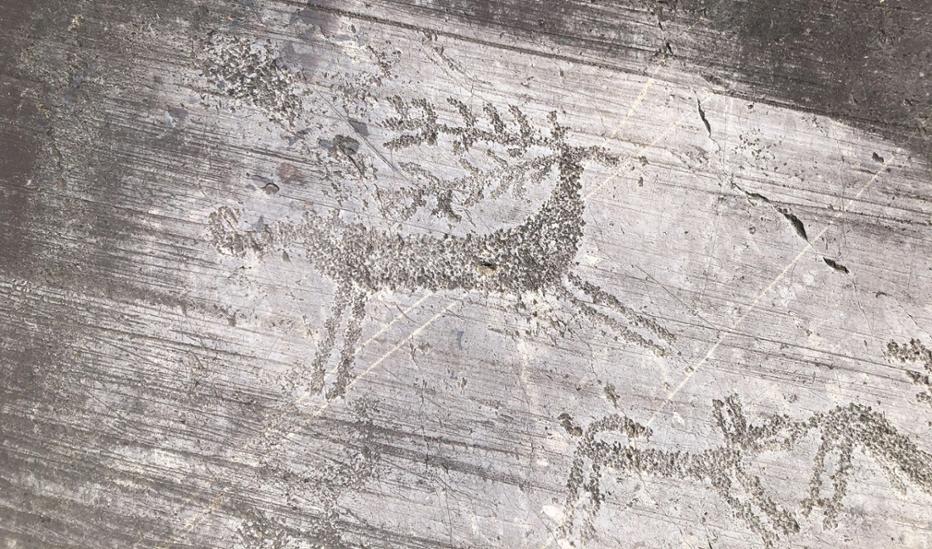
In the Camonica Valley, in Lombardy, lies one of the largest collections of petroglyphs in the world. However, a study of the discovered figures shows that the deer already occupied a privileged place in the human imagination in prehistoric times. The animal is depicted being hunted, certainly, but also in the form of anthropomorphic creatures with antlers, which could correspond to deities. [xiii] This strong representation of the deer in rock art is common to most of the major known sites, and one can therefore wonder about the symbolic role played by this animal. It is not impossible that it already occupied a psychopomp function, allowing the passage of deceased souls to the divine spheres.

A prehistoric deer on the rocks of the Camonica Valley.

While penetrating the minds of such remote times, and in possession of such limited sources, is utopian, it can be affirmed that the deer of the Celtic era forged a unique relationship with the world of the dead. Moreover, the deer that became our « king of the forests » was associated with the concept of eternity, as if the notions of life and death did not interfere with the existence of this pure and enchanted being, who straddled the border connecting the two states. In this regard, it is worthwhile to examine a particular deer from the Irish tale of Culhwch and Olwen.

This story features a young man named Culhwch who, due to a curse from his stepmother, falls in love with a certain Olwen, the only woman he can marry, but who, to his great misfortune, is the daughter of the terrible giant Yspaddaden. The monstrous stepfather in fact conditions his protégé’s hand in a series of seemingly impossible tests, some of which can only be achieved with the support of a supernatural being named Mabon, « divine son. » But it turns out that Mabon was abducted at the age of three by his mother and that no one knows where he is. Culhwch then gets help from a certain Gwrhyr, who has the particularity of being able to speak to animals and who begins to investigate among the inhabitants of the forest. Now, one of them is the Redynvre stag, who explains to Gwrhyr that when he arrived at this place, there were no trees except for a young oak, which has since grown to become an « oak with a hundred branches, » then perished, becoming nothing more than a dried-up stump[xiv]… It goes without saying that the cervid’s mention of the tree is intended to emphasize the immense span of time that has passed, especially since it refers to the life cycle of an oak tree, renowned for its longevity. Thus, the stag symbolizes supernatural old age, eternity beyond death… It does not pass away and straddles the boundary that separates the world of the living from the world of wonder.

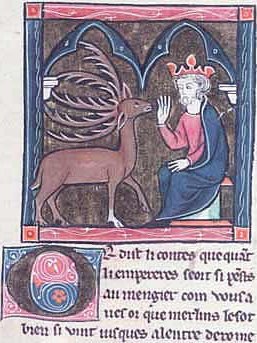
This immortal quality, of course, testifies to a magical essence. Indeed, it is found in the most famous magician of the Middle Ages, and perhaps even of all time: Merlin. Indeed, despite the fact that there is a « Merlin’s tomb » in the forest of Brocéliande, the wise protector of the Round Table generally does not die in the stories we know about him. Better still, his extraordinary old age and fantastic longevity are frequently emphasized in the manuscripts. Born of magic, he is a supernatural being and therefore presumed to be imperishable. Furthermore, the magician’s favorite tree, the one under which he divulges his prophecies, is the apple tree, the tree of the Otherworld, but also of the eternity that results from it. In the most widespread version, that of the Lancelot-Grail, Merlin ends up being imprisoned by the fairy Viviane, in an enigmatic place where he will have to survive until the end of time. On the other hand, there is never any question of death in the sense that we understand it. But what does the deer have to do with it? Well, Merlin shows a particular relationship with the animal that interests us. Not only is he able to communicate with it (as with the other animals of the forest), but he also happens to transform into a deer on occasion. For example, in the Lancelot-Grail, a series of anonymous works dating from the 13th century that is also called the « Vulgate Cycle », the sorcerer finds himself in the form of a deer in the forests of Rome, then in the palace of Julius Caesar, whom he helps in the interpretation of his dreams[xv]. Thus, through Merlin, the deer once again shows a strange relationship with the river of death, which he crosses without even getting wet. He crosses the ages above mortal souls, like a symbol of eternity that no one can reach.

Merlin, transformed into a deer, discusses with the Emperor. Manuscript of the « Vulgate Suite ». 1286.

However, if the marvelous stag symbolizes immortality, it nonetheless always plays its role as a ferryman of souls to the afterlife. Thus, if it does indeed cross this famous river between life and death, it often does so with someone on its back. In fact, stags are frequently mentioned in places that constitute an interface, or an airlock to the Otherworld. In Germano-Scandinavian mythology, for example, there is a stag named Eikthyrnir, who according to Storri Sturluson’s Prose Edda « stands near the father’s hall and bites the branches of Læradr »[xvi]. Now, this famous « father’s hall » is none other than Valhalla, that is to say the palace where Odin welcomes the warriors fallen in battle, who are invited to feast and train there while waiting for Ragnarök. Eikthyrnir thus perfectly embodies the psychopomp dimension of the stag, which here welcomes humans into the world of the gods after their passing.

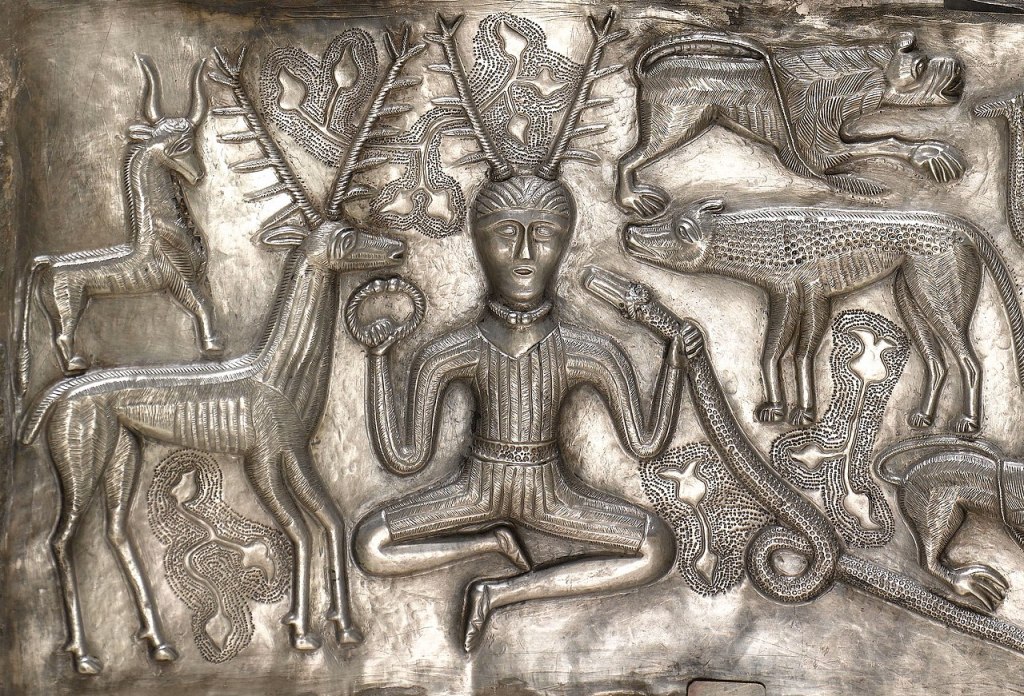
In many cases, there is also talk of a psychopomp deer god, working to ensure the smooth passage of souls to the realm of the dead. When we think of such an entity, the image of Cernunnos naturally comes to mind. This Gallic deity adorned with horns on his head is indeed linked to the idea of ​​a cycle, and therefore of a journey between life and death; something that the loss and regrowth of antlers may suggest. Nevertheless, the paucity of sources available on this figure forces us to remain at the stage of conjecture. However, the iconography offers us some very interesting clues that point in this direction, such as the fact that the god is sometimes depicted as young and beardless, and sometimes as a bearded old man, as if his existence were an eternal renewal. In any case, contemporary fiction has not hesitated to make Cernunnos a psychopomp being, favoring the passage of the living towards the post-mortem spheres. For example, in the series Zone Blanche, he is responsible for several murders aimed at preserving the forest in which he resides, but he is also the guardian of the border leading to the afterlife, choosing those who should or should not cross it. The beginning of season 2 thus sees him take care of the main character of Laurène Weiss, and even resurrect her by burying her underground after she was shot dead[xvii]. From then on, Cernunnos occupies the interface between the two states, and plays with them by passing souls from one side or the other as he sees fit.

Depiction of Cernunnos on the Gundestrup cauldron. 1st century BC.

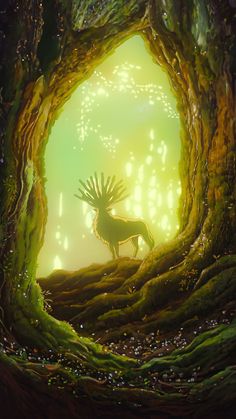
The scene of the antlered god caring for the hero in a sanctuary in the heart of nature is reminiscent of another well-known contemporary work: Hayao Miyazaki’s animated film Princess Mononoke[xviii]. Indeed, in this film, it is about a forest threatened by the human economy, generating a conflict in which the action of the main characters Ashitaka and San (the « Princess Mononoke ») takes place. The forest is embodied in a « Spirit », a mysterious entity surrounded by a mythical and divine character, which takes the form of a large peaceful deer with an anthropomorphic face. However, the film includes a scene during which Ashitika is on the verge of death following a gunshot wound sustained in a fight in the forge village. He is then led into the forest sanctuary by San, then placed in the grass where he receives a visit from the Spirit, who escorts him back to the world of the living. Everything is staged to demonstrate the deer’s power to grant life… or, on the contrary, to take it away. Thus, when it approaches, each of its steps makes the vegetation bloom in the place it has trodden. Conversely, just before healing Ashitika, the Spirit causes a plant to wither with its mere gaze. From then on, this enigmatic being perfectly represents the psychopomp dimension of the deer, capable of dispensing both life and death; fertile abundance and arid decrepitude. It embodies the cosmic force par excellence, deciding the subsistence or, on the contrary, the decline of each of us. The Spirit accompanies souls in this troubled zone that separates presence and absence, life and death; it serves as their guide. If it allows Ashitika to return to the shore of existence, it conversely shortens the suffering of a cursed boar by leading it to death. Finally, let us note an interesting detail: the Spirit of the forest is capable of walking on water… as Jesus did[xix], who can manifest himself precisely through the figure of the deer, as we have shown.

The forest spirit in « Princess Mononoke. » 1997.

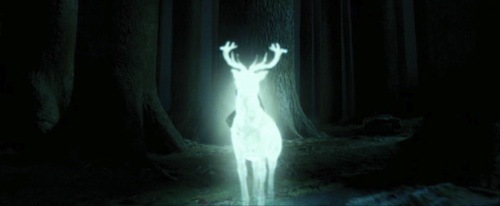
Let’s conclude this brief overview of psychopomp deer by discussing a very famous work: the Harry Potter saga. Indeed, it is marked by two major encounters with the deer, each of which is consistent with the idea of ​​a pivotal animal, connecting the real and the supernatural, guarding the border between life and death. First, Harry and his friends see a large white deer in the third book, devoted to « The Prisoner of Azkaban »[xx]. It miraculously appears in the Forbidden Forest and thus allows them to put to flight the dementors who were sucking out their souls. From then on, the deer manifests itself as a protector of life. But better still, Harry initially imagines that the animal comes directly from the world of the dead. Indeed, he suggests to his friends that the deer could be his father, James Potter, who as an Animagus was capable of metamorphosis. It turns out that the apparition was actually Harry’s own Patronus, duplicated through time travel. However, the stag in question in no way betrays the symbolism associated with it; it effectively connects worlds, enabling the junction between two divergent time dimensions.

Without revisiting the various Patronuses produced by Harry in the intervening volumes, let’s now turn to the final book, in which the second crucial encounter with a mysterious white stag takes place. Harry, accompanied by Ron and Hermione, is then searching for Horcruxes, that is, objects containing a fragment of Voldemort’s soul. Standing guard in front of the tent in the middle of a winter evening, he encounters a phenomenon that is, to say the least, disturbing: he first distinguishes a light between the trees, before realizing that it is in fact « a silvery white doe, bright as the moon and dazzling »[xxi]. Everything then seems to indicate a ghostly apparition, from the time of its occurrence to the description of the animal, supernaturally pale and leaving no trace on the snow. The doe finally leads him to a pond at the bottom of which he finds the sword of Gryffindor. Of course, the trio wonders about this strange event… and as in the previous example, they initially hypothesize that this deer could be a post-mortem manifestation. Indeed, they suggest that this deer could have been sent by Dumbledore himself, despite the fact that he had already been dead for several months… Thus, the deer would have played its symbolic role as a ferryman between worlds, an intermediary with the afterlife. However, the reader will eventually learn that the deer was once again only a patronus: that of Severus Snape who was trying to help them without being discovered. In any case, the deer does indeed appear as the expression of hidden dimensions, especially when it adopts a pale coat making it look like a ghost wandering on Earth.

The appearance of the white stag in the film « Harry Potter and the Prisoner of Azkaban ». 2004.

__

At the end of this brief overview, we can see that the psychopomp character of the deer is widespread and timeless. From ancient Celtic myths to recent films and books, it presents a coherent symbolism and is attributed well-defined roles. The deer guides souls to the Otherworld, guards the border between life and death, and more generally relates to the notion of passage. It goes without saying that exhaustiveness is impossible within the framework of such a subject, but I hope that the examples mentioned will allow readers to observe the deer with a different eye… or to listen to its bellow while taking into account the mystery surrounding this legendary animal, which has always fascinated man. In this deep, guttural sound, anyone who listens closely can perceive the echoes of distant and hidden worlds; worlds where mortal souls can sometimes get lost if they start following the hoof prints.

Pablo Behague. « Sous le feuillage des âges ». Octobre 2024.


[i] Auteur inconnu, XVIIe s., Oisín ar Tír na n-Óg.

[ii] Auteur inconnu, XIVe s., Mabinogion, première branche.

[iii] Auteur inconnu, XIIe-XIIIe s., Lai de Tyolet.

[iv] Hubert le Prévost, XVe s., Vie de saint Hubert.

[v] Auteur inconnu, Ve-VIIe s., Vie et Passion de saint Eustache.

[vi] Halfdan Ozurrson, 2018, The Great Hunt: The Historical Perspective and Themes in the Mythology of the White Stag.

[vii] Auteur inconnu, XIIIe s., Le Lancelot – Lancelot-Graal.

[viii] Marie de France, XIIe s., Lai de Graelent.

[ix] George R. R. Martin et Ryan Condal, 2022, House of the Dragon – S.1, E.3.

[x] Florie Maurin, 2022, Cerfs blancs à l’écran : résurgences et reconfigurations d’un motif médiéval dans quelques productions de fantasy.

[xi] Clive Staples Lewis, 1950, The Chronicles of Narnia – The Lion, the Witch and the Wardrobe.

[xii] 2011, The Elder Scrolls V : Skyrim – jeu vidéo.

[xiii] Cindy Cadoret, 2020, La chasse comme rite initiatique dans la mythologie irlandaise : la formation du guerrier et l’action préliminaire à la découverte et à la rencontre surnaturelle.

[xiv] Auteur inconnu, vers le XIe s., Culhwch ac Olwen.

[xv] Auteur inconnu, XIIIe s., L’Estoire de Merlin – Lancelot-Graal.

[xvi] Snorri Sturluson, XIIIe s., Edda en prose.

[xvii] Mathieu Missoffe, 2019, Zone Blanche – S2, E1.

[xviii] Hayao Miyazaki, 1997, Princesse Mononoké.

[xix] Auteur inconnu, Ier s. – IIe s, Bible – Nouveau Testament.

[xx] J.K. Rowling, 1999, Harry Potter and the Prisoner of Azkaban.

[xxi] J.K. Rowling, 2007, Harry Potter and the Deathly Hallows.

You can follow my news on Instagram: https://www.instagram.com/sous.le.feuillage.des.ages/
Animation d’un atelier d’écriture sur l’imaginaire et le symbolisme des arbres

Ce mardi 17 décembre, à la Médiathèque de Senones (88), j’animerai un atelier d’écriture sur l’imaginaire et le symbolisme des arbres et arbustes de nos régions.

Après une présentation de mes recherches sur le sujet – qui se traduiront bientôt en livres -, nous aborderons le cas de quelques espèces emblématiques, puis réaliserons des jeux de plume afin de mettre tout cela en pratique…

Je reviendrai à la Médiathèque le 9 février, cette fois pour initier les enfants à la reconnaissance des oiseaux et de leurs différents chants.

Le cerf : un animal psychopompe

Discret la plupart du temps, le cerf devient en septembre l’hôte le plus bruyant et le plus tapageur des forêts. Son brame résonne alors à la tombée de la nuit ou à l’aube, parfois en journée, faisant tressaillir les quelques humains qui erreraient dans les parages. Il se trouve quelque chose de profondément mystérieux, presque de surnaturel, dans ce cri rauque et intense, qui tel le tonnerre au cœur des ténèbres parait émerger des entrailles mêmes de la terre. Avec un peu d’imagination, on pourrait tout à fait le croire sorti d’une dimension parallèle, d’un pays inconnu et inexploré… en bref, de l’Autre Monde cher à la mythologie celtique. Cela étant dit, il n’y a rien d’étonnant à ce que ce « roi des forêts » ait été considéré, depuis l’Antiquité jusqu’à nos jours, comme un symbole de passage entre la vie et la mort, et plus généralement entre la réalité et l’irréel. On parle alors d’un animal « psychopompe », c’est-à-dire qui permet le transfert entre les mondes, le voyage des âmes depuis la Terre vers l’Au-delà. C’est précisément cet aspect du cerf que nous allons essayer d’éclaircir, par le biais de pérégrinations qui nous feront partir de l’Irlande celtique et nous mèneront jusqu’à Poudlard.

Deux cerfs dans un bestiaire anglais. Vers 1220-1230.

La poursuite du cerf vers l’Autre Monde : un motif classique.

Il nous faut tout d’abord aborder un schéma narratif extrêmement répandu, qui voit un personnage se lancer à la poursuite d’un cerf qui, plus ou moins subtilement, le conduira à s’égarer jusqu’à atteindre un autre monde. Très souvent, cette rencontre a lieu au cours d’une chasse, durant laquelle le héros se sépare de ses compagnons sans s’en apercevoir. Ce motif s’observe à plusieurs reprises dans la mythologie celtique, aussi bien irlandaise que galloise.

En ce qui concerne la première, nous pouvons nous pencher sur l’histoire d’Oisin, fils du célèbre Finn. Celui-ci chasse en compagnie de son père, poursuivant des cerfs, quand il distingue, au milieu de la forêt, une jeune femme d’une beauté surnaturelle, montant un cheval d’une blancheur éclatante. La dame en question s’avère issue d’un royaume lointain nommé la « Terre de Jeunesse » et, éprise d’Oisin, elle l’invite à l’y rejoindre. Après des adieux émouvants à son peuple, notre héros part donc avec la ravissante inconnue, sur son coursier. Or, au cours de leurs voyages, plusieurs indices sont égrainés dans le manuscrit pour indiquer au lecteur un passage progressif vers le sidh, c’est-à-dire vers le pays des Tuatha-de-Danann, qui sont les dieux celtiques. Par exemple, ils voient « une jeune fille au sommet d’une vague sur un destrier brun, tenant une pomme d’or dans la main droite ». Or, la pomme est un marqueur de paradis, ce dont on sera convaincu en songeant au jardin d’Eden ou à la dernière demeure du roi Arthur, l’île d’Avallon. Mais surtout, et c’est précisément ce détail qui nous intéresse, ils aperçoivent une « biche sans cornes sauter agilement tandis qu’un chien blanc aboie derrière elle »[i]. Ainsi, l’animal mène symboliquement Oisin vers l’Autre Monde, et ce à deux reprises : d’abord en le conduisant à Niamh, ensuite en l’accompagnant vers la « Terre de Jeunesse ». Après quelques années, cependant, les paysages d’Irlande finissent par manquer à Oisin, qui décide de s’en aller en dépit des avertissements de son épouse. De retour dans son pays natal, il ne reconnait rien. Trois-cents ans se sont en fait écoulés, et lorsqu’il en prend conscience, le malheureux mortel tombe de son cheval, raide mort.

Dans la mythologie galloise également, c’est la chasse d’un cerf qui va conduire Pwyll, seigneur du royaume de Dyfell, à entrer en contact avec l’Autre Monde. Alors qu’il parcourt les bois, il entend des chiens qui ne lui appartiennent pas aboyer dans les parages. S’approchant, il découvre un cerf dans une clairière, qu’une meute mystérieuse, composée d’animaux blancs aux oreilles rouges, est en train d’attaquer. Pwyll les fait fuir et lance ses propres molosses sur la proie, jusqu’à ce qu’il aperçoive un cavalier venir à sa rencontre. Celui-ci est un dénommé Arawn qui, comme pouvait le laisser deviner la couleur de ses chiens, est issu de l’Autre Monde. Il reproche à Pwyll de ne pas avoir respecté les règles de la chasse en lui volant le cerf qu’il poursuivait. Par conséquent, afin de laver cet affront, il lui propose un pacte : tous deux devront échanger leurs places pendant un an. De plus, Pwyll devra affronter un certain Havgan, ennemi d’Arawn. Dans ce mythe, issu de la première branche du Mabinogion, Pwyll est donc conduit vers l’Autre Monde par la poursuite d’un cerf, qui lui fait rencontrer un être surnaturel qui lui en ouvre la porte[ii].

Cette rencontre d’un chevalier merveilleux par l’intermédiaire d’une chasse au cerf se retrouve dans le Lai de Tyolet, poème anonyme du Moyen Âge s’intégrant dans le cadre des légendes arthuriennes[iii]. Il met en scène un jeune homme vivant avec sa mère veuve dans la forêt, et à qui une fée a donné à la naissance la capacité d’attirer les animaux en sifflant. Mais un jour, il aperçoit un cerf qui ne s’approche pas et qu’il décide par conséquent de suivre. Celui-ci le mène à un deuxième cerf, puis traverse une rivière. Tyolet s’en désintéresse alors et tue le nouveau venu. Toutefois, quand il relève la tête, il se rend compte avec stupeur que le premier cerf s’est transformé en un chevalier, qui l’observe de l’autre côté de la rive. N’ayant jamais vu un tel individu, il lui pose une multitude de questions, jusqu’à ce que son interlocuteur lui ordonne de retourner chez lui afin d’enfiler l’armure de son père. Après cela, Tyolet se rendra à la cour d’Arthur où il vivra de nouvelles péripéties jusqu’à son mariage avec une princesse mystérieuse. Ainsi, c’est une fois de plus la piste du cerf qui mène notre héros au surnaturel, en l’occurrence à un chevalier métamorphe, incarnation de l’Autre Monde et de la magie.

L’imaginaire chrétien n’est pas en reste à ce sujet, et il nous offre même une figure psychopompe tout à fait singulière : celle du cerf crucifère, allégorie du Christ et de la lumière divine éclairant l’homme. Cette créature énigmatique se retrouve autant dans les Vies légendaires des saints Hubert et Eustache que dans un conte relatif à un roi écossais nommé David. Le premier, Hubert, était un seigneur passionné par la chasse au point d’en oublier ses obligations morales. Son péché est tel qu’il va jusqu’à pratiquer son activité favorite un Vendredi saint (c’est-à-dire à la date commémorant la mort de Jésus). Or, c’est précisément au cours de cette journée qu’il fait la rencontre d’un cerf qui lui apparait d’emblée comme extraordinaire : il est tout blanc et porte une croix scintillante entre ses bois. Hubert commence pourtant par traquer l’animal, mais s’interrompt brusquement quand une voix s’élève depuis le néant et s’adresse à lui en ces termes : « Jusqu’à quand poursuivras-tu les bêtes dans les forêts ? Jusqu’à quand cette vaine passion te fera-t-elle oublier le salut de ton âme ? ». Le seigneur finit par se prosterner et par suivre les conseils qu’on lui prodigue, se convertissant et dédiant sa vie à l’Église[iv]. Le motif est peu ou prou le même dans l’histoire de saint Eustache. Alors général romain, celui-ci poursuit une harde de cerfs quand il s’aperçoit que l’un d’eux est nettement plus beau et plus grand que les autres. Il décide de le prendre en chasse jusqu’à ce qu’il le rattrape et distingue un crucifix entre ses cors. L’animal s’adresse alors à Eustache et affirme être venu pour le sauver, en le menant vers le Dieu unique[v]. Enfin, pour ce qui est de David, roi écossais, celui-ci est déjà chrétien en 1128 lorsqu’il croise le chemin du cerf christique. Celui-ci l’attaque et l’oblige à se défendre en lui agrippant les bois. Ce n’est qu’à ce moment-là qu’il distingue la croix, qui l’incitera ensuite à fonder l’abbaye d’Halyrood (dont l’étymologie provient de « sainte croix », en scots)[vi].

Dans les trois cas que nous venons d’aborder, le cerf mène donc les personnages vers l’au-delà, les sphères immatérielles de l’existence, en l’occurrence en les conduisant à Dieu. Il les incite à délaisser les futilités humaines pour rejoindre quelque chose de plus grand et de plus spirituel, un « autre monde » en somme. L’allégorie christique que représente le cerf ne doit rien au hasard. Rappelons en effet que cet animal a la particularité de perdre ses bois tous les ans… mais aussi de les voir repousser. À cet égard, il est l’image du cycle de la mort et de la résurrection, qui nous ramène bien sûr à Jésus. Ainsi, le cerf, à l’instar d’Hermès dans la mythologie grecque, est le messager et passeur entre le monde des vivants et celui des morts ; entre la réalité matérielle et la dimension mystique.

La figure légendaire du cerf blanc.

Nous avons pu constater que, dans la plupart des épisodes narrés ci-dessus, les cerfs psychopompes se distinguent plus ou moins subtilement de leurs congénères par des caractéristiques physiques ou comportementales : ils peuvent être plus grands, plus agiles, plus beaux, plus rapides, se transformer en chevaliers ou encore porter un crucifix éclatant entre leurs bois… Mais le critère le plus répandu et le plus sûr qui nous permette de suspecter un cerf passeur de mondes est celui de sa couleur. Dans bien des cas, en effet, la créature en question est blanche, soit entièrement soit en partie. Au sein de la mythologie celtique, cette singularité est propre à tous les animaux venus de l’Autre Monde, et elle s’accompagne parfois de portions rouges, comme les yeux ou les oreilles (souvenons-nous par exemple des chiens d’Arawn). Le Moyen Âge poursuit cependant cette tradition en se concentrant davantage sur le cerf que sur les autres mammifères.

Ainsi, on retrouve la mention d’un cerf blanc dans le Lancelot-Graal, ce cycle de romans en rapport avec les chevaliers de la Table ronde et la quête du calice légendaire. Or, cette créature mystérieuse se fond une nouvelle fois avec la figure du Christ, intimement liée au Graal puisque l’on croit alors qu’il s’agit du récipient utilisé au cours de la Cène. C’est tout d’abord Lancelot, le chevalier-pécheur, qui aperçoit l’animal. Il porte une chaîne d’or autour du cou et est entouré de six lions, « qui le gardaient aussi précieusement que la mère son enfant ». L’amant de Guenièvre rencontre le même cortège un peu plus tard, cette fois en compagnie du magicien Mordred, et tous deux tentent de le suivre avant d’être interrompus par deux chevaliers qui les jettent à terre. C’est finalement Galahad, le chevalier au cœur pur, escorté de Perceval et de Bohort, qui parviendra à l’accompagner jusqu’à un ermitage où un vieillard est en train de dire une messe. Survient alors un phénomène qui prouve de façon indubitable le caractère surnaturel du cerf blanc, et son rapport avec l’Autre Monde : « Le Cerf en effet leur sembla devenir un homme et, sur l’autel, il prenait place dans un siège magnifique ». Les quatre fauves se transforment ensuite en quatre créatures ailées représentant les évangélistes – l’humain, le lion, le bœuf et l’aigle – et s’en vont en portant l’individu assis. C’est finalement une voix jaillie de l’au-delà qui révèle la véritable nature dudit individu : « C’est ainsi, dit-elle, que le Fils de Dieu descendit en la Vierge Marie, sans qu’elle en perdît sa virginité »[vii]. Le cerf blanc est donc le Christ. L’animal conduit symboliquement à Dieu, aussi bien pour Hubert, Eustache et le roi David que pour Galahad et ses compagnons.

Lancelot et Mordred croisant le cerf blanc escorté par des lions. XIIIe siècle.

Néanmoins, cet étrange mammifère n’est pas toujours auréolé de sainteté biblique. Dans le Lai de Graelent, par exemple, texte médiéval écrit par Marie de France, la biche blanche ne mène pas le chevalier à Dieu, mais à une belle femme nue, se baignant dans une fontaine en compagnie de deux servantes. Graelent, qui vient de repousser les avances de la reine, est pris de passion pour l’intéressée, à qui il dérobe les vêtements qu’elle avait suspendus à un arbre. S’en suit une scène de viol, conduisant de façon incompréhensible à une relation amoureuse consentie. Mais on apprend un peu plus tard que la dame n’est pas tout à fait humaine, puisqu’elle propose à Graelent de lui apparaitre où il le voudra et quand il le voudra. En réalité, elle s’apparente davantage à une fée, ce que la poursuite du cerf blanc pouvait aisément nous laisser supposer. Elle finit d’ailleurs par emmener Graelent dans l’Autre Monde, d’où il ne reviendra plus[viii].

Il est intéressant de constater que la figure du cerf blanc traverse les siècles, et se retrouve dans des œuvres contemporaines qui nous sont familières. Souvent, elle apparait aux protagonistes dans le cadre d’une chasse, ce qui souligne la persistance d’un même motif depuis l’Antiquité celtique jusqu’à nos jours. Toutefois, ceux qui ont la chance de croiser sa route ne sont pas forcément des chasseurs invétérés, mais plutôt des êtres singuliers, doux, dont le tempérament contraste justement avec le bruit et la fureur de la battue. Par exemple, dans House of the Dragon, qui est une série se penchant sur le règne des Targaryen plus de 150 ans avant la naissance de la célèbre Daenerys de Games of Thrones, il est question d’une partie de chasse organisée par le roi Viserys[ix]. Or, celle-ci est liée à la rumeur qu’un cerf blanc se trouve dans les forêts d’alentour. On considère alors que le mammifère pourra servir à départager les héritiers qui se disputent le trône futur, à savoir Rhanyra et son demi-frère Aegon. Néanmoins, quand la première rencontre finalement le mythique animal, elle refuse tout bonnement de lui faire du mal. Ils s’observent longuement, et cette seule interaction la convainc qu’elle est bel et bien l’héritière légitime. Ici, le cerf joue donc son rôle de « roi de la forêt » ; il choisit le monarque à venir. Cependant, il revêt aussi un caractère surnaturel évident, ce que la mise en scène souligne de diverses manières. La jeune fille est en effet isolée avec Sir Criston au moment de la rencontre, alors qu’une foule importante participe pourtant à la chasse. De plus, la scène est calme et silencieuse, et contraste ainsi avec celles qui précèdent et qui suivent, où le vacarme des chiens, des cris et des cors résonne de toute part. Enfin, elle a lieu dans une zone ouverte, au décor lumineux, qui se distingue de la sombre forêt où chevauchent les hommes[x].

La rencontre du cerf blanc dans House of the Dragon. Saison 1, épisode 3. 2022.

Le motif de la chasse au cerf blanc se retrouve aussi dans Les Chroniques de Narnia, mais cette fois l’animal joue un rôle inverse de celui qu’on lui connait d’habitude. Tandis que la créature escorte généralement les humains vers le monde merveilleux, c’est au contraire elle qui amène ici les enfants à quitter le royaume parallèle pour qu’ils rejoignent leur chambre. À la fin du premier tome, en effet, alors que Peter, Susan, Edmund et Lucy sont devenus des rois et des reines de Narnia, ils apprennent l’existence de rumeurs au sujet d’un cerf blanc qui errerait dans les forêts du pays ; un cerf blanc capable d’accomplir les souhaits de celui ou celle qui saurait l’attraper. Ils partent ainsi en chasse et finissent par repérer sa trace. Mais le cerf blanc ne se laisse pas capturer si facilement et les conduit à s’enfoncer dans les fourrés épais… jusqu’à un réverbère. Là, ils regagnent les souvenirs de leurs vies antérieures et se retrouvent malgré eux dans la garde-robe qui les avait jadis menés à Narnia[xi]. Dès lors, le cerf joue une fois encore le rôle de passeur entre les mondes… mais dans un sens qui n’est pas habituel puisqu’il dissipe en l’occurrence la magie pour raccompagner les enfants dans la société moderne.

Dans le jeu vidéo The Elder Scrolls V : Skyrim, une quête consiste aussi à chasser un cerf blanc, et ce afin de pouvoir communiquer avec une créature spectrale et surnaturelle nommée Hircine. Celle-ci a provoqué la malédiction d’un certain Sinding, l’amenant à devenir un loup-garou incapable de se contrôler qui a déchiqueté une fillette et a été conduit en prison. L’origine de ce sort est le vol d’un anneau, que le joueur doit donc rendre à Hircine pour qu’il libère Sinding. Toutefois, il n’existe qu’un seul moyen d’entrer en contact avec lui : il faut pour cela trouver et tuer le mythique cerf blanc. Ainsi, le cervidé est encore une fois un intermédiaire entre les mondes, une passerelle entre la réalité et la dimension spectrale qu’habite Hircine ; qui se présente d’ailleurs sous la forme d’un cerf fantomatique[xii].

Relevons pour conclure ce chapitre que le cerf blanc est dans la fiction un animal fantastique, féérique, à l’instar de la licorne dont il est du reste très proche symboliquement. Néanmoins, contrairement à cette dernière, il dispose d’une existence véritable attestée par la science. En effet, nos forêts sont bel et bien peuplées de cerfs blancs, qui sont en fait des cerfs touchés par le leucisme ; cette pathologie entrainant la pâleur de différentes parties du corps, dont la peau et les poils. Il va de soi que ces individus sont exceptionnels, et qu’ils deviennent souvent célèbres dans la région qui les abrite. L’île d’Arran, en Écosse, aurait par exemple accueilli un cerf blanc dans les années 1960, et la légende veut qu’on en ait aperçu d’autres depuis. Quoi qu’il en soit, l’animal est désormais la mascotte de l’île et de la marque de whisky qu’on y produit.

Le cerf entre la vie et la mort.

Dans le val Camonica, en Lombardie, se trouve l’un des plus vastes ensembles de pétroglyphes du monde. Or, l’étude des figures découvertes montre que le cerf occupait, déjà à la préhistoire, une place privilégiée dans l’imaginaire des hommes. L’animal est dépeint en train d’être chassé, certes, mais aussi sous la forme de créatures anthropomorphes dotées de bois, qui pourraient correspondre à des divinités[xiii]. Cette forte représentation du cerf dans l’art rupestre est commune à la plupart des grands sites connus, et on peut dès lors s’interroger sur le rôle symbolique que jouait cet animal. Il n’est pas impossible qu’il occupât déjà une fonction psychopompe, en permettant le passage des âmes trépassées vers les sphères divines.

Un cerf daté de la préhistoire sur les roches du val Camonica

Si pénétrer les esprits en des temps aussi reculés, et en possession de sources aussi restreintes, relève de l’utopie, on peut en revanche affirmer que le cerf de l’époque celtique tissait avec le monde des morts un rapport singulier. En outre, celui qui est devenu notre « roi des forêts » était mis en rapport avec le concept d’éternité, comme si les notions de vie et de trépas n’interféraient pas avec l’existence de cet être pur et enchanté, qui enjambait la frontière connectant les deux états. À ce propos, il n’est pas inutile de nous pencher sur un cerf particulier issu du conte irlandais de Culhwch et Olwen.

Cette histoire met en scène un jeune homme du nom de Culhwch qui, en raison d’une malédiction de sa belle-mère, est tombé amoureux d’une certaine Olwen, seule femme qu’il peut marier, mais qui, pour son plus grand malheur, est la fille du terrible géant Yspaddaden. Le monstrueux beau-père conditionne en effet la main de sa protégée à une succession d’épreuves, en apparence impossibles, dont certaines ne peuvent être réalisées qu’avec l’appui d’un être surnaturel nommé Mabon, « fils divin ». Mais il se trouve que Mabon a été enlevé dès l’âge de trois ans par sa mère et que nul ne sait où il est. Culhwch se fait alors aider par un certain Gwrhyr, qui a la particularité de pouvoir parler aux animaux et qui se met à enquêter auprès des habitants de la forêt. Or, l’un d’eux est le cerf de Redynvre, qui explique à Gwrhyr que quand il est arrivé à cet endroit, il n’y avait aucun arbre à l’exception d’un jeune chêne, qui depuis a grandi jusqu’à devenir un « chêne à cent branches », puis a péri pour n’être plus qu’une souche desséchée[xiv]… Il va de soi que la mention de l’arbre par le cervidé vise à souligner l’immense laps de temps qui s’est écoulé, d’autant plus qu’il est question du cycle de vie d’un chêne, réputé pour sa longévité. Ainsi, le cerf symbolise la vieillesse surnaturelle, l’éternité par-delà la mort… Il ne trépasse pas et enjambe la frontière qui sépare le monde des vivants au monde merveilleux.

Ce caractère immortel témoigne bien sûr d’une essence magique. De fait, il se retrouve chez le plus célèbre des magiciens du Moyen Âge, et peut-être même de tous les temps : Merlin. En effet, en ce en dépit du fait qu’il existe un « tombeau de Merlin » en forêt de Brocéliande, le sage protecteur de la Table ronde ne meurt généralement pas dans les récits que nous connaissons à son sujet. Mieux encore, sa vieillesse extraordinaire et sa longévité fantastique sont fréquemment soulignées dans les manuscrits. Né de la magie, il est un être surnaturel et donc présumé impérissable. En outre, l’arbre favori du magicien, celui sous lequel il divulgue ses prophéties, est le pommier, arbre de l’Autre Monde, mais aussi de l’éternité qui en découle. Dans la version la plus répandue, celle du Lancelot-Graal, Merlin finit par se faire emprisonner par la fée Viviane, au sein d’un lieu énigmatique où il devra subsister jusqu’à la nuit des temps. En revanche, jamais il n’est question de trépas au sens où nous l’entendons. Mais que vient faire le cerf là-dedans ? Eh bien, Merlin montre avec l’animal qui nous intéresse un rapport particulier. Non seulement il est capable de communiquer avec lui (comme avec les autres animaux de la forêt), mais il lui arrive également de se métamorphoser en cerf à l’occasion. Par exemple, dans le Lancelot-Graal, série d’œuvres anonymes datées du XIIIe siècle que l’on appelle aussi le « Cycle de la Vulgate », l’ensorceleur se retrouve sous la forme d’un cerf dans les forêts de Rome, puis jusque dans le palais de Jules César qu’il aide dans l’interprétation de ses rêves[xv]. Ainsi, à travers Merlin, le cerf montre une fois encore une relation étrange avec le fleuve de la mort, qu’il enjambe sans même être mouillé. Il traverse les âges au-dessus des âmes mortelles, tel un symbole d’éternité que nul ne peut atteindre.

Merlin, changé en cerf, discute avec l’Empereur. Manuscrit de la « Suite-Vulgate ». 1286.

Toutefois, si le cerf merveilleux symbolise l’immortalité, il n’en joue pas moins toujours son rôle de passeur d’âme vers l’au-delà. Ainsi, s’il franchit effectivement ce fameux fleuve entre la vie et la mort, il le fait souvent avec quelqu’un sur son dos. De fait, les cerfs sont fréquemment mentionnés en des lieux qui constituent une interface, ou un sas d’entrée vers l’Autre Monde. Dans la mythologie germano-scandinave, par exemple, existe un cerf nommé Eikthyrnir, qui selon l’Edda en prose de Storri Sturluson « se tient près du hall du père et mord les branches de Læradr »[xvi]. Or, ce fameux « hall du père » n’est autre que le Valhalla, c’est-à-dire le palais où Odin accueille les guerriers tombés au combat, qui sont invités à y festoyer et à s’y entrainer en attendant le Ragnarök. Dès lors, Eikthyrnir incarne à merveille la dimension psychopompe du cerf, qui ici reçoit les hommes dans le monde des dieux après leur trépas.

Dans bien des cas, il est aussi question d’un dieu-cerf psychopompe, œuvrant à la bonne tenue du passage des âmes vers le royaume des morts. Quand on songe à une telle entité, l’image de Cernunnos nous vient naturellement à l’esprit. Cette divinité gauloise ornée de cors sur la tête serait en effet liée à l’idée de cycle, et donc de voyage entre la vie et la mort ; ce que la perte et la repousse des bois peuvent laisser suggérer. Néanmoins, la pauvreté des sources dont nous disposons sur cette figure nous oblige à demeurer au stade des conjectures. L’iconographie nous offre pourtant quelques indices fort intéressants qui vont dans ce sens, comme le fait que le dieu soit tantôt représenté jeune et imberbe, tantôt en vieillard barbu, comme si son existence était un éternel recommencement. Quoi qu’il en soit, la fiction contemporaine n’a pas hésité à faire de Cernunnos un être psychopompe, favorisant le passage des vivants vers les sphères post-mortem. Par exemple, dans la série Zone Blanche, il est responsable de plusieurs meurtres visant à préserver la forêt dans laquelle il réside, mais il est aussi le gardien de la frontière menant à l’au-delà, choisissant ceux qui doivent ou non la franchir. Le début de la saison 2 le voit ainsi prendre soin du personnage principal de Laurène Weiss, et même la ressusciter en l’enfouissant sous la terre après qu’elle fut tuée par balle[xvii]. Dès lors, Cernunnos occupe l’interface entre les deux états, et joue avec ces derniers en passant les âmes d’un côté ou de l’autre selon son bon vouloir.

Représentation de Cernunnos sur le chaudron de Gundestrup. Ier siècle av. J.-C.

La scène du dieu aux bois prenant soin du héros dans un sanctuaire au cœur de la nature n’est pas sans évoquer une autre œuvre contemporaine bien connue : le film d’animation Princesse Mononoké de Hayao Miyazaki[xviii]. En effet, dans celui-ci, il est question d’une forêt menacée par l’économie humaine, engendrant un conflit au sein duquel prennent place l’action des personnages principaux que sont Ashitaka et San (la « Princesse Mononoké »). La forêt s’incarne dans un « Esprit », mystérieuse entité auréolée d’un caractère mythique et divin, qui prend la forme d’un grand cerf paisible au visage anthropomorphe. Or, le film comprend une scène durant laquelle Ashitika est sur le point de mourir à la suite d’une blessure par balle contractée dans un combat survenu dans le village des forges. Il est alors conduit dans le sanctuaire de la forêt par San, puis déposé dans l’herbe où il reçoit la visite de l’Esprit, qui le raccompagne dans le monde des vivants. Tout est mis en scène afin de montrer le pouvoir dont dispose le cerf d’octroyer la vie… ou au contraire de la reprendre. Ainsi, lorsqu’il s’approche, chacun de ses pas fait fleurir la végétation à l’endroit qu’il a foulé. À l’inverse, juste avant de guérir Ashitika, l’Esprit amène une plante à se flétrir par son seul regard. Dès lors, cet être énigmatique représente à merveille la dimension psychopompe du cerf, capable de dispenser aussi bien la vie que la mort ; l’abondance fertile et la décrépitude aride. Il incarne la force cosmique par excellence, décidant de la subsistance ou au contraire du déclin de chacun d’entre nous. L’Esprit accompagne les âmes dans cette zone trouble qui sépare la présence et l’absence, la vie et la mort ; il leur sert de guide. S’il permet à Ashitika de retourner sur la rive de l’existence, il abrège à l’inverse les souffrances d’un sanglier maudit en le conduisant vers le trépas. Notons enfin un détail intéressant : l’Esprit de la forêt est capable de marcher sur l’eau… ainsi que le faisait Jésus[xix], qui peut justement se manifester par la figure du cerf, ainsi que nous l’avons montré.

L’esprit de la forêt dans « Princesse Mononoké ». 1997.

Concluons ce petit tour d’horizon des cerfs psychopompes en abordant une œuvre célébrissime : la saga Harry Potter. En effet, celle-ci est marquée par deux rencontres majeures du cerf, qui à chaque fois sont en cohérence avec l’idée d’un animal charnière, connectant le réel et le surnaturel, gardant la frontière entre la vie et la mort. Tout d’abord, Harry et ses amis aperçoivent un grand cerf blanc dans le troisième tome, consacré au « Prisonnier d’Azkaban »[xx]. Il apparait miraculeusement dans la forêt interdite et permet ainsi de mettre en fuite les détraqueurs qui étaient en train d’aspirer leurs âmes. Dès lors, le cerf se manifeste comme un protecteur de la vie. Mais mieux encore, Harry imagine dans un premier temps que l’animal soit directement originaire du monde des morts. En effet, il suggère à ses amis que le cerf pourrait être son père, James Potter, qui en tant qu’animagus était capable de se métamorphoser. Il s’avérera que l’apparition était en réalité le patronus d’Harry lui-même, dédoublé grâce à un voyage dans le temps. Reste que le cerf en question ne trahit en aucune façon le symbolisme qui lui est associé ; il connecte effectivement les mondes entre eux, permet la jonction entre deux dimensions temporelles divergentes.

Sans revenir sur les divers patronus produits par Harry dans les tomes intermédiaires, penchons-nous maintenant sur le dernier livre, au sein duquel a lieu la deuxième rencontre cruciale d’un cerf blanc mystérieux. Harry, accompagné de Ron et d’Hermione, est alors à la recherche des horcruxes, c’est-à-dire des objets accueillant un fragment de l’âme de Voldemort. Montant la garde devant la tente au cœur d’une soirée hivernale, il fait face à un phénomène pour le moins troublant : il distingue d’abord une lumière entre les arbres, avant de s’apercevoir qu’il s’agit en fait d’ « une biche blanche argentée, brillante comme la lune et éblouissante »[xxi]. Tout semble alors indiquer une apparition fantomatique, depuis l’heure de sa survenue jusqu’à la description de l’animal, d’une pâleur surnaturelle et ne laissant aucune trace sur la neige. La biche le mène finalement à un étang au fond duquel il trouve l’épée de Gryffondor. Bien sûr, le trio s’interroge sur cet étrange évènement… et comme dans l’exemple précédent, ils émettent dans un premier temps l’hypothèse que ce cerf puisse être une manifestation post-mortem. En effet, ils suggèrent que cette biche pourrait avoir été envoyée par Dumbledore en personne, et ce en dépit du fait que celui-ci soit mort depuis déjà plusieurs mois… Ainsi, le cerf aurait joué son rôle symbolique de passeur entre les mondes, d’intermédiaire avec l’au-delà. Toutefois, le lecteur apprendra finalement que la biche n’était une fois encore qu’un patronus : celui de Severus Rogue qui cherchait à les aider sans être découvert. Quoi qu’il en soit, le cerf apparait bel et bien comme l’expression des dimensions cachées, d’autant plus quand il adopte un pelage pâle le faisant ressembler à un spectre errant sur la Terre.

L’apparition du cerf blanc dans le film « Harry Potter et le Prisonnier d’Azkaban ». 2004.

__

Au terme de ce petit tour d’horizon, nous constatons donc que le caractère psychopompe du cerf est largement répandu et intemporel. Depuis les anciens mythes celtiques jusqu’aux films et livres récents, il présente une symbolique cohérente et se voit attribuer des rôles bien définis. Le cerf guide les âmes vers l’Autre Monde, garde la frontière entre la vie et la mort, et plus généralement se rapporte à la notion de passage. Il va de soi que l’exhaustivité est impossible dans le cadre d’un tel sujet, mais j’espère que les exemples évoqués permettront aux lecteurs d’observer le cerf avec un œil différent… ou d’écouter son brame en tenant compte du mystère qui entoure cet animal légendaire, qui a de tout temps fasciné l’homme. Dans ce son guttural et profond, quiconque tend l’oreille peut percevoir les échos de mondes lointains et cachés ; des mondes où il peut arriver aux âmes mortelles de se perdre s’ils se mettent à suivre les empreintes de sabots.

Pablo Behague. « Sous le feuillage des âges ». Octobre 2024.


[i] Auteur inconnu, XVIIe s., Oisín ar Tír na n-Óg.

[ii] Auteur inconnu, XIVe s., Mabinogion, première branche.

[iii] Auteur inconnu, XIIe-XIIIe s., Lai de Tyolet.

[iv] Hubert le Prévost, XVe s., Vie de saint Hubert.

[v] Auteur inconnu, Ve-VIIe s., Vie et Passion de saint Eustache.

[vi] Halfdan Ozurrson, 2018, The Great Hunt: The Historical Perspective and Themes in the Mythology of the White Stag.

[vii] Auteur inconnu, XIIIe s., Le Lancelot – Lancelot-Graal.

[viii] Marie de France, XIIe s., Lai de Graelent.

[ix] George R. R. Martin et Ryan Condal, 2022, House of the Dragon – S.1, E.3.

[x] Florie Maurin, 2022, Cerfs blancs à l’écran : résurgences et reconfigurations d’un motif médiéval dans quelques productions de fantasy.

[xi] Clive Staples Lewis, 1950, The Chronicles of Narnia – The Lion, the Witch and the Wardrobe.

[xii] 2011, The Elder Scrolls V : Skyrim – jeu vidéo.

[xiii] Cindy Cadoret, 2020, La chasse comme rite initiatique dans la mythologie irlandaise : la formation du guerrier et l’action préliminaire à la découverte et à la rencontre surnaturelle.

[xiv] Auteur inconnu, vers le XIe s., Culhwch ac Olwen.

[xv] Auteur inconnu, XIIIe s., L’Estoire de Merlin – Lancelot-Graal.

[xvi] Snorri Sturluson, XIIIe s., Edda en prose.

[xvii] Mathieu Missoffe, 2019, Zone Blanche – S2, E1.

[xviii] Hayao Miyazaki, 1997, Princesse Mononoké.

[xix] Auteur inconnu, Ier s. – IIe s, Bible – Nouveau Testament.

[xx] J.K. Rowling, 1999, Harry Potter and the Prisoner of Azkaban.

[xxi] J.K. Rowling, 2007, Harry Potter and the Deathly Hallows.

Vous pouvez suivre mon actualité sur instagram : https://www.instagram.com/sous.le.feuillage.des.ages/